Questions

MCQ

🎯

Test yourself on this topic

29 questions · timed · auto-graded

MCQ 11 Mark
Assertion $(A):$ A machine can have a mechanical advantage greater then its velocity ratio.
Reason $(A):$ A machine always has efficiency less than $100\%.$
  • A
    Both $A$ and $R$ are true and $R$ is the correct explanation of $A$
  • B
    Both $A$ and $R$ are true but $R$ is not the correct explanation of $A$.
  • Assertion is false but reason is true.
  • D
    Assertion is true but reason is false.
Answer
Correct option: C.
Assertion is false but reason is true.
View full question & answer
MCQ 21 Mark
Assertion (A): If the displacement of load is equal to the displacement of the effort, then the velocity ratio of such machine is one.
Reason (A): Such a machine generally changes the direction of effort.
  • A
    Both A and R are true and R is the correct explanation of A
  • Both A and R are true but R is not the correct explanation of A.
  • C
    Assertion is false but reason is true.
  • D
    Assertion is true but reason is false.
Answer
Correct option: B.
Both A and R are true but R is not the correct explanation of A.
B
View full question & answer
MCQ 31 Mark
For levers of third order, the mechanical advantage is always
  • A
    more than one
  • B
    equal to one
  • less than one
  • D
    any one of these
Answer
Correct option: C.
less than one
View full question & answer
MCQ 41 Mark
For levers of second order, the mechanical advantage is always
  • more than one
  • B
    equal to one
  • C
    less than one
  • D
    all of these
Answer
Correct option: A.
more than one
View full question & answer
MCQ 51 Mark
For levers of first order, the mechanical advantage can have
  • A
    greater than one
  • B
    equal to one
  • C
    less than one
  • any one of these
Answer
Correct option: D.
any one of these
View full question & answer
MCQ 61 Mark
A pulley which does not give any gain in mechanical advantage, for what purpose is such a pulley used?
  • A
    It acts as a speed multiplier.
  • B
    It acts as a force multiplier.
  • It helps in changing the direction of applying effort.
  • D
    None of these
Answer
Correct option: C.
It helps in changing the direction of applying effort.
View full question & answer
MCQ 71 Mark
A machine displaces a load of 125 kgf through a distance 0.3 m, when an effort of 12.5 kgf acts through a distance of 4.0 m then, the velocity ratio of the machine is:
  • A
    12.33
  • 13.33
  • C
    14.33
  • D
    15.33
Answer
Correct option: B.
13.33
B
View full question & answer
MCQ 81 Mark
A pulley system with velocity ratio 4 is used to lift a load of 150 kgf through a vertical height of 20 m. The effort required is 50 kgf in the downward direction. The efficiency of the pulley system is:
  • A
    25%
  • B
    50%
  • 75%
  • D
    80%
Answer
Correct option: C.
75%
C
View full question & answer
MCQ 91 Mark
An effort of 500 N is applied through a distance of 0.50 m on a machine, whose efficiency is 90%, such that resistance is overcome through a distance of 0.04 m. The resistance overcome by the machine is:
  • A
    5025 N
  • B
    5225 N
  • C
    5425 N
  • 5625 N
Answer
Correct option: D.
5625 N
D
View full question & answer
MCQ 101 Mark
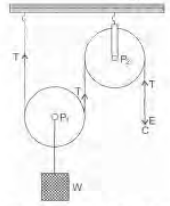
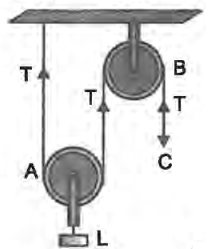
The diagram alongside shows the combination of two pulleys $P _1$ and $P _2$ used to lift up a load $W$.
If the free end $C$ of the string moves through a distance $x$, by what distance is the load $W$ raised?
Image
  • A
    $x$
  • B
    $\frac{x}{3}$
  • $\frac{x}{2}$
  • D
    $2 x$
Answer
Correct option: C.
$\frac{x}{2}$
View full question & answer
MCQ 111 Mark
If a machine acts as a force multiplier, its velocity ratio is :
  • A
    less than 1
  • B
    equal to 1
  • more than 1
  • D
    none of these
Answer
Correct option: C.
more than 1
C
View full question & answer
MCQ 141 Mark
For gain in speed, velocity ratio must be less than 1, but velocity ratio of a single fixed pulley is always:
  • 1
  • B
    greater than 1
  • C
    either (a) or (b)
  • D
    neither (a) nor (b)
Answer
Correct option: A.
1
A
View full question & answer
MCQ 151 Mark
The most prominent loss in energy is:
  • in overcoming the force of friction between the moving parts of a machine
  • B
    due to the string in it $($if any$)$ is not perfectly elastic
  • C
    due to its different parts are not perfectly rigid
  • D
    none of these
Answer
Correct option: A.
in overcoming the force of friction between the moving parts of a machine
View full question & answer
MCQ 161 Mark
In case of a single fixed pulley, in the ideal case, the mechanical advantage will be:
  • 1
  • B
    1.5
  • C
    2
  • D
    2.5
Answer
Correct option: A.
1
A
View full question & answer
MCQ 171 Mark
Calculate the ideal mechanical advantage of a machine in which the effort arm is 60 cm and the load arm is 4 cm:
  • A
    10
  • 15
  • C
    20
  • D
    25
Answer
Correct option: B.
15
B
View full question & answer
MCQ 181 Mark
The product of efficiency and velocity ratio of a machine is called the:
  • A
    work output
  • B
    work input
  • mechanical advantage
  • D
    none of these
Answer
Correct option: C.
mechanical advantage
View full question & answer
MCQ 191 Mark
The point at which the energy is supplied to a machine by applying the effort is called the:
  • A
    load point
  • B
    pivot
  • effort point
  • D
    none of these
Answer
Correct option: C.
effort point
View full question & answer
MCQ 201 Mark
A machine in which displacement of load is less than the displacement of effort, such a machine:
  • A
    gives the gain in speed
  • acts as a force multiplier
  • C
    generally changes the direction of effort
  • D
    none of these
Answer
Correct option: B.
acts as a force multiplier
View full question & answer
MCQ 211 Mark
A machine in which the displacement of load is more than the displacement of effort, such a machine:
  • A
    generally changes the direction of effort
  • B
    acts as a force multiplier
  • gives the gain in speed
  • D
    none of these
Answer
Correct option: C.
gives the gain in speed
View full question & answer
MCQ 221 Mark
The ratio of the displacement of effort to the displacement of load is called the:
  • A
    mechanical advantage of the machine
  • velocity ratio of the machine
  • C
    efficiency of the machine
  • D
    none of these
Answer
Correct option: B.
velocity ratio of the machine
View full question & answer
MCQ 231 Mark
Mechanical advantage $(M.A.)$, load $(L)$ and effort $(E)$ are related as:
  • A
    $E = M . A . \times L$
  • B
    $M.A. = L \times E$
  • $M.A. \times E = L$
  • D
    none of these
Answer
Correct option: C.
$M.A. \times E = L$
View full question & answer
MCQ 241 Mark
The mechanical advantage of a machine is equal to the product of its efficiency and:
  • A
    effort
  • B
    load
  • velocity ratio
  • D
    none of these
Answer
Correct option: C.
velocity ratio
View full question & answer
MCQ 251 Mark
The loss of energy in an actual machine due to:
  • A
    the moving parts in it are neither weightless nor smooth
  • B
    the string in it is not perfectly elastic
  • C
    its different parts are not perfectly rigid
  • all of these
Answer
Correct option: D.
all of these
View full question & answer
MCQ 271 Mark
A machine having the mechanical advantage less than $1$:
  • A
    acts as a force multiplier
  • gives the gain in speed
  • C
    is generally used to change the direction of effort
  • D
    any of these
Answer
Correct option: B.
gives the gain in speed
View full question & answer
MCQ 281 Mark
The force applied on the machine to overcome the load is called the:
  • effort
  • B
    load
  • C
    fulcrum
  • D
    none of these
Answer
Correct option: A.
effort
View full question & answer
MCQ 291 Mark
The resistive or opposing force overcome by a machine is called the:
  • load
  • B
    fulcrum
  • C
    effort
  • D
    none of these
Answer
Correct option: A.
load
View full question & answer
MCQ - Physics STD 10 Questions - Vidyadip