Questions

[2 Mark Question Answer]

🎯

Test yourself on this topic

31 questions · timed · auto-graded

Question 12 Marks
A block and tackle system has 5 pulleys. If an effort 0f 1000 N is needed in the downward direction to raise a load of 4500 N, calculate:
(a) the mechanical advantage
(b) the velocity ratio, and
(c) the efficiency of the system
Answer
A block and tackle system has 5 pulleys. $(n=5)$
$
\begin{aligned}
& \text { Effort }=1000 N \\
& \text { Load }=4500 N
\end{aligned}
$
(a) The mechanical advantage M.A $=\frac{\text { load }}{\text { effort }}=\frac{4500}{1000}=4.5$
(b) The velocity ratio $=n=5$
(c) The efficiency of the system $\eta=\frac{M \cdot A}{V \cdot R}=\frac{4.5}{5}=0.9$ or $90 \%$
View full question & answer
Question 22 Marks
In a block and tackle system consisting of 3 pulleys, a load of 75 kgf is raised with an effort of 25 kgf. Find: (i) the mechanical advantage, (ii) velocity ratio and (iii) efficiency.
Answer
Load = $75 kgf$
Effort $=25 kgf$
$
n =3
$
$
\text { MA = Load/Effort }=\text { 75/25 }=3
$
or $M A=n=3$
velocity ratio $V R=n=3$
Efficiency $\eta=\frac{M \cdot A}{V \cdot R}=\frac{3}{3}=1$ or $100 \%$
View full question & answer
Question 32 Marks
A Woman draws water from a well using a fixed pulley. The mass of bucket and water together is $6 kg$. The force applied by the woman is $70 N$. Calculate the mechanical advantage. $($ Take $g = 10 m s-^2)$
Answer
The force applied by the women is $=70 N$
The mass of bucket and water together is $=6 kg$
Total load $=6 \times 10=60 N$
Mechanical advantage M.A $=\frac{\text { Load }}{\text { Effort }}=\frac{60}{70}=0.857$
View full question & answer
Question 42 Marks
Give two reasons why the efficiency of a single movable pulley system is not 100%?
Answer
The efficiency of a single movable pulley system is not 100% this is because
(i)The friction of the pulley bearing is not zero,
(ii)The weight of the pulley and string is not zero.
View full question & answer
Question 52 Marks
What is a single movable pulley? What is its mechanical advantage in the ideal case?
Answer
WhSingle movable pulley: A pulley, whose axis of rotation is not fixed in position, is called a single movable pulley.
Mechanical advantage in the ideal case is 2.
View full question & answer
Question 62 Marks
Name the pulley which has no gain in mechanical advantage. Explain, why is such a pulley then used?
Answer
There is no gain in mechanical advantage in the case of a single fixed pulley. A single fixed pulley is used only to change the direction of the force applied that is with its use, the effort can be applied in a more convenient direction. To raise a load directly upwards is difficult.
View full question & answer
Question 72 Marks
Give reason for the following:
In a single fixed pulley, the velocity ratio is always more than the mechanical advantage.
Answer
In a single fixed pulley, some effort is wasted in overcoming friction between the strings and the grooves of the pulley; so the effort needed is greater than the load and hence the mechanical advantage is less than the velocity ratio.
View full question & answer
Question 82 Marks
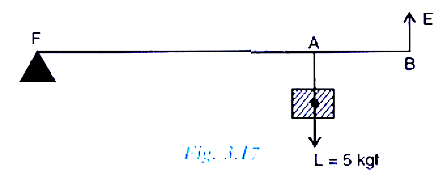
Fig 3.17 below shows a lever in use.


(a) To which class of lever does it belong?
(b) If $FA =80 cm , AB =20 cm$, find its mechanical advantage.
(c) Calculate the value of $E$.
Answer
(a) This is a class II lever.
(b) Given: $F A=80 cm , A B=20 cm , B F=F A+A B=100 cm$
Mechanical advantage M.A $=\frac{B F}{A F}=\frac{100}{80}=1.25$
(c) Effort (E) $=\frac{\operatorname{Load}(L)}{M \cdot A}=\frac{5}{1.25}=4 Kgf$
View full question & answer
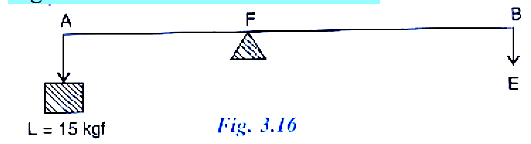
Question 92 Marks
\text { Fig } 3.16 \text { below shows a lever in use. }


(a) To which class of lever does it belong?
(b) If $A B=1 m , A F=0.4 m$, find its mechanical advantage,
(c) calculate the value of $E$.
Answer
(a) This is a class I lever.
(b) Given $A B=1 m , A F=0.4 m$ and $B F=0.6 m$
Mechanical advantage M.A $=B F A F=0.60 .4=1.5$
(c) Load $=15 kfg$
$
\text { Effort }=\frac{L o a d}{M \cdot A}=\frac{15}{1.5}=10 kgf
$
View full question & answer
Question 102 Marks
A pair of scissors has its blades 15 cm long, while its handles are 7.5 cm long. What is its mechanical advantage?
Answer
Effort arm $=7.5 cm$
Load arm $=15 cm$
Mechanical advantage M.A $=\frac{\text { Effort arm }}{\text { Load arm }}=\frac{7.5}{15}=0.5$
View full question & answer
Question 112 Marks
A crowbar of length 120 cm has its fulcrum situated at a distance of 20 cm from the load. Calculate the mechanical advantage of the crowbar.
Answer
$\begin{aligned} & \text { Total length of crowbar }=120 cm \\ & \text { Load arm }=20 cm \\ & \text { Effort } arm =120-20=100 cm \\ & \text { Mechanical advantage M.A }=\frac{\text { Effort arm }}{\text { Load arm }} \\ & \text { M.A }=\frac{100}{20}=5\end{aligned}$
View full question & answer
Question 122 Marks
A fire tongs has arms 20 cm long. Its is used to lift a coal of weight 1.5 kgf by applying an effort at a distance 15 cm from the fulcrum. Find: (i) the mechanical advantage of fire tongs and (ii) the effort needed.
Answer
Fire tongs has its arms $=20 cm$
Effort arm $=15 cm$
Load arm $=20 cm$
(i) Mechanical advantage M.A $=\frac{\text { Effort arm }}{\text { Load arm }}=\frac{15}{20}=0.75$
(ii) Effort = Load M.A $=\frac{1.5}{0.75}=2.0 kgf$
View full question & answer
Question 132 Marks
What do you understand by an ideal machine?
Answer
An ideal machine is a machine whose parts are weightless and frictionless so that which there is no dissipation of energy in any manner. Its efficiency is 100%, i.e. the work output is equal to work input.
View full question & answer
Question 142 Marks
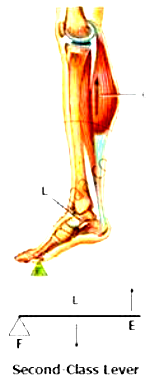
What type of lever is formed by the human body while raising the weight of body on toes?
Answer
Class II.
Here, the fulcrum is at toes at one end, the load (i.e. weight of the body) is in the middle and effort by muscles is at the other end.
View full question & answer
Question 152 Marks
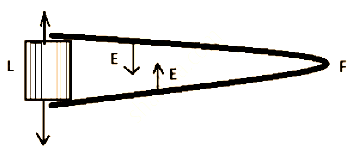
Draw Diagrams to illustrate the position of fulcrum load and effort, in the following:
Forceps .
Answer
Forceps :
View full question & answer
Question 162 Marks
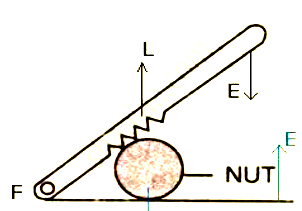
Draw Diagrams to illustrate the position of fulcrum load and effort, in the following:
A nut cracker .
Answer

A nut cracker :

View full question & answer
Question 172 Marks
Draw Diagrams to illustrate the position of fulcrum load and effort, in the following:
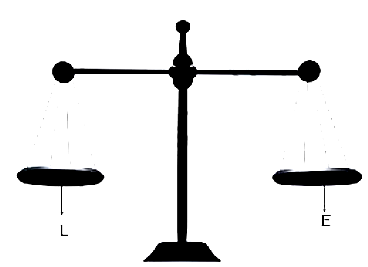
A common balance .
Answer

A common balance :

View full question & answer
Question 182 Marks
Draw Diagrams to illustrate the position of fulcrum load and effort, in the following :
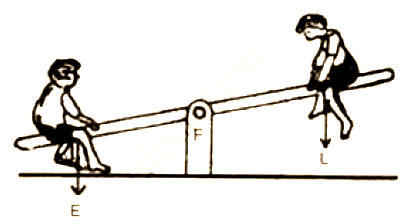
A seesaw .
Answer
A seesaw
View full question & answer
Question 192 Marks
Name a machine to change the direction of force ?
Answer
To change the direction of force: a single fixed pulley is used to lift a bucket full of water from the well by applying the effort in the downward direction instead of applying it upwards when the bucket is lifted up without the use of pulley.
View full question & answer
Question 202 Marks
State four ways in which machines are useful to us?
Answer
Machines are useful to us in the following ways:
(1) In lifting a heavy load by applying less effort.
(2) In changing the point of application of effort to a convenient point.
(3) In changing the direction of effort in a convenient direction.
(4) For obtaining a gain in speed.
View full question & answer
Question 212 Marks
Explain why scissors for cutting cloth may have blades longer than the handles, but shears for cutting metals have short blades and long handles.
Answer
A pair of scissors used to cut a piece of cloth has blades longer than the handles so that the blades move longer on the cloth than the movement at the handles.
While shears used for cutting metals have short blades and long handles because as it enables us to overcome large resistive force by a small effort.
View full question & answer
Question 222 Marks
A pair of scissors and a pair of pliers both belongs to the same class of levers. Name the class of lever. Which one has the mechanical advantage less than 1?
Answer
A pair of scissors and a pair of pliers both belong to class I lever.
A pair of scissors has mechanical advantage less than 1.
View full question & answer
Question 232 Marks
Write down a relation expressing the mechanical advantage of a lever.
Answer
$
\text { M.A. of a lever }=\frac{\text { Load }}{\text { Effort }}=\frac{\text { Effort arm }}{\text { Load arm }}
$
This is the expression of the mechanical advantage of a lever.
View full question & answer
Question 242 Marks
State the principle of a lever ?
Answer
Principle: A lever works on the principle of moments. For an ideal lever, it is assumed that the lever is weightless and frictionless. In the equilibrium position of the lever, by the principle of moments,
Moment of load about the fulcrum=Moment of the effort about the fulcrum.
Load × Load arm = Effort × Effort arm.
View full question & answer
Question 252 Marks
State reason why is mechanical advantage less than the velocity ratio for an actual machine.
Answer
This is because the output work is always less than the input work, so the efficiency is always less than 1 because of energy loss due to friction.
M.A = V.R × n
View full question & answer
Question 262 Marks
How is the mechanical advantage related with the velocity ratio for an actual machine? State whether the efficiency of such a machine is equal to 1, less than 1 or more than 1.
Answer
The mechanical advantage for an actual machine is equal to the product of its efficiency and velocity ratio.
M.A = V.R × n
The efficiency of such a machine is always less than 1, i.e. h<1. This is because there is always some loss in energy in form of friction etc.
View full question & answer
Question 272 Marks
(i) State the relationship between mechanical advantage, velocity ratio and efficiency.
(ii) Name the term that will not change for a machine of a given design.
Answer
Mechanical advantage is equal to the product of velocity ratio and efficiency.
M.A = η × V.R
For a machine of a given design, the velocity ratio does not change.
View full question & answer
Question 282 Marks
Stat the principle of an ideal machine.
Answer
An ideal machine is a machine whose parts are weightless and frictionless so that which there is no dissipation of energy in any manner. Its efficiency is 100%, i.e. the work output is equal to work input.
View full question & answer
Question 292 Marks
A machine works as a
(i) force multiplier,
(ii) speed multiplier.
In each case state whether the velocity ratio is more than or less than 1.
Answer

(i) For a machine working as a force multiplier, displacement of load is less than displacement of effort. Thus, the velocity ratio is more than 1.

(ii) For a machine working as a speed multiplier, displacement of load is more than displacement of effort. Thus, the velocity ratio is less than 1.

View full question & answer
Question 302 Marks
What do you understand by a simple machine?
Answer
A machine is a device by which we can either overcome a large resistive force at some point by applying a small force at a convenient point and in a desired direction or by which we can obtain a gain in the speed.
View full question & answer
Question 312 Marks
Can a machine act as a force multiplier and a speed multiplier simultaneously?
Answer
It is not possible for a machine to act as a force multiplier and speed multiplier simultaneously.
This is because machines which are force multipliers cannot gain in speed and vice-versa.
View full question & answer
[2 Mark Question Answer] - Physics STD 10 Questions - Vidyadip