Questions

[5 Mark Question Answer]

🎯

Test yourself on this topic

6 questions · timed · auto-graded

Question 15 Marks
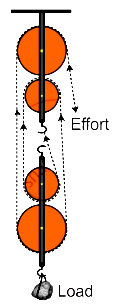
A block and tackle system has the velocity ratio 3. Draw a labelled diagram of the system indicating the points of application and the directions of load L and effort E. A man can exert a pull of 200 kgf.
If the effort end moves a distance 60 cm, what distance does the load move?
Answer
For block and tackle system, V.R. = $n$ (number of pulleys)
Hence, $n=3$
The diagram is as shown below
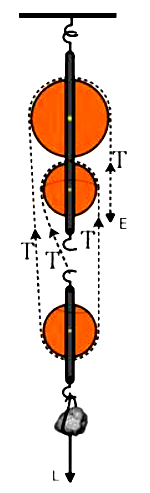


The velocity ratio of system is V.R. $=3$
Hence, we get
$
\begin{aligned}
& \text { V.R. }=\frac{ d _{ E }}{ d _{ L }}=n=3 \\
& \therefore d _{ L }=\frac{ d _{ E }}{ d _{ L }}=\frac{60}{3}=20 cm
\end{aligned}
$
View full question & answer
Question 25 Marks
A block and tackle system has the velocity ratio 3. Draw a labelled diagram of the system indicating the points of application and the directions of load and effort. A man can exert a pull of 200 kgf. What is the maximum load he can raise with this pulley system is its efficiency is 60%?
Answer

A block and tackle system has the velocity ratio = 3
i.e., VR = n = 3
Efficiency of system η = 60% = 0.6
The mechanical advantage of the system MA. = V.A × η = 3 × 0.6 = 1.8
Man can exert a maximum effort = 200 kgf
Load = M.A. × effort = 1.8 × 200 = 360 kgf
View full question & answer
Question 35 Marks
In which direction the force need to applied, when a single pulley is used with a mechanical advantage greater than one? How can you change the direction of force applied without altering its mechanical advantage? Draw a labelled diagram of the system.
Answer
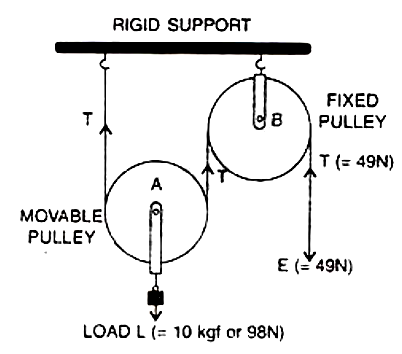
The force should be in upward direction.
The direction of force applied can be changed without altering its mechanical advantage by using a single movable pulley along with a single fixed pulley to change the direction of applied force.
Diagram:
View full question & answer
Question 45 Marks
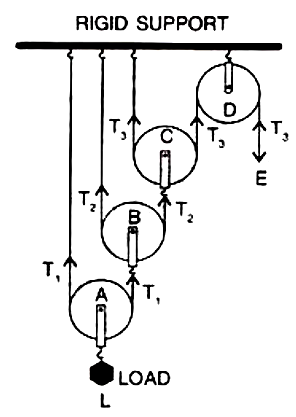
Draw a diagram of combination of three movable pulleys with a fixed pulley showing the directions of load, effort and tension in each strand. Find: (i) mechanical advantage, (ii) Velocity ration and (iii) efficiency of the combination in ideal situation.
Answer
Diagram :


Tension $T_1$ in the string passing over the pulley $A$ is given as $2 T _1= L$ or $T _1= L / 2$
Tension $T 2$ in the string passing over the pulley $B$ is given as $2 T _2= T _1$ or $T _2= T _1 / 2= L / 2^2$
Tension $T 3$ in the string passing over the pulley $C$ is given as $2 T _3= T _2$ or $T _3= T _2 / 2= L / 2^3$
In equilibrium, $T_3=E$
$
E=L / 2^3
$
Mechanical advantage $= MA = L / E =2^3$
As one end of each string passing over a movable pulley is fixed, so the free end of string moves twice the distance moved by the movable pulley.
If load $L$ moves up by a distance $x, d L=x$, effort moves by a distance $2^3 x, d E=2^3 x$
Velocity Ration VR $=\frac{\text { Distance moved by the effort } dE }{\text { Distance moved by the load } dL }=\frac{2^3 x}{x}=2^3$
Efficiency $=$ MA/VR $=2^3 / 2^3=1$ OR $100 \%$
View full question & answer
Question 55 Marks
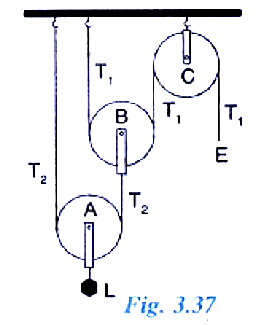
The Diagram alongside shows an arrangement of three pulleys A, B, and C. The load is marked as L and the effort as E.
(a) Name the Pulleys A, B, and C.
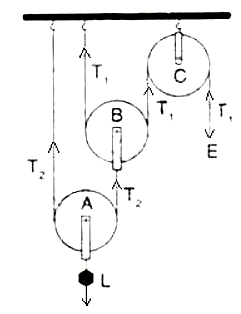
(b) Mark in the diagram the directions of load (L), effort (E) and tension T1 and T2 in the two strings.
(c) How are the magnitudes of L and E related to the tension T1?
(d) Calculate the mechanical advantage and velocity ratio of the arrangement.
(e) What assumptions have you made in parts (c) and (d)?
Answer
(a) Pulleys A and B are movable pulleys. Pulley C is fixed pulley.
(b)


(c) The magnitude of effort $E=T_1$
And the magnitude of $L=2^2 T_1=4 T_1$
(d) The mechanical advantage $=2^2=4$
The velocity ratio $=2^2=4$
(e) Assumption: the pulleys A and B are weightless.
View full question & answer
Question 65 Marks
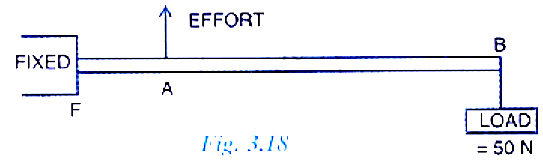
Fig 3.18 below shows the use of a lever.


(a) State the principle of moments as applied to the above lever.
(b) Give an example of this class of lever.
(c) If $FA =10 cm , AB =500 cm$ calculate: (i) the mechanical advantage and (ii) the minimum effort required to lift the load.
Answer
(a) The principle of moments: Moment of the load about the fulcrum=moment of the effort about the fulcrum
$
\text { FB } \times \text { Load }=\text { FA } \times \text { Effort }
$
(b) Sugar tongs the example of this class of lever.
(c) Given: $FA =10 cm , AB =500 cm , BF =500+10=510 cm$. The mechanical advantage
$
M \cdot A=\frac{A F}{B F}=\frac{10}{510}=\frac{1}{51}
$
The minimum effort required to lift the load
$
\text { Effort }=\frac{\text { Load }}{\text { M.A }}=\frac{50}{\frac{1}{51}}=2550 N
$
View full question & answer
[5 Mark Question Answer] - Physics STD 10 Questions - Vidyadip