Questions

MCQ

🎯

Test yourself on this topic

40 questions · timed · auto-graded

MCQ 11 Mark
A movable pulley is used as : ________ .
  • a force multiplier
  • B
    a speed multiplier
  • C
    a device to change the direction of effort
  • D
    an energy multiplier
Answer
Correct option: A.
a force multiplier
Force multiplier
Explanation: The mechanical advantage of movable pulley is greater than 1. Thus, using a single movable pulley, the load can be lifted by applying an effort equal to half the load (in ideal situation), i.e. the single movable pulley acts as a force multiplier.
View full question & answer
MCQ 21 Mark
The mechanical advantage of an ideal single movable pulley is ________ .
  • A
    1
  • 2
  • C
    less than 2
  • D
    less than 1
Answer
Correct option: B.
2
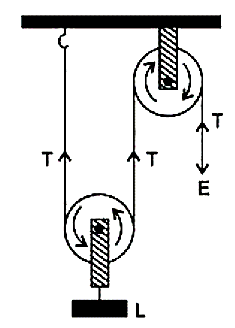
The mechanical advantage of an ideal single movable pulley is 2 . Derivation: Consider the diagram given below:


Here the load $L$ is balance by the tension in two segments of the string and the effort $E$ balances the tension $T$ at the free end, so $L = T + T =2 T$ and $E = T$
Assumption: Weight of the pulley is negligible.
We know that,
$
\text { M.A }=\frac{\operatorname{Load}(L)}{\text { Effort }(E)}=\frac{2 T}{T}=2
$
Thus, a single movable pulley has a M.A. equal to 2 .
View full question & answer
MCQ 31 Mark
A Single fixed pulley is used because it : ________ .
  • A
    Has a mechanical advantage greater than 1
  • B
    Has a velocity ratio less than 1
  • C
    Gives 100% efficiency
  • Helps to apply the effort in a convenient direction.
Answer
Correct option: D.
Helps to apply the effort in a convenient direction.
It helps in applying effort in a convenient direction.
Explanation: A single fixed pulley though does not reduce the effort but helps in changing the direction of effort applied. As it is far easier to apply effort in downward direction, the single fixed pulley is widely used.
View full question & answer
MCQ 41 Mark
Class II levers are designed to have : ________ .
  • A
    M.A. = V.R.
  • B
    M.A. > V.R.
  • M.A. > 1
  • D
    M.A. < 1
Answer
Correct option: C.
M.A. > 1
M.A > 1
Hint: In class II levers, the load is in between the effort and fulcrum. Thus, the effort arm is always longer than the load arm and less effort is needed to overcome a large load. Hence, M.A > 1
View full question & answer
MCQ 51 Mark
The lever for which the mechanical advantage is less than 1 has : ________ .
  • A
    Fulcrum at mid-point between load and effort.
  • B
    Load between effort and fulcrum.
  • Effort between fulcrum and load.
  • D
    Load and effort acting at the same point.
Answer
Correct option: C.
Effort between fulcrum and load.
Effort is between fulcrum and load
Hint: Levers, for which the mechanical advantage is less than 1, always have the effort arm shorter than the load arm.
View full question & answer
MCQ 61 Mark
State the incorrect statement : ________ .
  • A
    A machine always has the efficiency less than 100%
  • B
    The mechanical advantage of a machine can be less than 1.
  • C
    A machine can be used as speed multiplier.
  • A machine can have the mechanical advantage greater than the velocity ratio.
Answer
Correct option: D.
A machine can have the mechanical advantage greater than the velocity ratio.
A machine can have a mechanical advantage greater than the velocity ratio.
Reason: If the mechanical advantage of a machine is greater than its velocity ratio, then it would mean that the efficiency of a machine is more than 100%, which is practically not possible.
View full question & answer
MCQ 71 Mark
The correct relationship between the mechanical advantage (M.A), the velocity ratio (V.R) and the efficiency (n) is : ________ .
  • M.A. = η x V.R
  • B
    V.R. = η x M.A.
  • C
    η = M.A. x V.R.
  • D
    None of these
Answer
Correct option: A.
M.A. = η x V.R
M.A. = η x V.R
View full question & answer
MCQ 81 Mark
Mechanical advantage (M.A), load (L) and effort (E) are related as : ________ .
  • A
    M.A. = L x E
  • M.A. x E = L
  • C
    E = M.A. x L
  • D
    None of these
Answer
Correct option: B.
M.A. x E = L
M.A. x E = L
View full question & answer
MCQ 91 Mark
Which of the following is a class III lever?
  • A
    Pair of scissors
  • B
    Wheelbarrow
  • C
    Crowbar
  • Human forearm
Answer
Correct option: D.
Human forearm
(d)
Human forearm
Explanation:
Because the human forearm is an example of a class III lever. The effort is applied between fulcrum and the load.
View full question & answer
MCQ 101 Mark
What characteristic is typical of Class $\Pi$ levers regarding mechanical advantage (M.A.)?
  • A
    M.A. = V.R.
  • B
    M.A. > V.R.
  • M.A. > 1
  • D
    M.A. $<1$
Answer
Correct option: C.
M.A. > 1
(c)
M.A. > 1
Explanation:
In Class II levers, the load is located between the effort and the fulcrum. This arrangement means that the effort arm is longer than the load arm, leading to a mechanical advantage greater than 1,which makes lifting heavy loads easier by using less force.
View full question & answer
MCQ 111 Mark
Which lever configuration results in a mechanical advantage of less than 1?
  • A
    Fulcrum at the midpoint between load and effort
  • B
    Load between effort and fulenum
  • Effort between fulcrum and load
  • D
    Load and effort acting at the same point
Answer
Correct option: C.
Effort between fulcrum and load
(c)
Effort between fulcrum and load
Explanation:
In a Class III lever, where the effort is applied between the fulcrum and the load, the mechanical advantage is less than 1. This setup is typically used in applications where speed and range of motion are prioritized over force amplification, such as in tweezers or tongs.
View full question & answer
MCQ 121 Mark
Which of the following statements about machines is incorrect?
  • A
    The velocity ratio does not change for a machine
  • Due to friction, the mechanical advantage of a machine increases
  • C
    For an ideal machine, work output is equal to work input
  • D
    For an ideal machine, mochanical advantage is numerically equal to the velocity ratio.
Answer
Correct option: B.
Due to friction, the mechanical advantage of a machine increases
(b)
Due to friction, the mechanical advantage of a machine increases
Explanation:
Friction actually decreases the mechanical advantage of a machine. It introduces resistance that opposes motion, reducing the efficiency of the machine and consequently lowering its mechanical advantage.
View full question & answer
MCQ 131 Mark
What is true for an ideal machine regarding energy?
  • Output energy = Input energy
  • B
    Output energy > Input energy
  • C
    Output energy < Input energy
  • D
    Work output > Work input
Answer
Correct option: A.
Output energy = Input energy
(a)
Output energy = Input energy
Explanation:
In an ideal machine, the output energy equals the input energy, meaning there are no losses due to friction, heat, or other inefficiencies. This demonstrates the conservation of energy principle.
View full question & answer
MCQ 141 Mark
Which of the following is not a force multiplier?
  • A
    A jack used to lift a car
  • A single fixed pulley used to lift a bucket of water from a well
  • C
    A bar used to lift a heavy stone
  • D
    A wheelbarrow used to carry a load
Answer
Correct option: B.
A single fixed pulley used to lift a bucket of water from a well
(b)
A single fixed pulley used to lift a bucket of water from a well
Explanation:
A single fixed pulley does not act as a force multiplier but rather changes the direction of the force applied. It allows the force to be applied more conveniently but does not increase the force's magnitude.
View full question & answer
MCQ 151 Mark
Which type of lever has velocity ratio and mechanical advantage always less than one?
  • Class III lever
  • B
    Class I lever
  • C
    Class II lever
  • D
    None of these
Answer
Correct option: A.
Class III lever
(a)
Class III lever
Explanation:
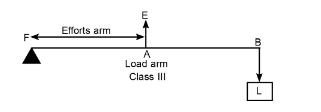
The Mechanical Advantage and Velocity Ratio of Class III lever is always less than one because the load arm is greater than the effort arm. Hence it can be used as a speed gainer.
Image
View full question & answer
MCQ 161 Mark
Which type of lever present in the human body when we raise the body weight on our toes?
  • A
    Class I lever
  • Class II lever
  • C
    Class III lever
  • D
    None of these
Answer
Correct option: B.
Class II lever
(b)
Class II lever
Explanation:
Class $\Pi$ lever is present in the human body when we raise the body weight on our toes as the fulcrum is at one end, the load is in the middle and effort by muscles is at the other end.
View full question & answer
MCQ 171 Mark
If the mechanical advantage of a lever is 4 and the efficiency of the system is 2 . Calculate the velocity ratio of the system.
  • A
    4
  • 2
  • C
    6
  • D
    9
Answer
Correct option: B.
2
(b) 2
Explanation:
As we know, $\eta= MA / VR$.
$MA =4$
$\eta=2$
$VR = MA / \eta$
$VR =4 / 2=2$
View full question & answer
MCQ 181 Mark
On what factors does the mechanical advantage of the first class lever depend on?
  • On the placement of fulcrum
  • B
    On the position of load
  • C
    On the position of effort
  • D
    On the position of both fulcrum and load
Answer
Correct option: A.
On the placement of fulcrum
(a)
On the placement of fulcrum
Explanation :
Correct as the mechanical advantage of first class lever depends on the position or placement of fulcrum only.
If the fulcrum is closer to the load than to the input force, the lever has a MA $>1$.
If the fulcrum is exactly in the middle of the load and the input force, the $MA =1$.
If the fulcrum is closer to the input force than to the load, the lever's MA $<1$.
View full question & answer
MCQ 191 Mark
Calculate the work done by the effort when a load of 60 kgf is lifted through a distance of 20 m by applying an effort of 30 kgf which is displaced through 60 m using a pulley having velocity ratio of 3 .
  • A
    120 J
  • B
    1200 J
  • C
    180 J
  • 18000 J
Answer
Correct option: D.
18000 J
(d)
18000 J
Explanation:
Force of effect $=30 \times 10=300 N$
Work done $=300 \times 60=18,000 J$
View full question & answer
MCQ 201 Mark
A pulley system consisting of four pulleys has efficiency as $90 \%$. Calculate the mechanical advantage of the system:
  • A
    360
  • 3.6
  • C
    36
  • D
    0.36
Answer
Correct option: B.
3.6
(b)
3.6
Explanation:
Efficiency $=\frac{\text { M.A. }}{\text { V.R. }}$
$
\begin{array}{l}
MA=\text { Efficiency } \times VR \\
=0.9 \times 4=3.6
\end{array}
$
View full question & answer
MCQ 211 Mark
A pulley is used to lift a load of 180 kgf by applying an effort of 90 kgf in the downward direction. Calculate the work done by the effort applied on the pulley:
  • 2
  • B
    12
  • C
    6
  • D
    24
Answer
Correct option: A.
2
(a)
2
Explanation :
$
MA=\frac{\text { Load }}{\text { Effort }}=\frac{180}{90}=2
$
View full question & answer
MCQ 221 Mark
A pulley system of velocity ratio 6 is used to lift a load of 250 kgf through a vertical height of 30 m . Find the distance through which effort is applied:
  • A
    18 m
  • B
    1800 m
  • 180 m
  • D
    1.8 km
Answer
Correct option: C.
180 m
(c)
180 m
Explanation :
Distance through which effort is applied
$
\begin{array}{l}
=6 \times 30 \\
=180 m
\end{array}
$
View full question & answer
MCQ 231 Mark
The size of pulleys __________ towards the load and ___________ towards rigid support.
  • A
    decreases, increases
  • B
    increases, decreases
  • increases, increases
  • D
    decreases, decreases.
Answer
Correct option: C.
increases, increases
(c)
increases, increases
View full question & answer
MCQ 241 Mark
Jibs, cranes and hoist are examples of ___________ .
  • A
    complex machines
  • B
    sophisticated machines
  • block and tackle system
  • D
    robotic machines
Answer
Correct option: C.
block and tackle system
(c)
block and tackle system
Explanation :
These devices use a system of pulleys and cables or chains which is classic example of a block and tackle system.
View full question & answer
MCQ 251 Mark
In block and tackle system of pulleys the velocity ratio is ___________ .
  • A
    one less than total number of pulleys
  • equal to number of pulleys
  • C
    ratio of displacement of load to displacement of effort
  • D
    none of the above.
Answer
Correct option: B.
equal to number of pulleys
(b)
equal to number of pulleys
Explanation:
The velocity ratio in a block and tackle system equals the number of pulleys. This ratio reflects how much the effort's displacement exceeds the loads.
View full question & answer
MCQ 261 Mark
In block and tackle system the mechanical advantage is _____________ .
  • A
    number of pulleys always
  • B
    one less than number of pulleys
  • C
    (2) $\times$ total number of pulleys
  • load / effort
Answer
Correct option: D.
load / effort
(d)
load / effort
View full question & answer
MCQ 271 Mark
A single fixed pulley is a modified form of :
  • Class I lever
  • B
    Class II lever
  • C
    Class III lever
  • D
    None of these
Answer
Correct option: A.
Class I lever
(a)
Class I lever
Explanation:
In Class I lever, Fulcrum between load and effort.
View full question & answer
MCQ 281 Mark
A block and tackle system of pulleys is used to lift a load of 360 kgf by applying an effort of 200 kgf such that load is lifted to a height of 2 m and effort is applied through a distance of 8 m . Find MA and VR of the system.
  • A
    $MA =3.6$ and $VR =2$
  • B
    $MA =2$ and $VR =8$
  • $MA =1.8$ and $VR =4$
  • D
    $MA =4$ and $VR =6$
Answer
Correct option: C.
$MA =1.8$ and $VR =4$
(c)
MA = 1.8 and VR = 4
Explanation:
$
\begin{array}{l}
MA=\frac{\text { Load }}{Effort}=\frac{360}{2000}=1.8 \\
VR=\frac{d_{E}}{d_{L}}=\frac{8}{2}=4
\end{array}
$
View full question & answer
MCQ 291 Mark
In a block and tackle system of pulleys the load is lifted through a height of 2 m while the effort is applied for 6 m . Hence, the velocity ratio of this system is:
  • A
    2
  • 3
  • C
    6
  • D
    12
Answer
Correct option: B.
3
(b)
3
Explanation:
$
\begin{aligned}
VR & =\frac{V_{E}}{V_{L}}=\frac{d_{E}}{d_{L}} \\
& =\frac{6}{2}=3
\end{aligned}
$
View full question & answer
MCQ 301 Mark
Greater the effort arm___________  the force multiplication.
  • A
    lesser
  • B
    greater
  • C
    larger
  • both (b) and (c)
Answer
Correct option: D.
both (b) and (c)
(d)
both (b) and (c).
View full question & answer
MCQ 311 Mark
A villager uses a single fixed pulley while a person in urban areas uses the combination of single fixed and single movable pulley. Which out of the two are more effective?
  • A
    Single fixed
  • Single fixed and single movable
  • C
    Both (a) and (b)
  • D
    None of the above
Answer
Correct option: B.
Single fixed and single movable
(b)
Single fixed and single movable
Explanation:
A combination of a single fixed and a single movable pulley is more effective because it reduces the effort needed to lift object, the fixed pulley changes effort direction and the movable pulley lessens the required force, offering a mechanical advantage.
View full question & answer
MCQ 321 Mark
The losses in case of practical machine are:
  • A
    frictional loss
  • B
    elasticity in the string
  • C
    weight of the movable parts
  • All of the above
Answer
Correct option: D.
All of the above
(d)
All of the above
Explanation:
In a practical machine, the losses typically include frictional loss, loss due to elasticity in the string and loss attributed to the weight of the movable parts. Each of these factors contributes to the overall inefficiency of a machine in a practical setting.
View full question & answer
MCQ 331 Mark
Efficiency is defined as ___________ .
  • Mechanical advantage / velocity ratio
  • B
    Mechanical advantage + velocity ratio
  • C
    Mechanical advantage - velocity ratio
  • D
    Mechanical advantage $\times$ velocity ratio.
Answer
Correct option: A.
Mechanical advantage / velocity ratio
(a)
Mechanical advantage / velocity ratio
View full question & answer
MCQ 341 Mark
Velocity ratio is also called _________ ratio.
  • A
    impure
  • B
    current
  • C
    speed
  • pure
Answer
Correct option: D.
pure
(d)
pure
Explanation:
It is a dimensionless ratio, comparing two velocities without any units.
View full question & answer
MCQ 351 Mark
Velocity ratio is the ratio of:
  • A
    velocity of girl to velocity of boy
  • velocity of effort to velocity of load
  • C
    velocity of load to velocity of effort
  • D
    none of the above
Answer
Correct option: B.
velocity of effort to velocity of load
(b)
velocity of effort to velocity of load
Explanation :
It's measures how the speed of the effort is related to the speed of the load in a mechanical system.
View full question & answer
MCQ 361 Mark
Mechanical advantage is ratio of ____________ .
  • load to effort
  • B
    effort to load
  • C
    useful effort to load
  • D
    useful load to useful effort
Answer
Correct option: A.
load to effort
(a)
load to effort
Explanation:
It measures how much a machine multiplies the force or effort applied to it.
View full question & answer
MCQ 371 Mark
Mechanical advantage is ratio of ____________ .
  • A
    impure quantities
  • B
    pure quantities
  • similar quantities
  • D
    dissimilar quantities
Answer
Correct option: C.
similar quantities
(c)
similar quantities
Explanation:
Both load and effort are forces.
View full question & answer
MCQ 381 Mark
Effort is a __________ .
  • A
    exerted on machine
  • B
    supplied by wind
  • external agency supplied to the machine
  • D
    created by the machine
Answer
Correct option: C.
external agency supplied to the machine
(c)
external agency supplied to the machine
Explanation:
Effort is an external agency supplied to the machine, typically human or mechanical, force, used to operate or drive the machine's functions.
View full question & answer
MCQ 391 Mark
Load is:
  • A
    force, exerted by machine
  • resistive force to be overcome by machine
  • C
    external agency supplied to the machine
  • D
    none of the above
Answer
Correct option: B.
resistive force to be overcome by machine
(b)
resistive force to be overcome by machine
Explanation:
Load in mechanics refers to the resistive force that a machine must overcome to perform its intended function, such as lifting a weight or overcoming friction.
View full question & answer
MCQ 401 Mark
Machine acts as a __________ .
  • A
    force multiplier
  • B
    speed multiplier
  • C
    torque multiplier
  • all of the above
Answer
Correct option: D.
all of the above
(d)
all of the above
Explanation:
Machines can be designed to multiply force, speed or torque, depending on the requirements of the task they are intended for.
View full question & answer
MCQ - Physics STD 10 Questions - Vidyadip