Questions

[3 Mark Question Answer]

🎯

Test yourself on this topic

11 questions · timed · auto-graded

Question 13 Marks
State two similarities and two dissimilarities between the γ-rays and X-rays.
Answer
Similarities:
Both ?-radiations and X-rays affect photographic plate, both travel with the speed of light.
Dissimilarities:
?-radiations are obtained in emissions from the radioactive substances due to energy change in the nucleus of their atoms and X- rays are obtained when highly energetic cathode rays are stopped by a heavy metal target of high melting point.
?-radiations have high penetration power but X-rays do not have have very high penetration power.
View full question & answer
Question 23 Marks
A radioactive source emits three types of radiations. Name them.
(i) Name the radiations which are charged.
(ii) Name the radiations which are most penetrating.
(iii) Name the radiations which travel with the speed of light.
(iv) Name the radiations which have the largest mass.
Answer
A radioactive source emits three types of radiations. These are a
radiations, β radiations and Y radiations.
(i) α radiations and β radiations a re charged radiations.
(ii) Y radiations a re most penetrating radiations.
(iii) Y radiation travels with speed of light.
(iv) a radiations have largest mass.
View full question & answer
Question 33 Marks
What happens to the mass number of an element when (i) An $\alpha$-particle, (ii) $A \beta$-particle, and (iii) $\gamma$-radiation is emitted?
Answer
(i) a particle is represented by ${ }_2 He ^4$ this means it contains $2$ protons and $2$ neutrons so mass of a particle is $4$ unit.
Thus after emitting a particle mass number of element would decrease by $4$ unit.
(ii) $\beta$ particle is represented by $-1^{e^e}$ so after emitting a $\beta$ particle mass number of element would remain unchanged.
(iii) $Y$ radiations have no charge and no mass so after emitting a $Y$ radiation mass number of element remain unchanged.
View full question & answer
Question 43 Marks
What happens to the atomic number of element when (i) An $\alpha$-particle, (ii) $A \beta$-particle 1 and (iii) $\gamma$-radiation is emitted?
Answer
(i) $\alpha$ particle is represented by ${ }_2 He ^4$ this means it contains $2$ protons so after emitting a $\alpha$ particle atomic number of element would decrease bv $2$ unit.
(ii) $\beta$ particle is represented by $-1^{\theta^{\circ}}$ after emitting a $\beta$ particle atomic number of element would increase bv $1$ unit.
(iii) Y radiations have no charge and no mass so after emitting a $Y$ radiation atomic number of element remain unchanged.
View full question & answer
Question 53 Marks
State three safety precautions that you would take while handling the radioactive substances.
Answer
Following precautions should be taken while handling the radioactive substances.
(i) The sources should only be handled by the forceps provided and never touched by hand.
(ii) They should never be pointed towards a person.
(iii) Food should not be taken where the sources are being used, as it may be contaminated.
(iv) Never smoke near a radioactive source.
View full question & answer
Question 63 Marks
What are radioisotopes? State two uses of radioisotopes.
Answer
Artificial radioactive substances can be produced by bombarding lighter nuclides with alpha particles, protons and neutron. The radioactive substances produces in this manner are called radioisotopes.
Radioisotopes can be used as:
(i) Rays from Radium produce satisfactorily improvement in skin diseases.
(ii) Radioactive Sulphur S35 helps to study advantages and disadvantages of fungicides.
View full question & answer
Question 73 Marks
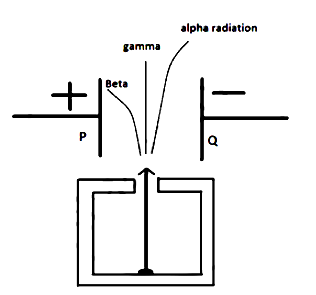
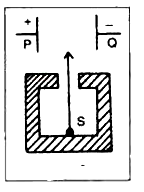
In the following fig. shows a radioactive source S in a thick lead container. The radiations pass through an electric field between the plates P and Q. Complete the diagram to show the paths of α , β and γ radiations.

Why is the source S placed in a thick lead container?
Answer

(i) Alpha particles are heavy in mass and are positively charged so they are deflected less and are deflected towards - charged plate.
(ii) Beta particles are negIigible in mass so they are highly deflected by electric field anc they are negatively charge particle so they are deflected towards positive charged plate.
(iii) Gamm a radiations have no mass and no charge so they are not deflected by electric field.
Source S is placed in thick lead container because it is radioactive substance and radiates. Thick walls of lead absorb a II the radiation except radiation going straight outside towards opened end. Thus, thick walIs help to reduce leakage of radiations outside.
View full question & answer
Question 83 Marks
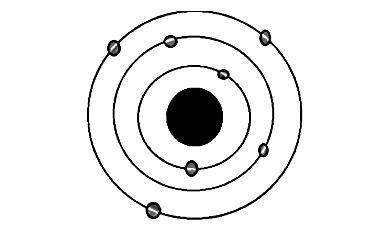
Draw a diagram of a simple atom showing the nucleus and electrons. In this atom:
(a) What type of charge will there be on the nucleus?
(b) What is the value of this charge?
Answer

The central sphere is nucleus where small spheres are electron moving in circular orbit around nucleus.
(a) There is positive charge on nucleus.
(b) Charge on proton is equal to $+1.6 \times 10^{-19} c$ and neutron is neutral so value of charge on nucleus is $p \times 1.6 \times 10^{-19}$ c where p is the number of proton in nucleus.
View full question & answer
Question 93 Marks
Define the term radioactivity. Of the three normally occurring radioactive radiations:
(a) Which has a positive charge?
(b) Which is most penetrating?
(c) Which has no electric charge?
Answer
The phenomenon of spontaneous disintegration of an unstable nucleus of naturally occurring isotope accompanied by emission of active radiations a
particles, β particles and γ radiations is called radioactivity.
(a) α particles have positive charge.
(b) γ radiation is most penetrating.
(c) γ radiation has no electric charge.
View full question & answer
Question 103 Marks
State some of the safety precautions that we have to taken when we are exposed to some of the radiations or when we are handling some of the radioactive substances.
Answer
Following precautions should be taken while handling the radioactive substances.
(i) The sources should only be handled by the forceps provided and never touched by hand.
(ii) They should never be pointed towards a person.
(iii) Food should not be taken where the sources are being used, as it may be contaminated.
(iv) Never smoke near a radioactive source.
View full question & answer
Question 113 Marks
What do you understand by radioactive decay? An isotope of Uranium ${ }_{92}^{238} \mathrm{U}$ is radioactive and changes into Thorium $92$ by the emission of an alpha particle. Write a symbolic equation for this decay process.
Answer
The process of destruction of the originaI nucleus during the formation of new nucleus due to radioactivity is called radioactive decay.
Question is wrong as Thorium has atomic number 90 not 92.
SymboIic equation of decay is
$_{92}U^{238} \rightarrow _{90}Th^{234} + _2He.$
View full question & answer
[3 Mark Question Answer] - Physics STD 10 Questions - Vidyadip