Questions

[2 Mark Question Answer]

🎯

Test yourself on this topic

19 questions · timed · auto-graded

Question 12 Marks
State two uses of nuclear fission.
Answer
(i) It is used in a nuclear bomb.
(ii) It is used in a nuclear reactor where the rate of release of energy is slow and controlled which is used to generate electric power.
View full question & answer
Question 22 Marks
What is nuclear fission? Name the particle used for it. Write one fission reaction.
Answer
Nuclear fission is the process in which a heavy nucleus is splits into two light nuclei nearly of the same size by bombarding it with slow neutrons.

$\ce {^235_92 U + ^1_0n -> (^236_92 U)-> ^144_56 Ba + ^89_36 Kr + 3 ^1_0n + Energy}$

View full question & answer
Question 32 Marks
Write down the Einstein's mass-energy equivalence relation, explaining the meaning of each symbol used in it.
Answer
Einstein's mass-energy equivalence relation : $E = \triangle mc^2$

Where $E$ is the energy released due to the loss in the mass $\triangle m$ and $c$ is the speed of light.
View full question & answer
Question 42 Marks
What do you mean by nuclear energy? What is responsible for its release?
Answer
Energy released by combining of nuclei of an atom or by decay of an unstable radioactive nucleus during a nuclear reaction i.e., during fusion or fission is known as nuclear energy.
View full question & answer
Question 52 Marks
Give two examples of nuclear fusion.
Answer
(1) $\ce{\underset{\text{(proton)}}{^1_1H} + \underset{\text{(proton)}}{^1_1H} -> \underset{\text{(deuterium)}}{^2_1H}} + 0.42 \text{MeV}$

(2) $\ce{\underset{\text{(deuterium)}}{^2_1H} + \underset{\text{(deuterium)}}{^2_1H} -> \underset{\text{(tritium)}}{^3_1He}} + \underset{\text{(proton)}}{^1_1H} + 4.0 \text{MeV}$

View full question & answer
Question 62 Marks
What is radioactivity? Name two radioactive substances.
Answer
Radioactivity is a nuclear phenomenon. It is the process of spontaneous emission of α or β and γ radiations from the nuclei of atoms during their decay.
Example: uranium, radium.
View full question & answer
Question 72 Marks
What are isobars? Give one example.
Answer

Isobars: the atoms of different elements which have the same mass number A, but differ in their atomic number Z are called isobars.

Example : $\ce{^23_11Na}$ & $\ce{^23_12Mg}$

View full question & answer
Question 82 Marks
What are isotopes? Give one example.
Answer
The atoms of the same element which have the same atomic number Z but differ in their mass number A are called isotopes.

Example: Hydrogen has three isotopes Protium `""_1^1"H" `, Deuterium `""_1^2"H"`, and Tritium `""_1^3"H"`.

View full question & answer
Question 92 Marks
Why should a radioactive substance not be touched by hands?
Answer
Radioactive substance should not be touched by hands because these radiations are harmful; when radiation falls on the human body, they kill the human living tissues and cause radiation burns.
View full question & answer
Question 102 Marks
Which of the following is the radio isotope in pair?

$\ce {^30_15 P , ^32_15 P}$

Give reason for your ansewr.

Answer
$\ce {^32_15P}$

The reason is that the number of neutrons exceeds the number of protons.

View full question & answer
Question 112 Marks
Which of the following is the radio isotope in pair ?

$\ce {^12_6 C , ^14_6 C}$

Give reason for your answer.

Answer
$\ce {^14_6 C}$

The reason is that the number of neutrons exceeds the number of protons.

View full question & answer
Question 122 Marks
Why do we usually use isotopes emitting gamma radiations as radioactive tracers in medical science?
Answer
Gamma radiations have very high penetration power and can easily pass through the human body. Therefore they are used as radioactive tracers in medical science.
View full question & answer
Question 132 Marks
A nucleus of stable phosphorus has 15 protons and 16 neutrons.

The nucleus of radio phosphorous has one neutron more than the stable nucleus. What will be its atomic number and mass number?

Answer
If Z is the atomic number and A is the mass number of an atom, then the atom contains Z number of electrons; Z number of protons and A - Z number of neutrons.

The atom is specified by the symbol $\ce {^A_Z X} $ where X is the chemical symbol for the element.

Atomic number is 15 and mass number is 32.

View full question & answer
Question 142 Marks
A nucleus of stable phosphorus has 15 protons and 16 neutrons.

What is its atomic number and mass number.

Answer
If Z is the atomic number and A is the mass number of an atom, then the atom contains Z number of electrons; Z number of protons and A - Z number of neutrons.

The atom is specified by the symbol $\ce{^A_Z X}$ where X is the chemical symbol for the element.

Atomic number is 15 and mass number is 31.

View full question & answer
Question 152 Marks
A certain radioactive nucleus emits a particle that leaves its mass unchanged, but increased its atomic number by one. Identify the particle and write its symbol.
Answer
Beta particle

Its symbolis $\ce{^0_-1e}$ or $\ce{^0_-1β }$

View full question & answer
Question 162 Marks
An α - -particle captures
(i) one electron,
(ii) two electrons.
In each case, What does it change to?
Answer
(i) It will become singly ionized helium $He^+$ (ii) neutral helium atom
View full question & answer
Question 172 Marks
Is it possible to deflect γ - radiations in a way similar to α and β -particles, using the electric or magnetic field ? Give reasons.
Answer
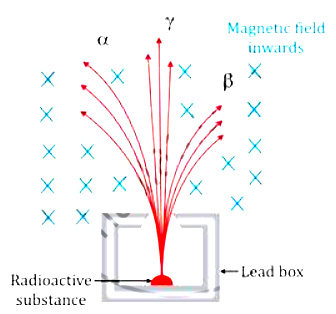
No, it is not possible to deflect gamma radiation in a way similar to alpha and beta particles, using the electric or magnetic field because they are neutral and hence do not deflected under the action of electric or magnetic field.
View full question & answer
Question 182 Marks
Explain why alpha and beta particles are deflected in an electric or a magnetic field, but gamma rays are not deflected in such a field.
Answer
α and β are positive and negative charged particles respectively, therefore these are deflected in electric or magnetic field whereas γ radiations are not charged particles so does not deflect.
View full question & answer
Question 192 Marks
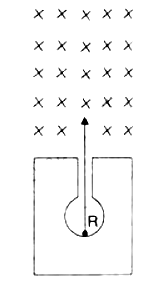
In following Figure shows a mixed source R of alpha and beta particles in a thick lead walled container.
The particles pass through a magnetic field in a direction perpendicular to the plane of paper inwards as shown by x.
(a) Show in the diagram how the particles get affected.
(b) Name the law used in part (a)


[Hint: Alpha particles will deflect to the left while beta particles to the right]
Answer
(a)


(b) Fleming's left hand rule
View full question & answer
[2 Mark Question Answer] - Physics STD 10 Questions - Vidyadip