Questions

[3 Mark Question Answer]

🎯

Test yourself on this topic

24 questions · timed · auto-graded

Question 13 Marks
When four hydrogen nuclei combine to form a helium nucleus in the interior of sun, the loss in mass is 0.0265 a.m.u. How much energy is released ?
Answer

Given that Δm = 0.0265 a.m.u.

1 a.m.u. liberates 931.5 MeV of energy.

Thus, energy liberated equivalent to 0.0265 a.m.u. is

= 0.0265 a.m.u. × 931.5 MeV

= 24.7 meV
View full question & answer
Question 23 Marks
Write the approximate value of the energy released in the fission of one nucleus of $\ce {^235_92 U}$ . What is the reason for it?
Answer
Nearly 190 MeV of energy is released due to fission of one nucleus of $\ce {^235_92 U}$ . The cause of emission of this energy is the loss in mass i.e., the sum of masses of product nuclei is less than the sum of mass of the parent nucleus and neutron.
View full question & answer
Question 33 Marks
Name two isotopes of uranium.

Which of the isotope mentioned in part (a) above is easily fissionable? Give reason.

State whether the neutron needed for fission reaction of the isotope mentioned in part (b) above, is slow or fast?

Answer
$\ce {^235_92 U and ^235_92 U}$

Experimentally it is found that isotope of $\ce {^235_92 U}$ is more easily fissionable because the fission of $\ce {^235_92 U}$ is possible by sloe neutron unlike $\ce {^235_92 U}$ where fission is possible only by the fast neutrons.

View full question & answer
Question 43 Marks
Write the approximate mass of a proton, neutron and electron in a.m.u.
Answer
Mass of proton = 1.00727 a.m.u.

Mass of neutron = 1.00865 a.m.u.

Mass of electron = 0.00055 a.m.u.

View full question & answer
Question 53 Marks
What is the source of energy of Sun or stars?
Answer
The source of energy in the Sun and stars is the nucleus fusion of light nuclei such as hydrogen present in them in their inner part. This takes place at a very high temperature and high pressure due to which helium nucleus is formed with the release of high amount of energy.
View full question & answer
Question 63 Marks
State two difference between the process of nuclear fission or fusion.
Answer
Nuclear fission: A heavy nucleus splits in two nearly equal light fragments when bombarded with neutrons. It is possible at very ordinary temperature and pressureNuclear fusion: Two light nuclei combine to form a heavy nucleus at very high temperature and high pressure. Possible only at a very high temperature ($≈10^7 K$) and a very high pressure.
View full question & answer
Question 73 Marks
Name the atoms of a substance having same atomic number, but different mass numbers. Give one example of such a substance. How do the structures of such atoms differ?
Answer

Atoms of a substance having same atomic number, but different mass numbers are called isotopes.

Example: Hydrogen has three isotopes $\ce({^1_1H}$ , $\ce{^2_1H}$ , $\ce{^3_1H})$

Structure of each isotope differs by the number of neutrons in its nuclei.

View full question & answer
Question 83 Marks
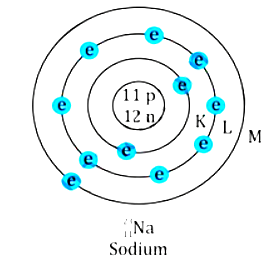
State the atomic number and mass number of $\ce{^23_11Na}$ and draw its atomic model.
Answer
Atomic number $Z =11$
Mass number $A =23$
Number of neutrons $A-Z=12$

View full question & answer
Question 93 Marks
State three safety precautions that you would take while handling the radioactive substances.
Answer
(i) The people working with radioactive materials should use mechanical devices such as tongs, clamps, tweezers, etc., to help minimize exposure.
(ii) The people working with radioactive materials should wear special lead lined lab coasts, gloves and safety glasses and remove them when leaving the work area or laboratory.
(iii) All radioactive materials should be stored in specially designed thick lead containers with a very narrow opening so as to stop radiations coming out from other directions.
View full question & answer
Question 103 Marks
State two safety measures to be taken while establishing a nuclear power plant?
Answer
The following safety measures must be taken in a nuclear power plant:

1.The nuclear reactor must be shielded with lead and steel walls so as to stop radiations from escaping out to the environment during its normal operation.

2.The nuclear reactor must be housed in an airtightbuilding of strong concrete structure which can withstand earthquakes, fires and explosion.

3.There must be back up cooling system for the reactor core, so that in case of failure of one system, the other cooling system could take its place and the core is saved from overheating and melting.

View full question & answer
Question 113 Marks
Name two main sources of nuclear radiations. How are these radiations harmful?
Answer
Two main sources of nuclear radiations are:

1.Radioactive fallout from nuclear plants and other sources.

2.Disposal of nuclear waste.

These radiations are harmful because when these radiations falls on the human body, they kill the human living tissues and cause radiation burns.

View full question & answer
Question 123 Marks
State the medical use of radioactivity.
Answer
Many diseases such as leukemia, cancer, etc., are cured by radiation therapy. Radiations from cobalt -60 are used to treat cancer by killing the cells in the malignant tumor of the patient.
The salt of weak radioactive isotopes such as radio-sodium chloride, radio-iron and radio-iodine are used for diagnosis. Such radio isotopes are called the tracers.
View full question & answer
Question 133 Marks
What is nucleus of an atom? Compare its size with that of the atom. Name its constitutents. How is the number of these constituents determined by the atomic number its atomic model.
Answer
The nucleus at the centre of atom, whose size is of the order of $10^{-15} m$ to $10^{-14} m$.
The size of a nucleus is $10^{-5}$ to $10^{-4}$ times the size of an atom. It consists of protons and neutrons.
If $Z$ is the atomic number and $A$ is the mass number of an atom, then the atom contains $Z$ number of electrons; $Z$ number of protons and $A - Z$ number of neutrons.
The atom is specified by the symbol ${ }_Z^A X$ where X is the chemical symbol for the element.
View full question & answer
Question 143 Marks
What are radio isotopes? Give one example of a radio isotope. State one use of radio isotopes.
Answer
Radio isotopes: The isotopes of some elements with atomic number Z

Example: carbon (Z=6, A=14).

Radio isotopes are used in medical and scientific and industrial fields. Radio isotopes such as $\ce {^232_92 U}$ are used as fuel for atomic energy reactors.

View full question & answer
Question 153 Marks
An element P disintegrates by α - -emission and the new element suffers two further disintegrations, both by β -emission, to form an element Q. Explain the fact that P and Q are the isotopes.
Answer
The atomic number of P decreases by 2 and mass no. decreases by 4 due to the emission of one alpha particle and then increases by 1 due to the emission of each beta particle, so the atomic number of Q formed after the emission of one alpha and two beta particles is same as that of P. Hence P and Q are the isotopes.
View full question & answer
Question 163 Marks
A nucleus of stable phosphorus has 15 protons and 16 neutrons.

What will be the atomic number and mass number of new nucleus formed by decay of a β-particle by the radio phosphorus in part(b)?

Answer
If Z is the atomic number and A is the mass number of an atom, then the atom contains Z number of electrons; Z number of protons and A - Z number of neutrons.

The atom is specified by the symbol $\ce {^A_Z X}$ where X is the chemical symbol for the element.

Atomic number is 16 and mass number is 32.

View full question & answer
Question 173 Marks
A nucleus is $\ce {^24_11 Na}$ is β-radioactive.

What are the numbers 24 and 11 called ?

Answer

An atom is specified by the symbol $\ce{^A_Z X}$ where X is the chemical symbol for the element.

Z is the atomic number and A is the mass number of an atom, then the atom contains Z number of electrons.

24 is the mass number and 11 is the atomic number.

View full question & answer
Question 183 Marks

(a)An atomic nucleus A is composed of 84 protons and 128 neutrons. The nucleus A emits an α -particle and is transformed into a nucleus B. What is the composition of B?

(b)The nucleus B emits a β -particle and is transformed into a nucleus C. What is the composition of C?

(c)What is the mass number of nucleus A?

(d)Does the composition of nucleus C change if it emits a γ -radiation?

Answer

(a) The composition of B - 82 protons and 126 neutrons.

(b) The composition of C – 83 protons and 125 neutrons.

(c) The mass number of nucleus A = no. of protons +no. of neurons = 84+128=212.

(d) Their will be no change in the composition of nucleus C.

View full question & answer
Question 193 Marks
What happens to the (i) atomic number, (ii) mass number of an element when (a) α - particle (b) β -particle and (c) γ -radiation are emitted?
Answer

(a)Atomic number decreases by 2.

(b)Atomic number increases by 1.

(c)Atomic number does not change.

View full question & answer
Question 203 Marks
How γ - radiations are produced? Mention two common properties of gamma radiations and visible light.
Answer
Gamma radiation are produced when a nucleus is in a state of excitation (i.e., it has an excess of energy). This extra energy is released in the form of gamma radiation.

Gamma radiations like light are not deflected by the electric and magnetic field.

Gamma radiations have the same speed as that of light.

View full question & answer
Question 213 Marks
What is the composition of α , β and γ -radiations?
Answer

Alpha radiations are composed two protons and two neutrons.

Beta particles are fast moving electrons.

Gamma radiations are photons or electromagnetic waves like X rays.

View full question & answer
Question 223 Marks
Name the three constituent of an atom and state their mass and charge of each. How are they distributed in an atom?
Answer
Three constituent of an atom are:
Electrons: mass is $9.1 \times 10^{-31} kg$, charge is $-1.6 \times 10^{-19} C$
Neutron: mass is $1.6749 \times 10^{-27} kg$, charge is zero.
Protons: mass is $1.6726 \times 10^{-27} kg$, charge is $+1.6 \times 10^{-19} C$
View full question & answer
Question 233 Marks
State the speed of each of $\alpha , \beta$ and $γ - $radiations.
Answer
Speed of $\alpha$ radiation is nearly $10^7 m / s$. Speed of $\beta$ radiation is about $90 \%$ of the speed of light or $2.7 \times 10^8 m / s$. Speed of y radiation is $31 \times 10^8 m / s$ in vacuum.
View full question & answer
Question 243 Marks
Arrange the α, β, or γ raditions in ascending order of their (i) ionising powers, and (ii) penetrating powers.
Answer

Ionizing power of alpha radiation is maximum i.e., 10000 times of gamma radiation while beta particles have lesser ionizing power i.e., 100 times of gamma radiation and gamma radiation have least ionizing power.

Penetration power is least for alpha particle and maximum for gamma radiation.

View full question & answer
[3 Mark Question Answer] - Physics STD 10 Questions - Vidyadip