Questions

[1 Mark Question Answer]

🎯

Test yourself on this topic

40 questions · timed · auto-graded

Question 11 Mark
A ray of light is incident as a normal ray on the surface of separation of two different mediums. What is the value of the angle of incidence in this case?
Answer
Value of the angle of incidence, ∠i = 0°
View full question & answer
Question 21 Mark
Why is the colour red used as a sign of danger?
Answer
Red colour is used as a sign of danger due to its greater wavelength and lesser deviation (scattering).
View full question & answer
Question 41 Mark
A ray of light passes from water to air. How does the speed of light change?
Answer
When light passes from water to air i.e., from denser to rarer its speed increases.
View full question & answer
Question 51 Mark
What is meant by the term ‘critical angle’?
Answer
It is the angle of incidence in the denser medium corresponding to which the angle of refraction in the rarer medium is 90°.
View full question & answer
Question 61 Mark
What is meant by the statement, ‘the critical angle for diamond is 24°’?
Answer
It means that when a light ray is an incident inside a diamond at an angle greater than 24°, the light will be totally internally refracted.
View full question & answer
Question 71 Mark
Define angle of deviation.
Answer
Angle of deviation may be defined as the angle between original path of incident ray and the path of refracted ray. 
View full question & answer
Question 81 Mark
A ray of light incident at an angle of incidence ‘i’ passes through an equilateral glass prism such that the refracted ray inside the prism is parallel to its base and emerges from the prism at an angle of emergence ‘e’.
What can you say about the value of the angle of deviation in such a situation?
Answer
Angle of deviation becomes minimum in this situation.
View full question & answer
Question 91 Mark
A ray of light incident at an angle of incidence ‘i’ passes through an equilateral glass prism such that the refracted ray inside the prism is parallel to its base and emerges from the prism at an angle of emergence ‘e’.
How is the angle of emergence ‘e’ related to the angle of incidence ‘i’?
Answer
Angle of emergence = angle of incidence.
View full question & answer
Question 101 Mark
Name two instruments of the total refracting prism in which is used.
Answer
It is used in (i) periscope and (ii) binoculars.
View full question & answer
Question 111 Mark
What is the total reflecting prism?
Answer
A total reflecting prism is a right-angled prism made of glass with other two angles each equal to 45°.
View full question & answer
Question 131 Mark
Name a prism required for obtaining a spectrum of Ultraviolet light.
Answer
Quartz prism is used to obtain a spectrum of UV light.
View full question & answer
Question 141 Mark
Can the absolute refractive index of a medium be less than one?
Answer
No, the absolute refractive index of a medium can not be less than one because the speed of light in any medium is always less than that in a vacuum.
View full question & answer
Question 151 Mark
How is the refractive index of a medium related to its real depth and apparent depth?
Answer
Refractive index = `"Real Depth"/"Apparent Depth"`
View full question & answer
Question 161 Mark
Define the term refractive index of a medium in terms of velocity of light.
Answer
It is defined as the ratio of the velocity of light in medium 1 to the velocity of light in medium 2.
View full question & answer
Question 171 Mark
Comment on the statement ‘The refractive index of glass is 3/2.’
Answer
It means that the speed of light in glass is 2/3rd the speed of light in the air (or vacuum).
View full question & answer
Question 181 Mark
For which colour of white light the refractive index of a transparent medium the least? Give the reason for your answer.
Answer
The refractive index of a transparent medium is least for the red light.
View full question & answer
Question 191 Mark
Write down the relationship between the critical angle and the refractive index of the medium.
Answer
$
\operatorname{Sin} i _{ C }=\frac{1}{\mu}
$
Where $i_c$ is the critical angle and $\mu$ is the refractive index of the medium.
View full question & answer
Question 231 Mark
Name the material for which the refractive index is found to be maximum.
Answer
The refractive index is maximum for the diamond, i. e., for a diamond the refractive index, μ = 2.418.
View full question & answer
Question 241 Mark
Name the phenomenon responsible in the following case:
Apparent bending of a stick in water
Answer
Refraction of light
View full question & answer
Question 251 Mark
Write a relation between the angle of incidence (i), angle of emergence (e), angle of the prism (A), and angle of deviation (d) for a ray of light passing through an equilateral prism.
Answer
i + e = A + d
View full question & answer
Question 261 Mark
How does a ray of light bend when it travels from when it is normal to the interface of the two media.
Answer
The ray goes straight into the second medium without any bending.
View full question & answer
Question 271 Mark
How does a ray of light bend when it travels from denser to rarer medium.
Answer
When a ray of light travels from denser to rarer medium it bends away from the normal.
View full question & answer
Question 281 Mark
How does a ray of light bend when it travels from rarer to denser medium
Answer
When a ray of light travels from rarer to the denser medium it bends towards the normal.
View full question & answer
Question 291 Mark
Name one main factor on which the direction of bending of a ray of light depends.
Answer
It mainly depends upon the optical density of the two media through which a ray of light travels.
View full question & answer
Question 301 Mark
Does the depth of a tank of water appear to change or remain the same when viewed normally from above?
Answer
Depth of the tank remains the same when viewed normally from above.
View full question & answer
Question 311 Mark
After a robbery, if a window has been broken, there will be tiny particles of glass. Some of these will be found at the scene of the crime and some may be caught in the thief’s clothing. If the police can prove that these particles are identical, they have a strong case.
A method of doing this is to suspend the particles of glass in a special liquid. Light of a single colour is thrown through the liquid and the particles viewed through a microscope. The temperature of the liquid is then slowly altered. This alters the speed of light through the liquid (i.e., it alters the refractive index). At one particular temperature, the particles of glass disappear. It this happens at the same temperature for both sets of glass particles, they probably came from the same broken pane of glass.
Complete and copy the diagram to show how light bends when it travels from the liquid to the glass and back to the liquid, If the light speeds up in the glass.
View full question & answer
Question 321 Mark
Show the path of a ray of light when it travels from air into water, the angle of incidence being 30°. Mark the angle of incidence and the corresponding angle of refraction.
View full question & answer
Question 331 Mark
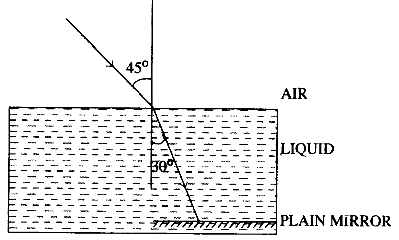
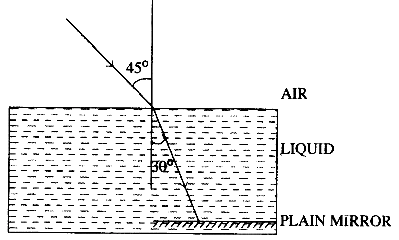
A ray of monochromatic light enters a liquid from the air as shown in the diagram given below:

Mark in your diagram the two angles on the surface of separation when the ray of light moves out from the liquid to air.
View full question & answer
Question 341 Mark
A ray of monochromatic light enters a liquid from the air as shown in the diagram given below:

Copy the diagram and show in the diagram the path of the ray of light after it strikes the mirror and re-enters the medium of air.
View full question & answer
Question 351 Mark
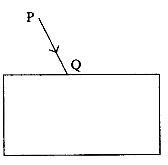
In the diagram below, PQ is a ray of light incident on a rectangular glass block.

Copy the diagram and complete the path of the ray of light through the glass block. In your diagram, mark the angle of incidence by letter ‘i’ and the angle of emergence by the letter ‘e’.
View full question & answer
Question 361 Mark
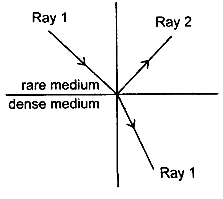
A ray of light moves from a rare medium to a dense medium as shown in the diagram below. Write down the number of the ray which represents the partially reflected ray.
Answer
Ray 2 shows partially reflected ray.
View full question & answer
Question 371 Mark
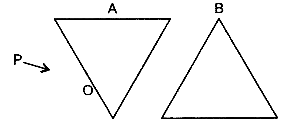
The figure shows two prisms A and B. A monochromatic ray of light PO is incident at the face of the prism A. Complete the diagram to show the path of the ray till it emerges out of the prism B.
View full question & answer
Question 381 Mark
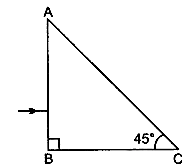
A ray of light passes through a right-angled prism as shown in the figure. State the angles of incidence at the faces AC and BC.
Answer
At AC – Angle is 45°
At BC – Angle is 0°
View full question & answer
Question 391 Mark
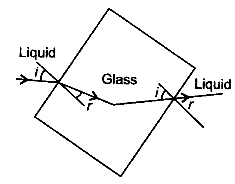
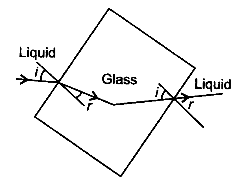
The diagram shows the path of a ray of light through a rectangular glass block placed in a liquid of uniform density.

Show with the help of a ray diagram the path of the ray when incident ray normally falls on the first surface of the glass block and passes through the block and the liquid.
View full question & answer
Question 401 Mark
The diagram shows the path of a ray of light through a rectangular glass block placed in a liquid of uniform density.

What is the angular, deviation of the emergent ray from the glass block with respect to the incident ray?
Answer
As shown by the line in the diagram, the emergent ray is parallel to the incident ray (when produced) and so there is no angular deviation.
View full question & answer
[1 Mark Question Answer] - Physics STD 10 Questions - Vidyadip