Questions

[2 Mark Question Answer]

🎯

Test yourself on this topic

28 questions · timed · auto-graded

Question 12 Marks
The refractive index of glass with respect to air is $3/2.$ What is the refractive index of air with respect to glass?
Answer
Given:$ _a\mu _g = `3/2`$
$_g\mu _a = `1/(""_"a"mu_"g")` = `1/(3//2)` = `2/3` = 0.67.$
View full question & answer
Question 22 Marks
You are provided with a printed piece of paper. Using this paper how will you differentiate between a convex lens and a concave lens?
Answer
First, we place the lens on a piece of printed paper. Then we lift it slowly. If the words of the printed paper, seen through the lens becomes bigger than is convex lens otherwise concave lens.
View full question & answer
Question 32 Marks
How is the critical angle of a material related to its refractive index?
Answer
Relation of critical angle and refractive index:

μ = `1/sin "C"`

Where μ = refractive index of the material and C = critical angle.

View full question & answer
Question 42 Marks
Name the factors affecting the critical angle for the pair of media.
Answer
Factors affecting the critical angle:
(i) Angle of incidence.
(ii) Refractive index of the medium.
View full question & answer
Question 52 Marks
What do you understand by the deviation produced by a prism?
Answer
When a ray of light passes through a prism, it bends towards the base of the prism. Thus, the path of the emergent ray differs from the path of the incident ray. This is called the deviation produced by a prism.
View full question & answer
Question 62 Marks
State two advantages of using a right-angle prism as a reflector, rather than a plane mirror.
Answer
(i) There is no absorption of light in a prism and hence the image is brighter.
(ii) Image is sharper in case of the prism.
View full question & answer
Question 72 Marks
Why does the sun appear bigger during sunset or sunrise?
Answer
During sunset or sunrise, the rays of light from the sun travel through a long distance through air. Thus, the apparent image of the sun is formed closer to the eye, which in turn appears bigger.
View full question & answer
Question 92 Marks
For which colour of white light the refractive index of a transparent medium the most? Give the reason for your answer.
Answer
The refractive index of a transparent medium is most for violet light.
The reason is that the speed of violet light is least in a transparent medium while the speed of red light is most in a transparent medium.
View full question & answer
Question 102 Marks
What is meant by the refraction of light?
Answer
It is a phenomenon in which a ray of light deviates from its original path while travelling from one optical medium to another optical medium.
View full question & answer
Question 112 Marks
After a robbery, if a window has been broken, there will be tiny particles of glass. Some of these will be found at the scene of the crime and some may be caught in the thief’s clothing. If the police can prove that these particles are identical, they have a strong case.
A method of doing this is to suspend the particles of glass in a special liquid. Light of a single colour is thrown through the liquid and the particles viewed through a microscope. The temperature of the liquid is then slowly altered. This alters the speed of light through the liquid (i.e., it alters the refractive index). At one particular temperature, the particles of glass disappear. It this happens at the same temperature for both sets of glass particles, they probably came from the same broken pane of glass.
Complete and copy the diagram to show how light bends when it travels from the liquid to the glass and back to the liquid, If the light slows down in the glass.
View full question & answer
Question 122 Marks
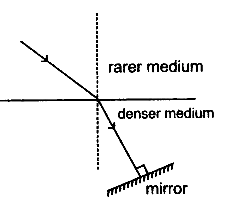
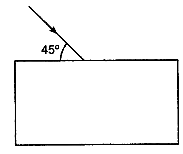
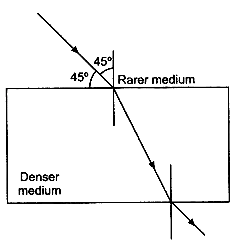
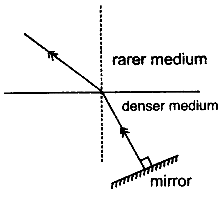
A ray of light is moving from a rarer medium to a denser medium and strikes a plane mirror placed at 90° to the direction of the ray as shown in the diagram.

(i) Copy the diagram and mark arrows to show the path of the ray of light after it is reflected from the mirror. (ii) Name the principle you have used to mark the arrows to show the direction of the ray.
Answer
(i)

(ii) Principle of reversibility of light.
View full question & answer
Question 132 Marks
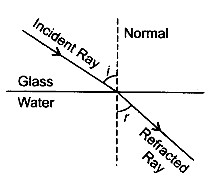
Draw ray of light bending towards the normal while passing from glass to water. Label your diagrams.
Answer

The ray of light bends away from the normal while passing from glass to water.
View full question & answer
Question 142 Marks
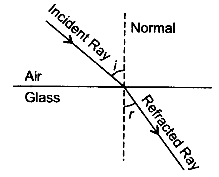
Draw ray of light bending towards the normal while passing from air to glass. Label your diagrams.
Answer
The ray of light bends towards the normal while passing from air to glass.
View full question & answer
Question 152 Marks
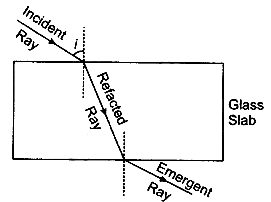
A ray of monochromatic light is incident from air into a glass slab. Draw a labelled ray diagram indicating the change in its path till it emerges out of the slab. In the diagram, mark the angle of incidence (i) and the angle of refraction (r) at the first interface. How is the refractive index of glass related to the angles i and r?
Answer
The labelled ray diagram is shown in the figure.

Refractive index of glass $=\frac{\operatorname{Sin} i }{\operatorname{Sin} r}$
View full question & answer
Question 162 Marks
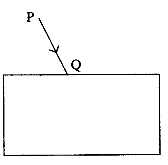
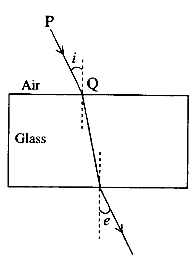
In the diagram below, PQ is a ray of light incident on a rectangular glass block.

How are the angles ‘i’ and ‘e’ related to each other?
Answer

When the incident ray is undergoing minimum deviation the angle of incidence is equal to the angle of emergence, i.e., ∠i – ∠e
View full question & answer
Question 172 Marks
How are the refractive index of water-related to the real depth and the apparent depth of a column of water?
Answer
Relation between the refractive index of water, real depth, and apparent depth$._a\mu _w= $`"real depth"/"Apparent depth"`
View full question & answer
Question 182 Marks
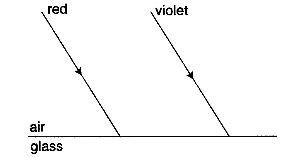
Two parallel rays of Red and Violet travelling through the air, meet the air-glass boundary as shown in the above figure. Will their paths inside the glass be parallel? Give a reason for your answer.
Answer
No.
Reason: Deviation suffered by each ray will be different because the refractive index is different for different colours of light.
View full question & answer
Question 192 Marks
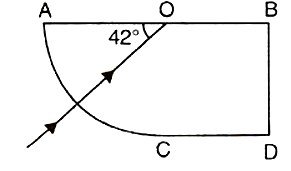
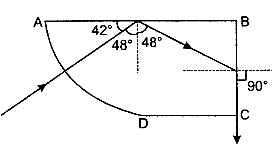
A ray of light enters a glass slab ABDC as shown in fig. 4.59 and strikes at the centre O of the circular part AC of the slab. The critical angle of glass is 42°. Complete the path of the ray till it emerges out from the slab. Mark the angles in the diagram wherever necessary.
Answer
The completed ray diagram is shown in figure given below.
View full question & answer
Question 212 Marks
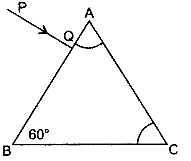
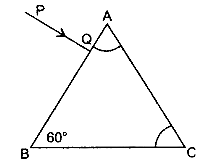
In the diagram alongside a ray of light, PQ is incident normally on one face AB of an equilateral glass prism. What is the angle of incidence at the faces AB and AC?
Answer
∠ of incidence of face AB = 60°
∠ of incidence of face AC = 60°
View full question & answer
Question 222 Marks
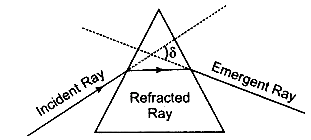
Draw a diagram to show the refraction of a monochromatic light ray through an equilateral prism. On the diagram, label the incident, refracted, and emergent rays. It also indicates the angle of deviation by the letter δ.
Answer
The labelled diagram is given below:
View full question & answer
Question 232 Marks
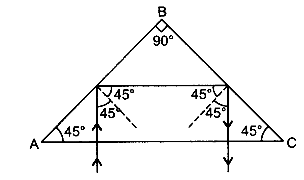
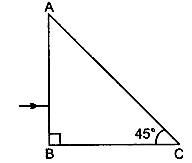
Draw a diagram, properly labelled, to illustrate the use of a total reflecting prism (a right-angled isosceles prism) to turn a ray of light through 180°. Name an instrument in which this device is used.
Answer
The diagram is shown below. This device is used in binoculars
View full question & answer
Question 242 Marks
Draw the diagram given below and clearly show the path taken by the emergent ray.
Answer
$i_c = 42$ for glass. The ray undergoes refraction as it emerges away from the slab.
View full question & answer
Question 252 Marks
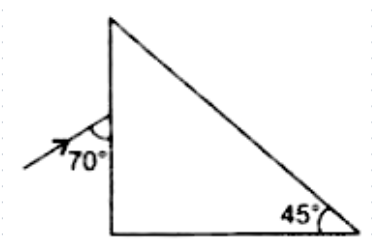
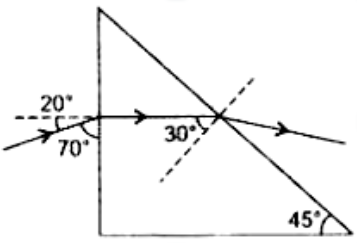
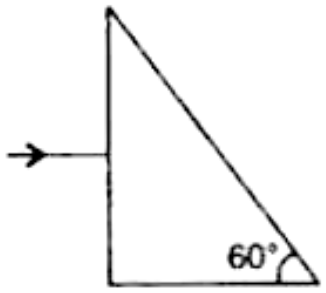
Complete the following diagram to show the path of the ray of a single colour in the diagram as if enters in and emerges out of the prism. Mark the angles wherever necessary. (Critical angle for glass = 42°).
Image
Answer
The completed diagram is given below.
Image
View full question & answer
Question 262 Marks
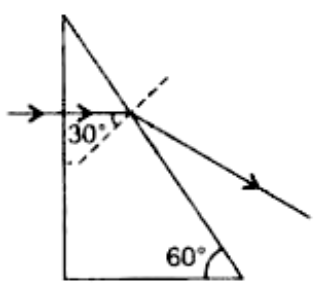
Complete the following diagram to show the path of the ray of a single colour in the diagram as if enters in and emerges out of the prism. Mark the angles wherever necessary. (Critical angle for glass = 42°).
Image
Answer
The completed diagram is given below.
Image
View full question & answer
Question 272 Marks
Calculate the velocity of light in a glass block of refractive index $1.5$. (Velocity of light in air $= 3 \times 10^8m/s)$​​​​​​​
Answer

$\frac{ V _{ air }}{ V _{\text {glass }}}=\frac{\mu_{\text {glass }}}{\mu_{\text {air }}}$
or $V _{\text {glass }}=3 \times 10^8 \times \frac{1}{1.5}$
$= 2 \times 10^8 m/s.$
View full question & answer
Question 282 Marks
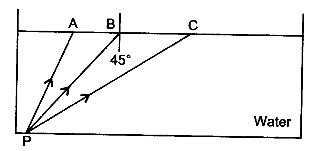
The diagram shows a point source P inside a water container. Three rays A, B, and C starting from P are shown up to the water surface. Show in the diagram the path of these rays after striking the water surface. The critical angle for the water-air pair is 48°.

View full question & answer
[2 Mark Question Answer] - Physics STD 10 Questions - Vidyadip