Questions

[1 Mark Question Answer]

🎯

Test yourself on this topic

49 questions · timed · auto-graded

Question 11 Mark
How will you differentiate between a convex and a concave lens by looking at a printed page?
Answer
On keeping the lens near a printed page, if the letters appear magnified, then the lens is convex, and if the letters appear diminished, then the lens is concave.
View full question & answer
Question 21 Mark
How will you differentiate between a convex and a concave lens by looking at a distant object.
Answer
On seeing a distant object through the lens, if its inverted image is seen, then the lens is convex, and if the upright image is seen, then the lens is concave.
View full question & answer
Question 31 Mark
A lens forms the image of an object placed at a distance 15 cm from it, at a distance 60 cm in front of it. Find : the nature of image.
Answer
The nature of the image is erect, virtual and magnified.
View full question & answer
Question 41 Mark
How does the power of a lens change is its focal length is doubled?
Answer
If focal length of a lens doubled then its power gets halved.
View full question & answer
Question 51 Mark
How is the power of a lens related to its focal length?
Answer
Power of lens (in $D$ ) $=\frac{1}{\text { focal lenght (in metre) }}$
View full question & answer
Question 61 Mark
Define the term power of a lens. In what unit is it expressed?
Answer
The power of a lens is a measure of deviation produced by it in the path of rays refracted through it.
Its unit is Dioptre (D).
View full question & answer
Question 81 Mark
A converging lens forms the image of an object placed in front of it, beyond $2F_2$​​​​​​​ of the lens.
State three characteristics of the image.
Answer
The image will be diminished, real and inverted.
View full question & answer
Question 91 Mark
A converging lens forms the image of an object placed in front of it beyond $2F_2$​​​​​​​ of the lens.
Where is the object placed?
Answer
The object is placed beyond $2F_1.$
View full question & answer
Question 101 Mark
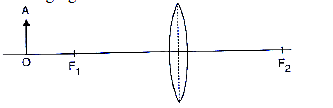
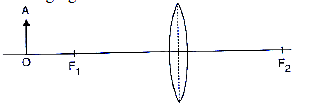
The diagram given below shows the position of an object OA in relation to a converging lens whose foci are at $F_1$ and $F_{2.}$


Describe three characteristic of the image.
Answer
The image will be magnified, real and inverted.
View full question & answer
Question 111 Mark

The diagram given below shows the position of an object OA in relation to a converging lens whose foci are at F1 and F2.


State the position of image with reference to the lens.

Answer
The position of the images will be more than twice the focal length of lens.
View full question & answer
Question 121 Mark
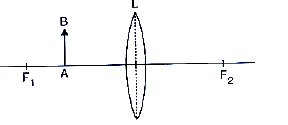
 The following diagram shows an object $A B$ and a converging lens $L$ with foci $F_1$ and $F_2$ State three characteristics of the image in relation to the object.

Answer
The image formed will be magnified, virtual and upright.
View full question & answer
Question 131 Mark
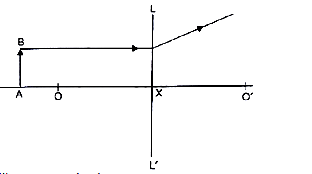
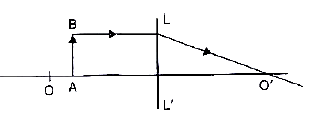
Study the diagram below.


what are the points O, O’ called?
Answer
The points O and O' are called second and first focal points respectively.
View full question & answer
Question 151 Mark
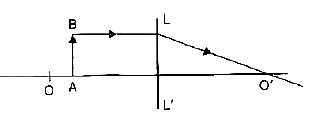
Study the following diagram :


Name a device in which this action of lens is used.
Answer
Such action of lens is used in a magnifying glass.
View full question & answer
Question 161 Mark

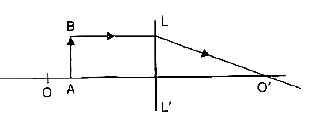
Study the following diagram :

state the three characteristics of the image.

Answer
The image formed will be magnified, virtual and upright.
O and O.
View full question & answer
Question 171 Mark
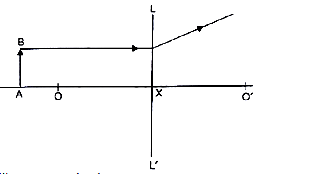
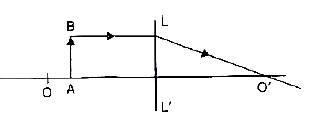
Study the following diagram :


What are the points O and O’ called?


Answer
O and O' are known as first and second focal points respectively.
View full question & answer
Question 191 Mark
In the following cases, where must an object be placed in front of a convex lens so that the image formed is upright and enlarged image?
Answer
between optical centre and focus.
View full question & answer
Question 201 Mark
In the following cases, where must an object be placed in front of a convex lens so that the image formed is inverted and enlarged .
Answer
between F and 2F.
View full question & answer
Question 211 Mark
In the following cases, where must an object be placed in front of a convex lens so that the image formed is of same size as the object .
Answer
at 2F.
View full question & answer
Question 221 Mark
In the following cases, where must an object be placed in front of a convex lens so that the image formed is at infinity.
Answer
at focus.
View full question & answer
Question 231 Mark
Give two characteristic of the virtual image formed by a convex lens.
Answer
The virtual image formed by a convex lens will be magnified and upright.
View full question & answer
Question 241 Mark
Give two characteristic of the image formed by a concave lens.
Answer
Image formed by a concave lens is virtual and diminished.
View full question & answer
Question 251 Mark
Can a concave lens form an image of size two times that of the object? Give reason?
Answer
A concave lens cannot form an image two times that of the object because it always forms a diminished image.
View full question & answer
Question 261 Mark
a) name the lens which always forms an erect and virtual image.
(b) state whether the image in part (a) is magnified or diminished.
Answer
(a) Concave lens
(b) Image is diminished
View full question & answer
Question 271 Mark
A lens forms an upright and magnified image of an object State whether the image is real or virtual
Answer
Virtual.
View full question & answer
Question 291 Mark
A lens forms an inverted image of an object what is the nature of the image real or virtual?
Answer
The nature of the image is real.
View full question & answer
Question 311 Mark
A lens forms an upright and diminished image of an object irrespective of its position. What kind of lens is this?
Answer
Concave lens
View full question & answer
Question 321 Mark
A lens always forms an image between the object and the lens.
state three characteristics of the image.
Answer
The image formed is virtual, erect and diminished.
View full question & answer
Question 331 Mark
A lens always forms an image between the object and the lens.
name the lens.
Answer
The lens that forms the image between the object and itself is a concave lens.
View full question & answer
Question 341 Mark
A lens forms an erect, magnified and virtual image of an object. name the device which uses this principle.
Answer
Magnifying glass' uses this principle.
View full question & answer
Question 351 Mark
A lens forms an erect, magnified and virtual image of an object.Where is the object placed in relation to the lens?
Answer
The object is placed between the lens and focus (F1).
View full question & answer
Question 361 Mark
A lens forms an erect, magnified and virtual image of an object. name the type of lens.
Answer
Convex lens
View full question & answer
Question 371 Mark
A convex lens forms an image of an object equal to the size of the object.state two more characteristics of the image.
Answer
The image formed is real and inverted.
View full question & answer
Question 381 Mark
A convex lens forms an image of an object equal to the size of the object.Where is the object placed in front of the lens?
Answer
The object is placed at the centre of curvature.
View full question & answer
Question 391 Mark
Define the term principal axis of a lens.
Answer
It is the line joining the centers of curvature of the two surfaces of the lens.
View full question & answer
Question 401 Mark
Out of the two lenses, one concave and the other convex, state which one will show the divergent action on a light beam.
Answer
Concave lens will show the divergent action on a light beam.
View full question & answer
Question 411 Mark

Which lens is converging:

A concavo-convex lens or a convexo-concave lens?

Answer
The concavo-convex lens is a converging lens. This is because it is thicker at the middle and thinner at edges allowing it to converge all the light that is incident on it.
View full question & answer
Question 421 Mark
Which lens is converging: An equiconcave lens or an equiconvex lens.
Answer
Equiconvex lens is converging.
View full question & answer
Question 431 Mark
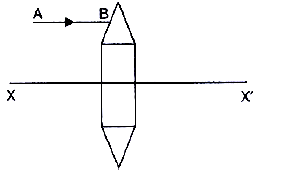
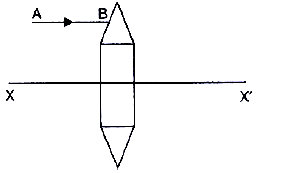
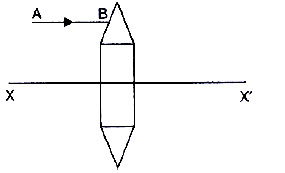
The diagram alongside shows a lens as a combination of a glass block and two prisms.
The final emergent ray will either meet XX’ at a point or appear to come from a point on XX’. Label the point as F. What is this point called?

Answer
The point F is called as Focal point or focus.
View full question & answer
Question 441 Mark
The diagram alongside shows a lens as a combination of a glass block and two prisms.
what is the rays the line XX’ called?

Answer
XX' is known as principal axis.
View full question & answer
Question 451 Mark
The diagram alongside shows a lens as a combination of a glass block and two prisms. Name the lens formed by the combination.

Answer
The combination forms convex lens.
View full question & answer
Question 461 Mark
State the condition for the following a ray passes undeviated through the lens .
Answer
If a ray passes undeviated through the lens it is incident at the optical centre of the lens.
View full question & answer
Question 471 Mark
State the condition for the following a lens has both its focal lengths equal .
Answer
If a lens has both its focal length equal medium is same on either side of lens.
View full question & answer
Question 481 Mark
What do you mean by focal plane of a lens?
Answer
A plane passing through the focal point and normal to the principal axis of the lens is called the first focal plane.
View full question & answer
Question 491 Mark
What is a lens?
Answer
A lens is a transparent refracting medium bounded by two curved surfaces which are generally spherical.
View full question & answer
[1 Mark Question Answer] - Physics STD 10 Questions - Vidyadip