Questions

[2 Mark Question Answer]

🎯

Test yourself on this topic

28 questions · timed · auto-graded

Question 12 Marks
What is magnifying glass? State its two uses.
Answer
Magnifying glass is a convex lens of short focal length. It is mounted in a lens holder for practical use.
It is used to see and read the small letters and figures. It is used by watch makers to see the small parts and screws of the watch.
View full question & answer
Question 22 Marks
A convex lens forms an inverted image of size same as that of the object which is placed at a distance 60 cm in front of the lens. Find : The focal length of the lens
Answer

To find the focal length of this lens, we use the relationship:

object distance (u) = 2f

object distance = 60 cm …(given)

60 = 2f

f = 30 cm

So, the focal length of this lens is 30 cm.

View full question & answer
Question 32 Marks
A convex lens forms an inverted image of size same as that of the object which is placed at a distance $60$ cm in front of the lens. Find: The position of image
Answer
A convex lens forms an inverted, real, and an image of the same size as the object when the object is placed at $2f$, i.e. $(u = 2f).$
In such cases, the image is formed at the point which is double the focal length on the other side of the lens $(2f_2).$
View full question & answer
Question 42 Marks
An object is placed at a distance of 20 cm in front of a concave lens of focal length 20 cm. find: the magnification of image.
Answer
Object distance, $u =-20 cm$
Focal length, $f=-20 cm$ (concave lens)
For a lens, magnification is
$
\begin{aligned}
& m =\frac{ v }{ u } \\
& \therefore m =\frac{-10}{-20} \\
& \therefore m =+0.5
\end{aligned}
$
View full question & answer
Question 52 Marks
A lens forms the image of an object placed at a distance of 45 cm from it on a screen placed at a distance 90 cm on other side of it. Find the name the kind of lens.
Answer

Object distance, u = -45 cm

Image distance, v = +90 cm

As the image is formed on the other side of the lens, the image is real. Hence, the lens is a convex lens.

View full question & answer
Question 62 Marks
A lens forms the image of an object placed at a distance 15 cm from it, at a distance 60 cm in front of it. Find : the magnification.
Answer
Object distance, $u =-15 cm$
Image distance, $v=-60 cm$
For a lens, magnification is
$
\begin{aligned}
& m =\frac{ v }{ u } \\
& \therefore m =\frac{-60}{-15} \\
& \therefore m =+4
\end{aligned}
$
View full question & answer
Question 72 Marks
A lens forms the image of an object placed at a distance 15 cm from it, at a distance 60 cm in front of it. Find :
the focal length,
Answer
Object distance, $u =-15 cm$
Image distance, $v=-60 cm$
Lens formula is,
$\frac{1}{ v }-\frac{1}{ u }=\frac{1}{ f }$
$\therefore \frac{1}{-60}-\frac{1}{-15}=\frac{1}{ f }$
$\therefore \frac{1}{ f }=\frac{1}{15}-\frac{1}{60}=\frac{3}{60}$
$\therefore f =20 cm$

View full question & answer
Question 82 Marks
The power of a lens is -2.0 D. Find its focal length and its kind.
Answer
$
\begin{aligned}
& \text { Focal length }(f)=\frac{1}{\text { power }} \\
& =\frac{1}{-2}=-0.5 m
\end{aligned}
$
So focal length is $-0.5 m$
Since, $f$ is negative, lens is concave.
View full question & answer
Question 92 Marks
The focal length of a convex lens is 25 cm. Express its power with sign.
Answer
Focal length, $f=+25 cm =+0.25 m$
Power of a lens is
$
\begin{aligned}
& P=\frac{1}{f}=\frac{1}{+0.25} \\
& \therefore P=+4.0 D
\end{aligned}
$
View full question & answer
Question 102 Marks
Express the power (with sign) of a concave lens of focal length 20 cm.
Answer
$
\begin{aligned}
& P=\frac{1}{F(\text { In metre })} \\
& \Rightarrow P=\frac{1}{0.2 m}=5 D
\end{aligned}
$
As it is a concave lens so power is negative i.e. $P=-5 D$
View full question & answer
Question 112 Marks
The power of a lens is +2.0 D. Find its focal length and state what kind of lens it is?
Answer
$\begin{aligned} & P=+2.0 D \\ & P=\frac{1}{F(\text { in meter })} \\ & \Rightarrow F=\frac{1}{P}=\frac{1}{2} \\ & F=0.5 m \text { or } 50 cm \end{aligned}$
View full question & answer
Question 122 Marks
How is the sign (+ Or -) of power of a lens related to its divergent or convergent action?
Answer
The sign of power depends on the direction in which a light ray is deviated by the lens. The power could be positive or negative. If a lens deviates a ray towards its centre (converges), the power is positive and if it deviates the ray away from its centre (diverges), the power is negative
View full question & answer
Question 132 Marks
What information about the nature of image (i) real or virtual, (ii) erect or inverted, do you get from the sign of magnification + or - ?
Answer
(i) Positive sign of magnification indicates that the image is virtual while negative sign indicates that the image is real.

(ii) Positive sign of magnification indicates that the image is erect while negative sign indicates that the image is inverted.

View full question & answer
Question 142 Marks
What do you understand by the term magnification? Write expression for it for a lens, explaining the meaning of the symbols used.
Answer
The term magnification means a comparison between the size of the image formed by a lens with respect to the size of the object.
For a lens: Magnification ' $m$ ' is the ratio of the height of the image to the height of the object.
$m=\frac{\text { Height of image }\left(h^{\prime}\right)}{\text { Height of object }(h)}=\frac{h \prime}{h}$
View full question & answer
Question 152 Marks
How will you differentiate between a convex and a concave lens by looking at (i) a distant object, (ii) a printed page?
Answer
(i) On seeing a distant object through the lens, if its inverted image is seen, then the lens is convex, and if the upright image is seen, then the lens is concave.
(ii) On keeping the lens near a printed page, if the letters appear magnified, then the lens is convex, and if the letters appear diminished, then the lens is concave.
View full question & answer
Question 162 Marks
State two applications a concave lens .
Answer
The two applications of a concave lens are:-
(i) A person suffering from short-sightedness or myopia wears spectacles having a concave lens.
(ii) A concave lens is used as an eye lens in a Galilean telescope to obtain an erect final image of the object.
View full question & answer
Question 172 Marks
State two applications of a convex lens.
Answer
The two applications of a convex lens are:-
(i) It is used as an objective lens in a telescope, camera, slide projector, etc.
(ii) With its short focal length, it is also used as a magnifying glass.
View full question & answer
Question 182 Marks
Which lens has more power: a thick lens or a thin lens?
Answer
A thick lens has more power than a thin lens. This is because a thick lens has a larger surface curvature. It has a short focal lengthand that is why it deviates the rays of light at a greater extent.
View full question & answer
Question 192 Marks
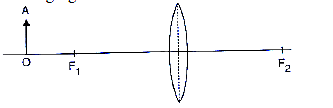
The diagram given below shows the position of an object OA in relation to a converging lens whose foci are at $F_1$ and $F_2.$​​​​​​​


Describe how the distance of the image from the lens and the size of the image change as the object is moved towards $F_1$.
Answer
As the object move towards $F_1$ the image will shift away from $F_2$ and it is magnified. At $F 1$ the image will form at infinity and it is highly magnified. Between $F_1$ and optical centre, the image will form on the same side of object and will be magnified.
View full question & answer
Question 202 Marks
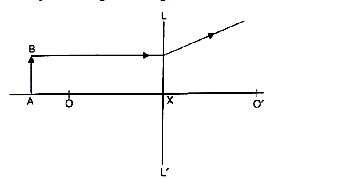
Study the diagram below.


State three characteristics of the image
Answer
The three characteristics of the image are:
Virtual
Erect
Diminished
View full question & answer
Question 212 Marks
Where must a point source of light be placed in front of a convex lens so as to obtain a parallel beam of light?
Answer
If the point source of light is placed at the 'first focal point' (i.e. the focal point on the left of the optical centreof the convex lens), then the rays of light after being refracted through the length obtain a parallel beam of light.
View full question & answer
Question 222 Marks
State two differences between a convex and a concave lens in their (a) appearence, and (b) action on the incident light.
Answer
Convex lens:
(a) Thick in the middle thinner at the edges.
(b)
(i) It converge the incident rays towards the principal axis.
(ii) It has a real focus.
Concave lens:
(a) Thin in the middle thicker at the edges.
(i) It diverges the incident rays away from the principal axis.
(ii) It has a virtual focus.
View full question & answer
Question 232 Marks
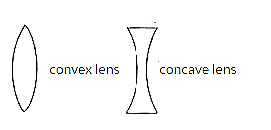
Name the different kinds of lenses. Draw diagrams to illustrate them.
Answer
Lenses are of two types :
(i) Convex or converging lens, and
(ii) Concave or diverging lens.

View full question & answer
Question 242 Marks
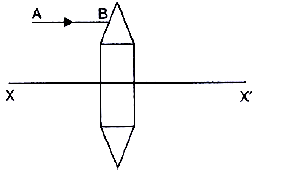
The diagram alongside shows a lens as a combination of a glass block and two prisms.
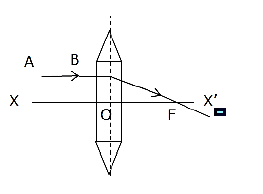
Complete the ray diagram and show the path of the incident ray AB after passing through the lens

Answer
The complete diagram is
View full question & answer
Question 252 Marks
Define the term focal length of a lens.
Answer
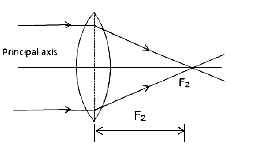
The distance from the optical centre O of the lens to its second focal point is called the focal length of the lens.
View full question & answer
Question 262 Marks
A beam of light incident on a convex lens parallel to its principal axis converges at a point on the principal axis. Name the point. Draw a ray diagram to show it.
Answer
Such a point will be second focus.
View full question & answer
Question 272 Marks
State the condition when a lens is called an equi-convex or equi-concave
Answer
A lens is called an equiconvex or equiconcave when radii of curvature of the two surfaces of lens are equal.
View full question & answer
Question 282 Marks
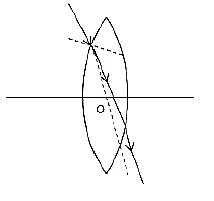
Explain optical centre of a lens with the help of proper diagram(s)
Answer
It is point on the principal axis of the lens such that a ray of light passing through this point emerges parallel to its direction of incidence.
It is marked by letter O in the figure. The optical centre is thus the centre of the lens.

View full question & answer
[2 Mark Question Answer] - Physics STD 10 Questions - Vidyadip