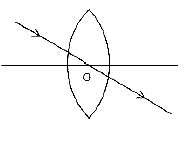
Questions

[3 Mark Question Answer]

🎯

Test yourself on this topic

44 questions · timed · auto-graded

Question 13 Marks
State two applications each of a convex lens and concave lens.
Answer

The two applications of a convex lens are:-

(i) It is used as an objective lens in a telescope, camera, slide projector, etc.

(ii) With its short focal length it is also used as a magnifying glass.

The two applications of a concave lens are:-

(i) A person suffering from short sightedness or myopia wears spectacles having concave lens.

(ii)A concave lens is used as eye lens in a Galilean telescope to obtain an erect final image of the object.
View full question & answer
Question 23 Marks
Define magnifying power of a simple microscope. How can it be increased?
Answer
The magnifying power of the microscope is defined as the ratio of the angle subtended by the image at the eye to the angle subtended by the object (assumed to be placed at the least distance of distinct vision $D=25 cm$ ) at the eye, i.e.,

Magnifying power $=1+\frac{D}{F}$

Where $F$ is the focal length of the lens.
The magnifying power of a microscope can be increased by using the lens of short focal length. But it cannot be increased indefinitely.
View full question & answer
Question 33 Marks
Where is the object placed in reference to the principal focus of a magnifying glass, so as to see its enlarged image? Where is the image obtained?
Answer
The object is placed between the lens and the principal focus.
The image is obtained between the lens and the principal focus.

View full question & answer
Question 43 Marks
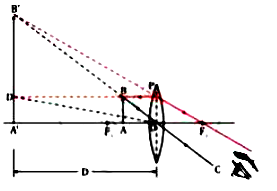
Draw a neat labelled ray diagram to show the formation of image by a magnifying glass. State three characteristics of the image.
Answer
Let the object (AB) is situated between focal length and optical centre of a convex lens then its image (A'B') will form on the same side of lens.

The image formed will be virtual, magnified and erect.
View full question & answer
Question 53 Marks
An object is placed at a distance of 20 cm in front of a concave lens of focal length 20 cm. find : the position of image.
Answer
Object distance, $u =-20 cm$
Focal length, $f=-20 cm$ (concave lens)
Lens formula is,
$\begin{aligned} & \frac{1}{ v }-\frac{1}{ u }=\frac{1}{ f } \\ & \therefore \frac{1}{ v }=\frac{1}{ f }+\frac{1}{ u }\end{aligned}$
$\therefore \frac{1}{ v }=\frac{1}{-20}+\frac{1}{-20}=-\frac{2}{20}$
$\therefore v=-10 cm$
Hence, the image is $10 cm$ in front of the lens on the same side as the object.
View full question & answer
Question 63 Marks
A lens forms the image of an object placed at a distance of 45 cm from it on a screen placed at a distance 90 cm on other side of it. find:
  1. the focal length of lens,
  2. the magnification of image.
Answer
Object distance, $u =-45 cm$
Image distance, $v=+90 cm$
(i) Lens formula is,
$\frac{1}{v}-\frac{1}{u}=\frac{1}{f}$
$\therefore \frac{1}{ f }=\frac{1}{90}+\frac{1}{45}$
$\therefore \frac{1}{ f }=\frac{\beta^1}{9 \sigma_{30}}$
$
\therefore f =30 cm
$
(ii) $m =\frac{ v }{ u }=\frac{90}{-45}=-2$
View full question & answer
Question 73 Marks
Where should an object be placed in front of a convex lens of focal length 0.12 m to obtain a real image of size three times the size of the object, on the screen?
Answer
Focal length of a convex lens, $f=+0.12 m$
$m=-3$ (real image)
For a lens, magnification is
$
m =\frac{ v }{ u }
$
$\therefore-3=\frac{ v }{ u }$
$
\therefore v=-3 u
$
Lens formula is,
$\begin{aligned} & \frac{1}{ v }-\frac{1}{ u }=\frac{1}{ f } \\ & \therefore \frac{1}{-3 u }-\frac{1}{ u }=\frac{1}{0.12}\end{aligned}$
$\begin{aligned} & \therefore-\frac{4}{3 u}=\frac{1}{0.12} \\ & \therefore 3 u=-0.48 m \\ & \therefore u=-0.16 m \end{aligned}$
View full question & answer
Question 83 Marks
The focal length of a convex lens is 25 cm. At what distance from the optical centre of the lens an object be placed to obtain a virtual image of twice the size?
Answer
Focal length, $f=+25 cm$
Image is virtual and magnified, $m=+2$
For a lens, magnification is
$\begin{aligned} & m =\frac{ v }{ u } \\ & \therefore+2=\frac{ v }{ u }\end{aligned}$
$
\therefore v =2 u
$
Lens formula is,
$\frac{1}{ v }=\frac{1}{ u }=\frac{1}{ f }$
$\therefore \frac{1}{2 u }-\frac{1}{ u }=\frac{1}{25}$
$\therefore-\frac{1}{2 u}=\frac{1}{25}$
$\therefore 2 u =-25 cm$
$\therefore u =-12.5 cm$
View full question & answer
Question 93 Marks
A concave lens forms the image of an object kept at a distance 20 cm in front of it, at a distance 10 cm on the side of the object.
What is the nature of the image?
Find the focal length of the lens.
Answer

Object distance, $u =-20 cm$
Image distance, $v=-10 cm$
(a) The image is formed on the same side as the object. Hence, it is a virtual image. Also, since the lens is a concave lens the image will be erect and diminished.
(b) Lens formula is
$\frac{1}{ v }-\frac{1}{ u }=\frac{1}{ f }$
$\therefore \frac{1}{-10}-\frac{1}{-20}=\frac{1}{ f }$
$\therefore \frac{1}{ f }=\frac{1}{20}-\frac{1}{10}=-\frac{1}{20}$
$\therefore f =-20 cm$


View full question & answer
Question 103 Marks
At what position a candle of length 3 cm be placed in front of a convex lens so that its image of length 6 cm be obtained on a screen placed at distance 30 cm behind the lens?
What is the focal length of lens in part (a)?
Answer
Height of the candle (object) $=3 cm$
Height of the image of the candle $=6 cm$
Image distance $=30 cm$
(a) The formula for magnification of a lens is
$\begin{aligned} & m =\frac{ h f}{ h }=\frac{ v }{ u } \\ & \therefore \frac{6}{3}=\frac{30}{ u }\end{aligned}$
$
\therefore u =15 cm
$
(b) Lens formula is
$\frac{1}{ v }-\frac{1}{ u }=\frac{1}{ f }$
$\therefore \frac{1}{30}-\frac{1}{-15}=\frac{1}{ f } \quad$ ( $u$ is taken as negative)
$\therefore \frac{1}{ f }=\frac{1}{30}+\frac{1}{15}=\frac{3}{30}$
$\therefore f =+10 cm$
View full question & answer
Question 113 Marks
Find the position and magnification of the image of an object placed at distance of 8.0 cm in front of a convex lens of focal length 10.0 cm. Is the image erect or inverted?
Answer
Object distance $= u =-8 cm$
Focal length $f=10 cm$
Image distance $v =$ ?
$\begin{aligned} & \frac{1}{ v }-\frac{1}{ u }=\frac{1}{ f } \\ & \frac{1}{ v }-\frac{1}{-8}=\frac{1}{10} \\ & \frac{1}{ v }=\frac{1}{10}-\frac{1}{8}\end{aligned}$
$\begin{aligned} & \frac{1}{v}=\frac{4-5}{40} \\ & \frac{1}{v}=\frac{1}{-40} \\ & v=-40 cm \end{aligned}$
As the object is placed between the focus and optical center of the lens the image formed is virtual and erect.
View full question & answer
Question 123 Marks
A concave lens is a focal length 30 cm. Find the position and magnification (m) of image for an object placed in front of it at distance 30 cm.State whether the image is real on virtual?
Answer
Object distance $=-30 cm$
Focal length $=f=-3- cm$
Image distance $= v =$ ?
$\begin{aligned} & \frac{1}{ v }-\frac{1}{-30}=\frac{1}{-30} \\ & \frac{1}{ v }=-\frac{1}{-30}-\frac{1}{30}\end{aligned}$
$\begin{aligned} & \frac{1}{ v }=-\frac{2}{30} \\ & \frac{1}{ v }=-\frac{1}{15} \\ & v =-15 \\ & m =\frac{ v }{ u }\end{aligned}$
$m=\frac{-15}{-30}=0.5$
Here image formed is virtual and erect.

View full question & answer
Question 133 Marks
The magnification by a lens is +0.5. Name the lens and state how are u and v related?
Answer
The image formed by the concave lens is always virtual, erect and smaller than the object. Therefore the magnification is always positive and less than 1 .
$\begin{aligned} & m =\frac{ v }{ u } \\ & 0.5=\frac{- v }{- u } \\ & \frac{1}{2}=\frac{ v }{ u } \\ & u =2 v \end{aligned}$
This shows that object distance is twice of image distance.
View full question & answer
Question 143 Marks
The magnification by a lens is -3. Name the lens and state how are u and v related?
Answer
The negative value of magnification suggests that image is real and inverted. The magnitude of magnification is greater than 1 which means image is enlarged. Therefore the lens should be convex lens.
Relation between $u$ and $v$ is given by
$\begin{aligned} & m =\frac{ v }{ u } \\ & -3=\frac{ v }{- u } \\ & v =3 u \end{aligned}$
This shows that image distance is 3 times that of object distance.
View full question & answer
Question 153 Marks
A concave lens forms an erect image of $1/3^{rd}$ size of the object which is placed at a distance $30\ cm$ in front of the lens. Find -
  1. the position of image, and
  2. the focal length of the lens.
Answer
$\begin{aligned} & \text { (a) } m =\frac{1}{3} ; \mu=-30 \\ & m =\frac{ v }{ u } \\ & \therefore \frac{1}{3}=\frac{ v }{-30} \\ & \therefore \frac{1}{\not \beta_1^{\prime}} \times 730^{-10}= v \\ & \therefore v =(-10)\end{aligned}$
$\therefore 10 cm$ infront of the lens.
$\begin{aligned} & \text { (b) } \frac{1}{ f }=\frac{1}{ v }-\frac{1}{ u } \\ & =\frac{1}{-10}-\frac{1}{-30} \\ & =\frac{1}{-10}+\frac{1}{30} \\ & =\frac{-3+1}{30} \\ & =\frac{-2}{30}\end{aligned}$
$
=\frac{1}{ f }=-\frac{1}{15}
$
$
\therefore f=-15
$
The focal length of the given lens is $15 cm$ (negative).
View full question & answer
Question 163 Marks
Write the lens formula explaining the meaning of the symbols used.
Answer
Lens formula :
$
\frac{1}{ v }-\frac{1}{ u }=\frac{1}{ f }
$
The distance of the object from the optical centre is called the object distance $(u)$.
The distance of the image from the optical centre is called the image distance (v).
The distance of the principal focus from the optical centre is called the focal length (f).
View full question & answer
Question 173 Marks
The focal length of a lens is (i) positive, (ii) negative.
In each case, state the kind of lens.
Answer

(i) The positive focal length of a lens indicates that it is a convex lens.

(ii) The negative focal length of a lens indicates that it is a concave lens.

View full question & answer
Question 183 Marks
State the sign convention to measure the distances for a lens.
Answer
The axis along which the distances are measured is called as the principal axis. These distances are measured from the optical centre of the lens.
All the distances which are measured along the direction of the incident ray of the light are taken positive, while the distances opposite to the direction of the incident ray are taken as negative.
All the lengths that are measured above the principal axis are taken positive, while the length below the principal axis is considered negative.
The focal length of the convex lens is taken positive and that of concave lens is negative.
View full question & answer
Question 193 Marks
A converging lens forms the image of an object placed in front of it, beyond $2F_2$​​​​​​​ of the lens.
Draw a ray diagram to show the formation of image.
View full question & answer
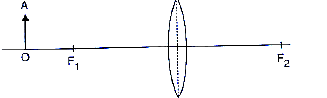
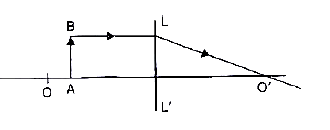
Question 203 Marks
The diagram given below shows the position of an object $OA$ in relation to a converging lens whose foci are at $F_1$​​​​​​​ and $F_2​​​​​​​$​​​​​​​.


draw two rays to locate the position of the image.
View full question & answer
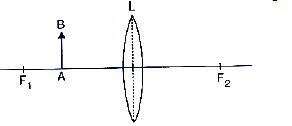
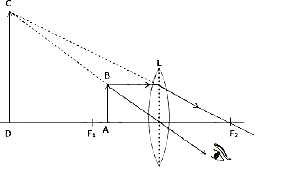
Question 213 Marks
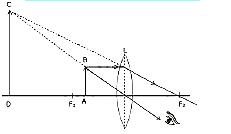
The following diagram shows an object $A B$ and a converging lens $L$ with foci $F_1$ and $F_2$.
Draw two rays from the object and complete the diagram to locate the position of the image. Mark the image $C D$. Clearly mark on the diagram the position of the eye from where the image can be viewed.

Answer
The complete diagram is

View full question & answer
Question 243 Marks
Distinguish between a real and a virtual image.
Answer
Real imageVirtual image
1. A real image is formed due to actual intersection of refracted (or reflected) rays1. A virtual image is formed when the refracted (or reflected) rays meet if they are produced backwards
2. 2 A real image can be obtained on a screen2. 2. A virtual image cannot be obtained on a screen
3. 3. A real image is inverted with respect to the object.3. 3. A virtual image is erect with respect to the object
View full question & answer
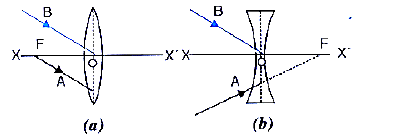
Question 253 Marks
In the diagram below, XX’ represents the principal axis, O the optical centre and F the focus of the lens. Complete the path of rays A and B as they emerge out of the lens.

View full question & answer
Question 263 Marks

Complete the following table:

Type of lensPosition of objectNature of imageSize of image
ConvexBetween optic centre and focus
ConvexAt focus
ConcaveAt infinity
ConcaveAt any distance
Answer
Type of lensPosition of objectNature of imageSize of image
ConvexBetween optic centre and focusVirtual and uprightMagnified
ConvexAt focusReal and invertedVery much magnified
ConcaveAt infinityVirtual and uprightHighly diminished
ConcaveAt any distanceVirtual and uprightDiminished
View full question & answer
Question 273 Marks
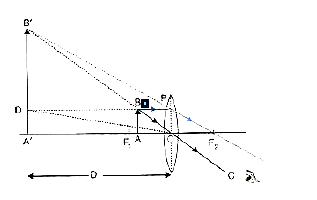
Draw a ray diagram to show how a converging lens is used as a magnifying glass to observe a small object. Mark on your diagram the foci of the lens and the position of the eye.
Answer


The object is placed between focal point F1 and convex lens and its image is formed at the same side of the lens which is enlarged.
So this lens can be used as a magnifying lens.
View full question & answer
Question 283 Marks
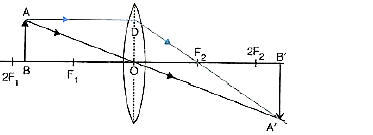
Draw a ray diagram to show how a converging lens can form a real and enlarged image of an object.
Answer


The image formed in above diagram is real, enlarged and inverted.
View full question & answer
Question 293 Marks
Show by a ray diagram that a diverging lens cannot form a real image of an object placed anywhere on its principal axis.
View full question & answer
Question 303 Marks
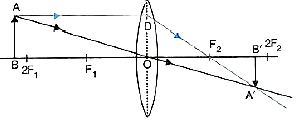
Classify as real or virtual, the image of a candle flame formed on a screen by a convex lens. Draw a ray diagram to illustrate how the image is formed.
Answer

Let the candle is placed beyond 2F1 and its diminished image which is real and inverted is formed between F2 and 2F2.


Here the candle is AB and its real and inverted image is formed between F2 and 2F2.

View full question & answer
Question 313 Marks
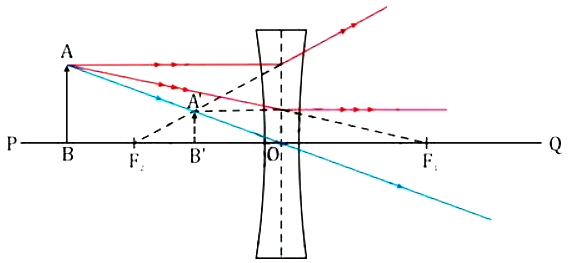
A lens always forms an image between the object and the lens.
Answer
Ray diagram

View full question & answer
Question 323 Marks
A lens forms an erect, magnified and virtual image of an object.Draw a ray diagram to show the formation of image.
View full question & answer
Question 333 Marks
A convex lens forms an image of an object equal to the size of the object.draw a diagram to illustrate it.
View full question & answer
Question 343 Marks
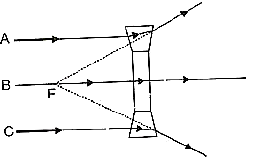
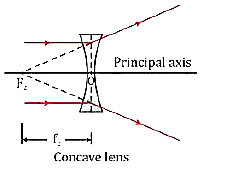
Show by a diagram, the refraction of two light rays incident parallel to the principal axis on a concave lens by treating it as a combination of a glass block and two triangular glass prisms.
Answer

As shown in the figure the concave lens has two glass prisms and one glass block. One of the glass prisms is situated above the glass block and one below the block.
View full question & answer
Question 353 Marks
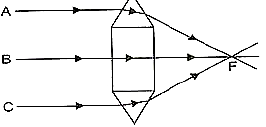
Show by a diagram the refraction of two light rays incident parallel to the principal axis on a convex lens by treating it as a combination of a glass block and two triangular glass prisms.
Answer


As shown in the figure the convex lens has two glass prisms and one glass block. One of the glass prisms is situated above the glass block and one below the block.


View full question & answer
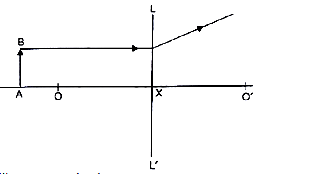
Question 363 Marks
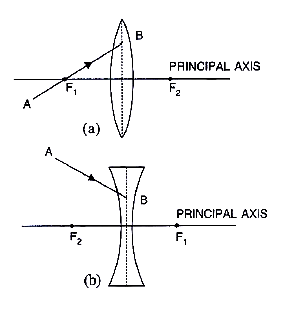
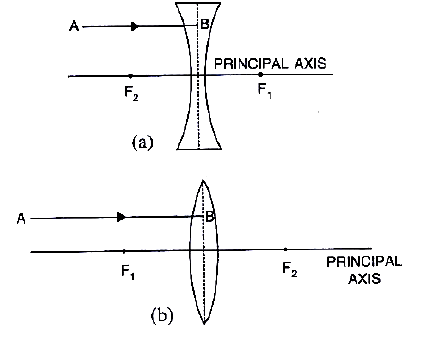
In following figure, F1 and F2 are the two foci of the thin lenses shown in diagram (a) and (b) and AB is the incident ray. Compete the diagram to show the path of the ray AB after refraction through the lens in each diagram (a) and (b).

View full question & answer
Question 373 Marks
In following figure ,, F1 and F2 are the positions of the two foci of the thin lenses shown in diagram (a) and (b) draw accurately the path taken by the light ray AB after it emerges from the lens in each diagram (a) and (b).

View full question & answer
Question 383 Marks
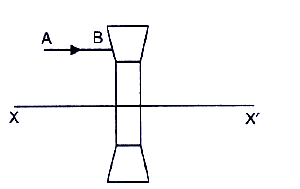
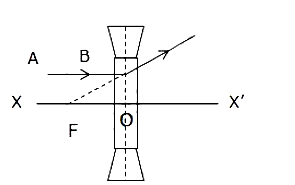
The diagram alongside shows a lens as a combination of a glass block and two prisms.
(i) Name the lens formed by the combination.
(ii) what is the line XX’ called?
(iii) Complete the path of the incident ray AB after passing through the lens.
(iv) The final emergent ray either meets XX’ at a point or appears to come from a point on XX’ Label it as F. what is this point called?

Answer

(i) The combination forms concave lens.(ii) XX' is known as principal axis.
(iii) Complete diagram is drawn as

(iv) The point F is called as Focal point or focus.

View full question & answer
Question 393 Marks
A parallel oblique beam of light falls on a (i) convex lens, (ii) concave lens. Draw a diagram in each case to show the refraction of light through the lens.
View full question & answer
Question 403 Marks
A beam of light incident on a thin concave lens parallel to its principal axis diverges and appears to come from a point on the principal axis. Name the point. Draw a ray diagram to show it.
Answer
It appears to come from 'Second Focus'.

View full question & answer
Question 413 Marks
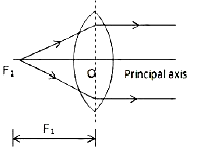
A ray of light after refraction through a convex lens emerges parallel to principal axis. (a) Draw a ray diagram to show it. (b) The incident ray passes through a point on the principal axis. Name the point
Answer

(b) The point where incident ray passes through a point on the principal axis is called first focus.
View full question & answer
Question 423 Marks
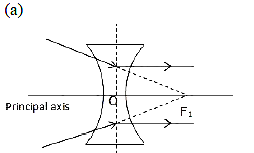
A ray of light, after refraction through a concave lens emerges parallel to the principal axis. (a) draw a ray diagram to show the incident ray and its corresponding emergent ray. (b) The incident ray when produces meets the principal axis at a point. Name the point.
Answer


(b) The point where incident ray when produced meets the principal axis is called first focus.
View full question & answer
Question 433 Marks
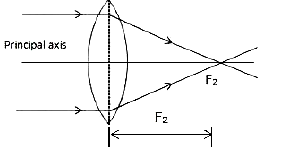
Draw a diagram to represent the second focus of a convex lens.
Answer


Convex lens representing second focus
View full question & answer
Question 443 Marks
A ray of light incident at a point on the principal axis of a convex lens passes undeviated through the lens.
(a) What special name is given to this point on the principal axis?
(b) Draw a labelled diagram to support your answer in part (a)
Answer
(a) This point is known as Optical centre.
View full question & answer
[3 Mark Question Answer] - Physics STD 10 Questions - Vidyadip