Questions · Page 1 of 2

MCQ

🎯

Test yourself on this topic

50 questions · timed · auto-graded

MCQ 11 Mark
The maximum magnifying power of a convex lens of focal length 5 cm can be : ________ .
  • A
    25
  • B
    10
  • C
    1
  • 6
Answer
Correct option: D.
6
Focal length of convex lens, $f=+5 cm$
Magnifying power of convex lens (simple microscope) is
$m=1+\frac{D}{f}$
$D$ is the distance of distinct vision, $D =25 cm$
$
m=1+\frac{25}{5}=6
$
View full question & answer
MCQ 21 Mark
A magnifying glass forms : ________ .
  • A
    A real and diminished image
  • B
    A real and magnified image
  • A virtual and magnified image
  • D
    A virtual and diminished image
Answer
Correct option: C.
A virtual and magnified image
Hint: A magnifying glass forms a virtual, magnified and upright image on the same side as the object.
View full question & answer
MCQ 31 Mark
The power of a lens is + 1.0 D is : ________ .
  • A
    convex of focal length 1.0 cm
  • convex of focal length 1.0 m
  • C
    concave of focal length 1.0 cm
  • D
    concave of focal length 1.0 m
Answer
Correct option: B.
convex of focal length 1.0 m
Power of a lens is $+1.0 D$. The positive sign indicates that the focal length of the lens is positive which indicates the lens is a convex lens.
Power is $P=\frac{1}{f(\text { in } m)}$
$+1.0 D =\frac{1}{ f (\text { in } m )}$
$
\therefore f =1.0 m
$
Hence, the correct answer is convex of focal length $1.0 m$.
View full question & answer
MCQ 41 Mark
On reducing the focal length of a lens, its power : ________ .
  • A
    Decreases
  • Increases
  • C
    Does not change
  • D
    First increases then decreases
Answer
Correct option: B.
Increases
Increases
Hint: Power (in Diopter) $=\frac{1}{\text { Focal length (in m) }}$
View full question & answer
MCQ 51 Mark
The correct lens formula is : ________ .
  • A
    $\frac{1}{ u }+\frac{1}{ v }=\frac{1}{ f }$
  • B
    $\frac{1}{ u }-\frac{1}{ v }=\frac{1}{ f }$
  • $\frac{1}{ v }-\frac{1}{ u }=\frac{1}{ f }$
  • D
    $f=\frac{u+v}{u v}$
Answer
Correct option: C.
$\frac{1}{ v }-\frac{1}{ u }=\frac{1}{ f }$
View full question & answer
MCQ 61 Mark
If the magnification produced by a lens is - 0.5, the correct statement is : ________ .
  • A
    The lens is concave
  • B
    The image is virtual
  • C
    The image is magnified
  • The images is real and diminished formed by a convex
Answer
Correct option: D.
The images is real and diminished formed by a convex
Magnification is -0.5. The negative sign of magnification indicates that the image is real while 0.5 indicates that the image is diminished. A convex lens only forms a real and diminished image of an object.
Hence, the correct answer is real and diminished formed by a convex.
View full question & answer
MCQ 71 Mark
A concave lens forms the image of an object which is : ________ .
  • A
    Virtual, inverted and diminished
  • Virtual, upright and diminished
  • C
    Virtual, inverted and enlarged
  • D
    Virtual, upright and enlarged
Answer
Correct option: B.
Virtual, upright and diminished
Hint: Concave lens forms virtual, upright and diminished image for all positions of the object.
View full question & answer
MCQ 81 Mark
For the object placed between optical centre and focus of a convex lens, the image is : ________ .
  • A
    Real and enlarged
  • B
    Real and diminished
  • Virtual and enlarged
  • D
    Virtual and diminished
Answer
Correct option: C.
Virtual and enlarged
Virtual and enlarged.
Explanation: When the object is kept between optical centre and focus of a convex lens, the image is formed on the same side, behind the object. The image thus formed is virtual, enlarged and erect.
View full question & answer
MCQ 91 Mark
For an object placed at distance 20 cm in front of a convex lens, the image is at distance 20 cm behind the lens. The focal length of convex lens is : ________ .
  • A
    20 cm
  • 10 cm
  • C
    15 cm
  • D
    40 cm
Answer
Correct option: B.
10 cm
The focal length of the convex lens is 10 cm.
Hint: As the object distance = image distance, the object must be kept at 2f.
Therefore, 2f = 20 cm or f = 10 cm.
View full question & answer
MCQ 101 Mark
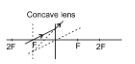
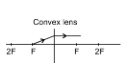
A ray of light incident on a lens parallel to its principal axis, after refraction passes through or appears to come from : ________ .
  • A
    Its first focus
  • B
    Its optical entre
  • Its second focus
  • D
    The centre of curvature of its second surface
Answer
Correct option: C.
Its second focus
its second focus
View full question & answer
MCQ 111 Mark
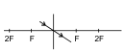
A ray of light after refraction through a lens emerges parallel to the principal axis of the lens. The incident ray either passes through : ________ .
  • A
    its optical centre
  • its first focus
  • C
    its second focus
  • D
    its centre of curvature of the first surface
Answer
Correct option: B.
its first focus
its First focus
View full question & answer
MCQ 121 Mark
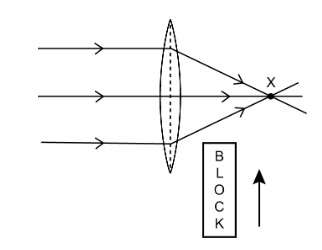
A block of glass is pushed into the path of the light as shown below. Then the converging point $X$ will:
Image
  • Move away from the slab
  • B
    Move towards the slab
  • C
    Not shift
  • D
    Move towards the left side of the lens
Answer
Correct option: A.
Move away from the slab
(a)
Move away from the slab
Explanation :
The point of convergence or focus will shift away from the glass slab as the light on passing through glass will bend towards the normal and after coming out in air, light will converge out at a point away from the glass slab in the direction the light
View full question & answer
MCQ 131 Mark
Linear magnification( $m$ ) produced by a concave lens is:
  • $m<1$
  • B
    $m>1$
  • C
    $m=1$
  • D
    $m=2$
Answer
Correct option: A.
$m<1$
(a)
$m<1$
Explanation:
Because image formed by a concave lens is smaller than the object.
View full question & answer
MCQ 141 Mark
What are the correct differences between a convex and a concave lens?
  • A
    Convex lens is thin in the middle, and concave lens is thick in the middle.
  • Convex lens converges the incident rays towards the principal axis, whereas concave lens diverges them.
  • C
    Convex lens has a virtual focus, and concave lens has a real focus.
  • D
    Convex lens converges the incident rays towards the principal axis, whereas concave lens diverges them.
Answer
Correct option: B.
Convex lens converges the incident rays towards the principal axis, whereas concave lens diverges them.
(b)
Convex lens converges the incident rays towards the principal axis, whereas concave lens diverges them.
Explanation :
The intensity of refracted light is always less than that of incident light due to some light being reflected.
View full question & answer
MCQ 151 Mark
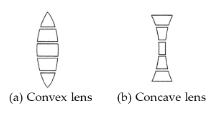
Regarding the orientation of the prism bases in the upper parts of lenses:
  • Downward for convex, upward for concave.
  • B
    Upward for convex, downward for concave.
  • C
    Upward for both convex and concave.
  • D
    Downward for both convex and concave.
Answer
Correct option: A.
Downward for convex, upward for concave.
(a)
Downward for convex, upward for concave.
Explanation:
The base of the prism in a convex lens is oriented downward, and upward in a concave lens, affecting the direction of light refraction.
Image
View full question & answer
MCQ 161 Mark
Which statement is incorrect?
  • A
    Both convexo-concave and concavo-convex lenses have one surface concave and the other surface convex.
  • A convexo-concave lens is thicker in the middle and has a converging action.
  • C
    A concavo-convex lens is thicker in the middle and has a converging action.
  • D
    A convexo-concave lens is thinner in the middle and has a diverging action.
Answer
Correct option: B.
A convexo-concave lens is thicker in the middle and has a converging action.
(b)
A convexo-concave lens is thicker in the middle and has a converging action.
Explanation:
Contrary to the statement, a convexo-concave lens is thinner in the middle and diverges light.
View full question & answer
MCQ 171 Mark
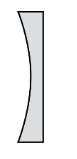
The structure of a plano-concave lens includes:
  • A
    One surface convex and the other surface plane.
  • B
    One surface concave and the other surface convex.
  • One surface plane and the other surface concave.
  • D
    None of the above
Answer
Correct option: C.
One surface plane and the other surface concave.
(c)
One surface plane and the other surface concave.
Explanation:
A plano-concave lens features one flat (plane) surface and another concave surface, differing from the initial incorrect assertion.
Image
View full question & answer
MCQ 181 Mark
Identify the type of lens depicted in the figure:
Image
  • A
    Convex lens
  • B
    Biconvex lens
  • C
    Concave lens
  • Concavo-convex
Answer
Correct option: D.
Concavo-convex
(d)
Concavo-convex
Explanation:
The concavo-convex lens is characterized by one convex surface and one concave surface, making it thicker at the center than at the periphery.
View full question & answer
MCQ 191 Mark
For a convex lens, the minimum distance between an object and its real image in terms of focal length $(f)$ of a given lens must be:
  • A
    1.5 f
  • B
    2.5 f
  • C
    $2 f$
  • $4 f$
Answer
Correct option: D.
$4 f$
(d)
$4 f$
Explanation:
$2 f$ on either side of the lens.
View full question & answer
MCQ 201 Mark
A concave lens produces only ________ image.
  • A
    real, enlarged
  • B
    virtual, enlarged
  • virtual, diminished
  • D
    real, diminished
Answer
Correct option: C.
virtual, diminished
(c)
virtual, diminished
Explanation:
Characterisitc of the Image Formed:
(a) Image is virtual
(b) Image is erect
(c) Image is diminished.
View full question & answer
MCQ 211 Mark
What type of image does a magnifying glass make?
  • A
    Real image
  • Virtual image
  • C
    inverted image
  • D
    Fake image
Answer
Correct option: B.
Virtual image
(b)
Virtual image
Explanation :
A magnifying glass is a convex lens which produces a magnified (larger) image of an object. A magnifying glass produces an upright, magnified virtual image.
View full question & answer
MCQ 221 Mark
What will be the magnification in case of a concave lens?
  • A
    Always negative
  • Always positive
  • C
    Sometimes positive and negative
  • D
    Cannot say
Answer
Correct option: B.
Always positive
(b)
Always positive
Explanation:
In case of a concave lens the image formed will be diminished. So magnification will definitely be less than 1 . The image formed will be on the same side of the object and erect. So magnification must be positive.
View full question & answer
MCQ 231 Mark
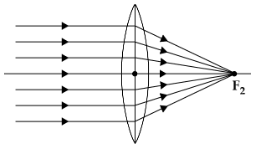
A ray of light incident on a lens parallel to its principal axis, after refraction, passes through or appears to come from.
  • A
    Optical centre
  • B
    First focus
  • C
    The centre of curvature of its second surface
  • Second focus
Answer
Correct option: D.
Second focus
(d)
Second focus
Explanation:
The parallel rays of light meet at a point on the principal axis after refraction by a convex lens or appear to come from a point on the principal axis after refraction by a concave lens. This point is known as the second focus of the lens.
Image
View full question & answer
MCQ 241 Mark
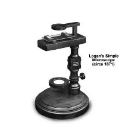
What type of lens is found in a simple microscope?
  • A
    Double concave lens
  • Double convex lens
  • C
    One concave and one convex lens
  • D
    None of the above
Answer
Correct option: B.
Double convex lens
(b)
Double convex lens
Explanation :
A simple microscope is a magnifying glass that has a double convex lens with a short focal length.
Image
View full question & answer
MCQ 251 Mark
A convex lens of power 5 D and a concave lens of power 9.5 D are placed in contact with each other. What will be the power of the combination of the lens?
  • A
    -3.5 D
  • B
    14.5 D
  • -4.5 D
  • D
    5 D
Answer
Correct option: C.
-4.5 D
(c)
- 4.5D
Explanation :
Power of convex lens $=5 D$
Power of concave lens $=-9.5 D$
The combined power is the algebraic sum of the individual powers of the lenses.
Therefore, the power of the combination
$
=5+(-9.5)=-4.5 D
$
View full question & answer
MCQ 271 Mark
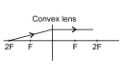
Where is the object placed in the device shown in the diagram to obtain a highly enlarged size of image?
Image
  • A
    Object placed between $F$ and $2 F$
  • B
    Object is placed beyond 2 F
  • C
    Object is placed at F
  • Object is between O and F
Answer
Correct option: D.
Object is between O and F
(d)
Object is between O and F
Explanation:
Since the lens used is a convex lens a highly magnified image is obtained when the object is placed between optical centre and the focus which is an erect image.
View full question & answer
MCQ 281 Mark
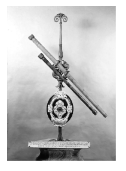
Which was the lens used in the original Galilean telescope?
Image
  • A
    Both convex
  • B
    Both concave
  • One convex and one concave
  • D
    None of the above
Answer
Correct option: C.
One convex and one concave
(c)
one convex and one concave
Explanation:
One was used as eyes piece and the other as objective.
View full question & answer
MCQ 291 Mark
Name the lens used by an ophthalmologist lens as shown in the figure.
Image
  • A
    Concave lens
  • Convex lens
  • C
    Concavo-convex lens
  • D
    None of the above
Answer
Correct option: B.
Convex lens
(b)
Convex lens
Explanation:
Enlarged image is obtained only in convex lens.
View full question & answer
MCQ 301 Mark
An eye specialist prescribes a number of +4.5 D to a person for his glasses. What is the focal length of lens in m ?
  • A
    10 m
  • B
    2 m
  • 0.22 m
  • D
    0.35 m
Answer
Correct option: C.
0.22 m
(c)
0.22 m
Explanation:
$P =+4.5 D$
$f=\frac{100}{ P }($ in cm $)$
$
=\frac{100}{4.5}=22 cm=0.22 m
$
View full question & answer
MCQ 311 Mark
A lens which forms a real image has a focal length of 8 cm . Find its power:
  • A
    -12.5 D
  • +12.5 D
  • C
    +2.5 D
  • D
    -2.5 D
Answer
Correct option: B.
+12.5 D
(b)
+12.5 D
Explanation:
$
f=8 cm
$
We know that convex lens producer real images, therefore, the power of the given lens would be positive.
$
\begin{array}{l}
P=\frac{100}{f}(incm) \\
=\frac{100}{8}=+12.5 D
\end{array}
$
View full question & answer
MCQ 321 Mark
A convex lens produces the image of the same size as the object when placed at a distance of 30 cm . Hence its focal length is:
  • A
    30 cm
  • B
    20 cm
  • C
    25 cm
  • 15 cm
Answer
Correct option: D.
15 cm
(d)
15 cm
Explanation :
As image is of the same size as the object when placed at a distance 30 cm , the image distance will be same as that of object, $i . e ., v=30 cm$
By lens formula,
$
\begin{array}{l}
\frac{1}{f}=\frac{1}{v}-\frac{1}{u} \\
\frac{1}{f}=\frac{1}{30}-\frac{1}{-30} \\
=\frac{2}{30}=\frac{1}{15}
\end{array}
$
$
f=15 cm
$
View full question & answer
MCQ 331 Mark
An object is placed at a distance of 24 cm from a convex lens of focal length 10 cm , when an image is obtained on the other side of the lens. Calculate the distance of the screen from the lens.
  • 17.14 cm
  • B
    16.5 cm
  • C
    25.6 cm
  • D
    30.8 cm
Answer
Correct option: A.
17.14 cm
(a)
17.14 cm
Explanation:
$
\begin{array}{l}
u=-24 cm \\
f=10 cm \\
v=? \\
\frac{1}{f}=\frac{1}{v} \quad u \\
\frac{1}{v}=\frac{1}{f}+\frac{1}{u} \\
=\frac{1}{10} \quad \frac{1}{24} \\
=\frac{12-5}{120}=\frac{7}{120} \\
v=\frac{120}{7}=17.14 \\
v=17.14 cm
\end{array}
$
View full question & answer
MCQ 341 Mark
An object is placed at a distance $X$ from a convex lens when a real image is formed at a distance of 15 cm from the lens. If focal length of lens is 10 cm , calculate the value of $X$ ?
  • A
    10 cm
  • 30 cm
  • C
    25 cm
  • D
    15 cm
Answer
Correct option: B.
30 cm
(b)
30 cm
Explanation:
Given, $v=+15 cm$
Focal length, $f=10 cm$
u=?
We know $\frac{1}{f}=\frac{1}{v}-\frac{1}{u}$
$\frac{1}{10}=\frac{1}{+15}-\frac{1}{u}$
$\frac{1}{n}=\frac{1}{+15}-\frac{1}{10}$
$=\frac{+2-3}{30}=-\frac{1}{30}$
u = - 30cm

View full question & answer
MCQ 351 Mark
An object is placed at a distance of more than 40 cm from a convex lens of focal length 20 cm . The image formed is real, inverted and ______________ .
  • diminished
  • B
    same as (or equal to)
  • C
    magnified
  • D
    none of the above
Answer
Correct option: A.
diminished
(a)
diminished
Explanation:
This is because the object is placed beyond twice the focal length ( 2 F$)$, leading to the formation of a real, inverted and diminished image.
View full question & answer
MCQ 361 Mark
Where should an object be placed in front of a convex lens so as to form an upright and enlarged image?
  • A
    at 2 F
  • B
    at focus
  • between optical centre and focus
  • D
    between F and 2F
Answer
Correct option: C.
between optical centre and focus
(c)
between optical centre and focus
Explanation:
When an object is placed between the focus $( F )$ and the optical centre of a convex lens, the lens forms a virtual, upright and magnified (enlarged) image.
View full question & answer
MCQ 371 Mark
In following case, where must an object be placed in front of a convex lens so that the image formed is at infinity:
  • A
    at 2 F
  • at focus
  • C
    between F and 2 F
  • D
    none of these
Answer
Correct option: B.
at focus
(b)
at focus
Explanation :
When an object is placed at the focal point of a convex lens, the image is formed at infinity.
View full question & answer
MCQ 381 Mark
A concave lens forms the image of an object which is ______________ .
  • A
    virtual, inverted and diminished
  • virtual, upright and diminished
  • C
    virtual, inverted and enlarged
  • D
    virtual, upright and enlarged
Answer
Correct option: B.
virtual, upright and diminished
(b)
virtual, upright and diminished
Explanation:
A concave lens, being a diverging lens, always forms images that are virtual, upright and diminished in size, regardless of the objects position relative to the lens.
View full question & answer
MCQ 391 Mark
What will be the nature of the image if a lens forms an inverted image of an object?
  • Real
  • B
    Virtual
  • C
    Both (a) and (b)
  • D
    None of these
Answer
Correct option: A.
Real
(a)
Real
View full question & answer
MCQ 401 Mark
A lens forms an upright and magnified image an object name the lens:
  • A
    concave
  • B
    bi-concave
  • convex
  • D
    plano-convex
Answer
Correct option: C.
convex
(c)
convex
Explanation:
This description is characteristic of a convex lens when the object is placed between the lens and its focal point. In this scenario, the lens produces a virtual, upright and magnified image.
View full question & answer
MCQ 411 Mark
If the rays from a point object after refraction through the lens do not actually meet at a point, but they appear to diverge from a point the image is ______________ .
  • A
    virtual
  • B
    real
  • C
    imaginary
  • both (a) and (c)
Answer
Correct option: D.
both (a) and (c)
(d)
both (a) and (c)
Explanation:
Virtual images are formed when the refracted rays diverge and appear to be coming from a point, but do not actually converge at that point.
View full question & answer
MCQ 421 Mark
State the correct condition when the lens has both its focal lengths equal:
  • A
    medium is different on either side of lens
  • medium is same on either side of lens
  • C
    when refractive index is one
  • D
    all of the above
Answer
Correct option: B.
medium is same on either side of lens
(b)
medium is same on either side of lens
Explanation:
Refractive index of both media are same
View full question & answer
MCQ 431 Mark
If the intensity of light entering the lens decreases the intensity of image formed by it __________ .
  • A
    increases
  • B
    remains same
  • decreases
  • D
    both (a) and (c)
Answer
Correct option: C.
decreases
(c)
decreases
Explanation:
The intensity of the image formed by a lens is directly related to the intensity of the light entering the lens.
View full question & answer
MCQ 441 Mark
Convex lens produces a __________ .
  • A
    virtual image
  • B
    real image
  • both (a) and (b)
  • D
    none of these
Answer
Correct option: C.
both (a) and (b)
(c)
both (a) and (b)
Explanation:
The type of image (virtual or real) depends on the position of the object relative to the lens.
View full question & answer
MCQ 451 Mark
The distance from the optical centre $O$ of the lens to its ___________  is called the first focal length, of the lens.
  • First focal point
  • B
    2nd focal point
  • C
    2nd local point
  • D
    First local point
Answer
Correct option: A.
First focal point
(a)
First focal point
Explanation:
The distance between optical centre $O$ and first focal point is called the first focal length of the lens.
View full question & answer
MCQ 461 Mark
A point on the principal axis of a lens such that a ray of light passing through this point emerges parallel to its direction of incidence is called as __________ .
  • A
    Optical centre
  • B
    Centre of curvature
  • C
    Radius of curvature
  • Focus
Answer
Correct option: D.
Focus
(d)
Focus
View full question & answer
MCQ 471 Mark
A concavo-convex lens is _________ in the middle and has _________ action on light beam.
  • A
    thinner, diverging
  • B
    thicker, diverging
  • thicker, converging
  • D
    thinner, converging
Answer
Correct option: C.
thicker, converging
(c)
thicker, converging
View full question & answer
MCQ 481 Mark
Which lens is thicker in the middle and thinner at its periphery?
  • convex
  • B
    bi-concave
  • C
    concave
  • D
    plano-concave.
Answer
Correct option: A.
convex
(a)
convex
Explanation:
Image
View full question & answer
MCQ 491 Mark
A concave lens may be of the following types:
  • A
    bi-concave or double-concave
  • B
    plano concave
  • C
    convexo-concave
  • all of the above
Answer
Correct option: D.
all of the above
(d)
all of the above
View full question & answer
MCQ 501 Mark
Concave lens is also known as __________ .
  • A
    converging lens
  • diverging lens
  • C
    dual lens
  • D
    none of the above
Answer
Correct option: B.
diverging lens
(b)
diverging lens
Explanation:
A beam of light diverges on passing through a concave lens; hence, it is also called a diverging lens.
View full question & answer
MCQ - Physics STD 10 Questions - Vidyadip