Questions

[1 Mark Question Answer]

🎯

Test yourself on this topic

42 questions · timed · auto-graded

Question 11 Mark
How are the distance of object (u), the distance of image (v), and focal length (f) of a lens-related?
Answer
The distance of object (u), the distance of image (u) and focal length if) of a lens are related as
$\frac{1}{ v }-\frac{1}{ u }=\frac{1}{ f }$
View full question & answer
Question 21 Mark
How is the magnification (m) produced by a lens related to the object distance (u) and the image distance (v)?
Answer
The magnification produced by a lens = v/u
View full question & answer
Question 31 Mark
A convex lens produces on a screen an image twice the size of the object. If the position of image and object be interchanged, what will be the magnification then?
Answer
On interchanging the position of image and object, the magnification will be 1/2.
View full question & answer
Question 51 Mark
Name the lens for which magnification can be 1. For what position of the object will the magnification be 1?
Answer
The lens for which magnification can be 1 is a convex lens. For this, the object must be at 2F (i.e.r at distance twice the focal length, in front of the lens).
View full question & answer
Question 61 Mark
What information we seek by the linear magnification of the image when it is positive or negative?
Answer
If magnification is positive, then the image will be real and inverted, and if negative then the image will be virtual and erect.
View full question & answer
Question 71 Mark
Will the image formed by a magnifying glass be real or virtual?
Answer
The image formed by a magnifying glass will be virtual.
View full question & answer
Question 81 Mark
Why is the focal length of the lens, used as a magnifying glass, kept short?
Answer
The focal length of the lens used as a magnifying glass is kept small to increase its magnifying power.
View full question & answer
Question 91 Mark
Name the lens used as a magnifying glass.
Answer
Convex (or converging) lens is used as a magnifying glass.
View full question & answer
Question 101 Mark
A converging lens is used to obtain an image of an object placed in front of it. The inverted image is formed between $F _2$ and $2 F_2$ of the lens. Where is the object placed?
Answer
Object is beyond $2F_1.$
View full question & answer
Question 121 Mark
State the nature and position of the object on the principal axis to obtain. A virtual and diminished image.
Answer
Lens is concave; the object may be at any place on the principal axis between the lens and infinity.
View full question & answer
Question 131 Mark
State three characteristics of the image of an extended source, formed by a concave lens.
Answer
Virtual, upright, and diminished.
View full question & answer
Question 141 Mark
A lens forms an erect, magnified and virtual image of an object. name the type of lens.
Answer
Convex lens
View full question & answer
Question 151 Mark
We can burn a piece of paper by focussing the sun rays by using a particular type of lens. Name the type of lens used for the above purpose.
Answer
Convex lens.
View full question & answer
Question 161 Mark
State the nature and position of the object on the principal axis to obtain a real image of the same size
Answer
Lens is convex; object to be placed at 2F.
View full question & answer
Question 171 Mark
State the nature and position of the object on the principal axis to obtain a virtual and magnified image.
Answer
Lens is convex; object to be placed between F and the lens.
View full question & answer
Question 181 Mark
State the nature and position of the object on the principal axis to obtain a real and magnified image.
Answer
Lens is convex; the position of the object is between F and 2F.
View full question & answer
Question 191 Mark
State the position of object, position of image, nature of image when: Convex lens is used in observing biological specimens.
Answer
Object is between $F_1$ and $O$. Image is formed on the same side of lefts. Image is virtual; erect and magnified.
View full question & answer
Question 201 Mark
State the position of object, position of image, nature of image when: Convex lens is used as in searchlight.
Answer
Object is at $F_1$​​​​​​​. Image is formed at infinity. Image is real; inverted and highly enlarged.
View full question & answer
Question 211 Mark
State the position of object, position of image, nature of image when: Convex lens is used in cine projector.
Answer
Object is between $F_1$ and $2 F_1$. Image is between $2 F_2$ and infinity. Image is real; inverted and enlarged.
View full question & answer
Question 221 Mark
What happens to the image formed by a convex lens if its lower part is blackened?
Answer
Every part of a lens forms a or complete image. If the lower part of the lens is blackened the complete image will be formed but its intensity will decrease.
View full question & answer
Question 231 Mark
State the position of object, position of image, nature of image when: Convex lens is used as an erecting lens in terrestrial telescope.
Answer
Object is at $2 F_1$. Image is formed at $2 F_2$. Image is the real; inverted and same size as object.
View full question & answer
Question 241 Mark
State the position of object, position of image, nature of image when: Convex lens is used as objective lens of photographic camera.
Answer
Object is in between infinity and $2 F_1$. Image is formed between $F_2$ and $2 F_1$. Image is real; inverted and diminished.
View full question & answer
Question 251 Mark
Name the subjective property of light related to its wavelength.
Answer
The subjective property of light related to its wavelength is colour.
View full question & answer
Question 261 Mark
What is lens?
Answer
A lens is a portion of the transparent refracting medium having at least one of its two surfaces spherical. One of the surfaces may also be a plane.
View full question & answer
Question 271 Mark
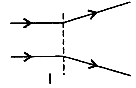
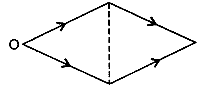
From the nature of the refracted rays, shown in the diagram interpret the nature of the lens represented by the dotted line.
Answer
Since the rays, starting from the object point ‘O’, are being made to converge to another point ‘I’, the lens used must be a convex lens.
View full question & answer
Question 281 Mark
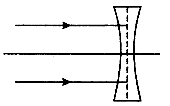
From the nature of the refracted rays, shown in the diagram interpret the nature of the lens represented by the dotted line.
Answer
Since the incident parallel rays are diverging after refraction, the lens represented by the dotted line must be a concave lens.
View full question & answer
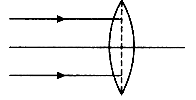
Question 291 Mark
We can burn a piece of paper by focussing the sun rays by using a particular type of lens. Name the type of lens used for the above purpose. Draw a ray diagram to support your answer.
View full question & answer
Question 301 Mark
An object is placed in front of a convex lens such that the image formed has the same size as that of the object. Draw a ray diagram to illustrate this.
View full question & answer
Question 311 Mark
A stick partly immersed in water appears to be bent. Draw a ray diagram to show the bending of the stick when placed in water and viewed obliquely from above.
View full question & answer
Question 321 Mark
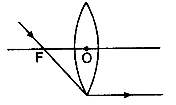
What is the path of the ray, after refraction, that passes through the first focus of the lens?
Answer
The ray becomes parallel to the principal axis after refraction through the lens. This is shown in the figure shown alongside.
View full question & answer
Question 331 Mark
Draw a ray diagram to illustrate the determination of the focal length of a convex lens using an auxiliary plane mirror.
View full question & answer
Question 341 Mark
A candle is placed between f and 2f a convex lens. Draw a ray diagram showing the position of the image.
View full question & answer
Question 351 Mark
An object is placed in front of a lens between its optical centre and the focus and forms a virtual, erect, and diminished image. Draw a ray diagram to show the formation of the image with the above-stated characteristics.
View full question & answer
Question 361 Mark
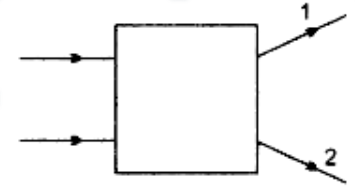
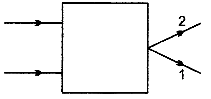
Figure shows the transmitted rays through lens kept in a box. Draw the lens and complete the path of ray
Image
View full question & answer
Question 371 Mark
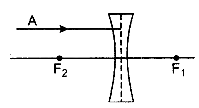
In figure give below of thin concave lens, $F_1$ and $F_2$​​​​​​​ are its foci, complete the path of the given ray of light after it emerges out of the lens.

View full question & answer
Question 381 Mark
Figure show the incident rays through the lens kept in a box. Draw the lens and complete the path of rays.
View full question & answer
Question 421 Mark
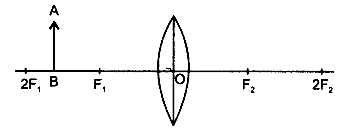
 An object $A B$ is placed between $2 F_1$ and $F_1$ on the principal axis of a convex lens as shown in the diagram. Copy the diagram and using three rays starting from point A , obtain the image of the object formed by the lens.
View full question & answer
[1 Mark Question Answer] - Physics STD 10 Questions - Vidyadip