What will be the behaviour of a lens, if it is placed in water instead of air?
Answer
Focal length depends upon the refractive index of the material of the lens with respect to the medium surrounding it. Since the surrounding medium changes from air to water, the refractive index decreases and so the focal length of the lens increases.
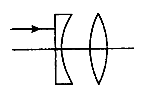
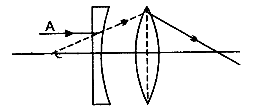
Out of the two lenses one concave and the other convex state which is a convergent or a divergent type of a lens. Give a reason for your answer.
Answer
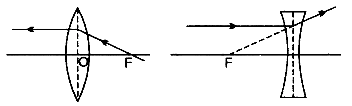
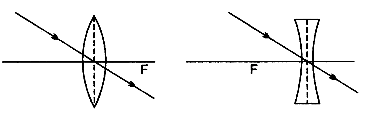
The convex lens is a convergent type of a lens since it converges the light rays to a point while the concave lens is a divergent type of lens since it spreads the light rays.
The two applications of a concave lens are:- (i) A person suffering from short-sightedness or myopia wears spectacles having a concave lens. (ii) A concave lens is used as an eye lens in a Galilean telescope to obtain an erect final image of the object.
The two applications of a convex lens are:- (i) It is used as an objective lens in a telescope, camera, slide projector, etc. (ii) With its short focal length, it is also used as a magnifying glass.
Magnifying glass is a convex lens of short focal length. It is mounted in a lens holder for practical use. It is used to see and read the small letters and figures. It is used by watch makers to see the small parts and screws of the watch.
Define magnification produced by a lens. State its unit.
Answer
The magnification produced by a lens is defined as the ratio of the size of the image to the size of the object, i.e., Magnification $(m)=\frac{\text { Size of the image }}{\text { Size of the object }}$ It has no unit.
Can a normal convex lens behave like a concave lens and vice-versa?
Answer
Yes, If a lens is kept in a medium whose refractive index is more than that of the material of the lens, the normal convex lens starts behaving like a concave lens and vice-versa.
The power of a lens (P) is the ability of the lens to converge or diverge an incident beam falling on it. It is expressed as the reciprocal of focal length (f). The power of a lens (P) is given by $P=\frac{1}{f(\text { in metre })}$
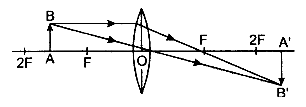
Where should an object be placed in front of a convex lens so as to form an inverted and enlarged image? Will the image be real or virtual? Draw a ray diagram to illustrate your answer.
Answer
To form an inverted and enlarged image by a convex lens, the object should be placed between F and 2F in front of the lens.
The image will be real.
The ray diagram is shown in the figure. For the object AB, the images are A’B’.
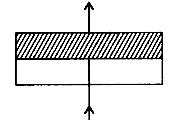
Show with the help of a ray diagram, the path of the ray when incident normally on the first surface of the glass block, through the block and the liquid.
Answer
We are assuming that the glass block is bounded by parallel plane refracting surfaces.
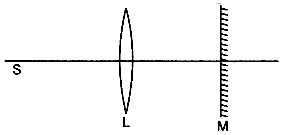
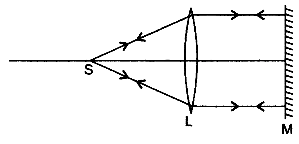
In the figure given below L is a convex lens, M is a plane mirror and S is a point source of light. Rays of light from the source S return to their point of origin. Complete the ray diagram to show this. What is the point S called?
Answer
The complete ray diagram is shown below: The point S is called the focus of the lens.
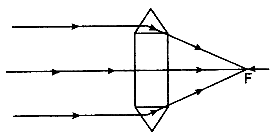
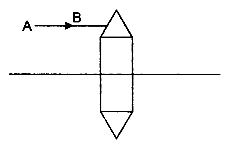
Draw a diagram to show the convergent action of a convex lens by treating it as a combination of glass block and two triangular glass prisms, with the aid of two parallel incident rays.
The diagram showed a lens as a combination of one glass block and two prisms. Complete the ray diagram and show the part of the incident ray AB after passing through the lens.
(i) Name of the lens formed by the combination.
(ii) What is the line XX’ called?
(iii) Mark the focus F.
Answer
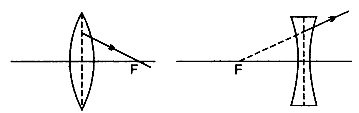
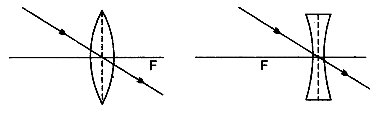
A ray of light parallel to the principal axis, after refraction by the lens, either passes through its principal focus or appear to pass through its principal focus.
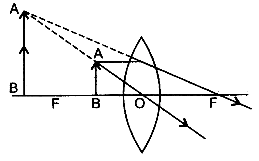
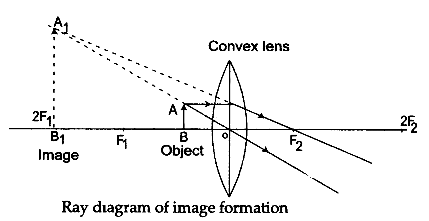
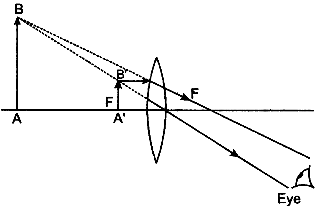
An erect, magnified, and a virtual image is formed when an object is placed between the optical centre and principal focus of a lens.
(i) Name the lens.
(ii) Draw a ray diagram to show the formation of the image with the above-stated characteristics.
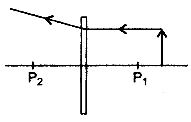
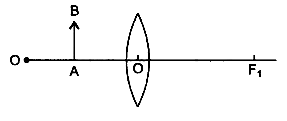
Diagram shows an object $AB$ placed on the principal axis $B$ of a convex lens placed in air. $F_1$ and $F_2$ are the two foci of the lens.
(i) Copy the diagram:
Draw a ray of light starting from $B$ and passing through $O$. Show the same ray after refraction by the lens. Draw another ray from $B$ which passes through $F_2$ after refraction by the lens. Locate the final image
(ii) Is the image real or virtual?