Questions

[3 Mark Question Answer]

🎯

Test yourself on this topic

22 questions · timed · auto-graded

Question 13 Marks
A woman draws water from a well using a fixed pulley. The mass of the bucket and water together is $60 \ kg$ . The force applied by the woman is $70 \ N$ . Calculate the mechanical advantage. [Take $g =10 m / s ^2$ ].
Answer
M.A. $=\frac{\text { Load }}{\text { Effort }}$
$=\frac{6 \times 10}{70}$
$=\frac{60}{70}$
$=\frac{6}{7}$
View full question & answer
Question 23 Marks
In a single movable pulley system, a load of 125 kgf is lifted by an effort of 75 kgf. Find the percentage efficiency of system.
Answer
V.R. of single movable pulley = No. of supporting segments of string = 2
M.A. of single movable pulley =
$\frac{ L }{ E }=\frac{125}{75}=\frac{5}{3}$
$\%$ efficiency $=\frac{\text { M.A. }}{\text { V.R. }} \times 100$
$=\frac{5 \times 100}{3 \times 2}=83 \%$.
View full question & answer
Question 33 Marks
A crowbar of length 100 cm is used to lift a load of 5 kgf. It has its fulcrum at a distance of 20 cm from the load. Calculate:
(i) the mechanical advantage of a crowbar and,
(ii) the effort applied at the other end.
Answer
Given: L = 5 kgf, Load arm = 20 cm, Effort arm = 100 – 20 = 80 cm.
(Since the crowbar is the lever of first order with the fulcrum in between the load and the effort).
(i) Mechanical advantage =
$\frac{\text { Effort arm }}{\text { Load arm }}=\frac{80}{20}=4$
(ii) M.A. $=\frac{\operatorname{Load}( L )}{\operatorname{Effort}( E )}$
$\therefore$ Effort $=\frac{\operatorname{Load}( L )}{\text { M.A. }}=\frac{5}{4}$
= 1.25 kgf.
View full question & answer
Question 43 Marks
The length of a nut-cracker is 12 cm. A nut, when kept at a distance of 4 cm from its fulcrum, requires an effort of 100 gf to crack it. What force will be required to crack the nut without using the nut-cracker?
Answer
Given : Effort arm = 12 cm, Load arm = 4 cm, Effort E = 100 gf, Load L = ?
(Nut-cracker is the lever of second order)
Since, $\frac{\text { Load }}{\text { Effort }}=\frac{\text { Effort arm }}{\text { Load arm }}$
$\therefore \frac{L}{100}=\frac{12}{4}$
or L = 300 gf.
Thus, a force of 300 gf is required to crack the nut without using the nut-cracker.
View full question & answer
Question 53 Marks
Define Velocity Ratio
Answer
The ratio of the velocity of effort to the velocity of the load is called the velocity ratio of the machine.
It is also defined as the ratio of the displacement of effort to the displacement of the load.
Velocity Ratio (V.R.) $=\frac{ d _{ E }}{ d _{ L }}$
View full question & answer
Question 63 Marks
State two reasons, why the efficiency of a pulley system is not 100 percent?
Answer
The two reasons are:
(i) Some effort is used (or wasted) in overcoming the friction between the string and the grooves of the pulleys.
(ii) Some effort is used up (wasted) in lifting up the movable block along with the load.
On account of the above two reasons, effort applied is always more than the load lifted up and so the M.A. is always less than 1. Hence efficiency is always less than 100%.
View full question & answer
Question 73 Marks
State the class of levers and the relative positions of load (L) effort (E) and fulcrum (F) in sugar tongs.
Answer
Sugar tongs are a lever of the third-order as the effort is in the middle, load at one end, and fulcrum at the other end.
Image
View full question & answer
Question 83 Marks
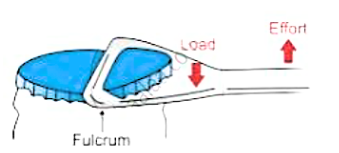
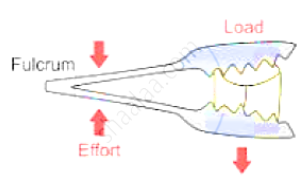
State the class of levers and the relative positions of load (L) effort (E) and fulcrum (F) in a bottle opener?
Answer
A bottle opener is a lever of the second order, as the load is in the middle, fulcrum at one end, and effort at the other.
Image
View full question & answer
Question 93 Marks
State the principle of machine.
Answer
According to the principle of machine work done by a machine or output work can never be greater than the work done on the machine or input work. In an ideal machine, “the output work of a machine is equal to input work”, is known as the principle of a machine.
View full question & answer
Question 103 Marks
Give three examples for leavers of the third order.
Answer
Levers of third order:
(i) Cutting bread with a knife.
(ii) A boy writing on a piece of paper
(iii) Forceps
(iv) A fishing rod.
View full question & answer
Question 113 Marks
State the principle of a lever ?
Answer
Principle: A lever works on the principle of moments. For an ideal lever, it is assumed that the lever is weightless and frictionless. In the equilibrium position of the lever, by the principle of moments,
Moment of load about the fulcrum=Moment of the effort about the fulcrum.
Load × Load arm = Effort × Effort arm.
View full question & answer
Question 123 Marks
A pulley system has a velocity ratio of 4 and an efficiency of 90%. Calculate:
(i) the mechanical advantage of the system.
(ii) the effort required to raise a load of 300 N by the system.
Answer
VR = 4, η = 90%
(i) MA = VR × η%
$=\frac{4 \times 90}{100}=3.6$
(ii) $MA =\frac{\text { Load }}{\text { Effort }}$
$\therefore$ Effort $=\frac{\text { Load }}{\text { MA }}$
$=\frac{300}{3.6}$
= 83.33 N
View full question & answer
Question 133 Marks
A simple machine enables us to lift a load of 10,000 N by the application of an effort of 500 N. However, when the point of application of the effort moves through 2.5 m, the load gets raised through 10 cm only. What are the values of the:
(i) M.A.
(ii) V.R. and
(iii) Efficiency of the machine?
Answer
(i) M.A. $=\frac{\text { Load }}{\text { Effort }}=\frac{10,000 N }{500 N }=20$
(ii) V.R. $=\frac{\text { Distance moved by the effort }}{\text { Distance moved by the load }}$
$=\frac{2.5 m }{(10 / 100) m }=25$.
(iii) Efficiency =
$\frac{\text { M.A. }}{\text { V.R. }}=\frac{20}{25}=\frac{4}{5}=\frac{4}{5} \times 100 \%=80 \%$.
View full question & answer
Question 143 Marks
How does a machine work?
Answer
A machine does some useful work when energy is supplied to it.
Energy supplied to machine (or input) = Effort × Displacement of the point of application of effort.
Work obtained from a machine (or output) = Load × Displacement of the point of application of load.
For an ideal machine, Work output = Work input.
View full question & answer
Question 153 Marks
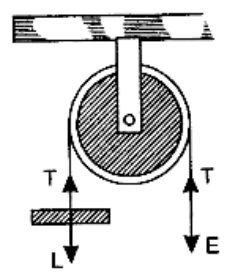
What is a pulley?
Answer
Image
A pulley is an example of a simple type of machine. It is either a wooden or a metallic disc which can rotate about a horizontal axis passing through its centre. It has a grooved rim along which a rope or chain can slide. It is generally mounted in a framework called a block.
View full question & answer
Question 163 Marks
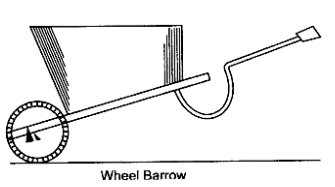
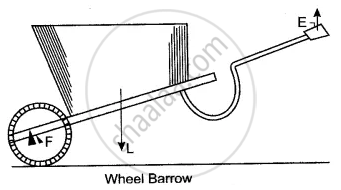
In the following diagram of a wheelbarrow, mark the fulcrum (F) and indicate the directions of load (L) and effort (E) with arrows.
Image
What class of lever is it? Give one more example of the same class of lever.
Answer
In the diagram given below F shows the position of fulcrum and arrows marked at L and E indicate the direction of load and effort respectively.
It belongs to the second class of lever.

A nutcracker is one more example of the same class of lever.
View full question & answer
Question 173 Marks
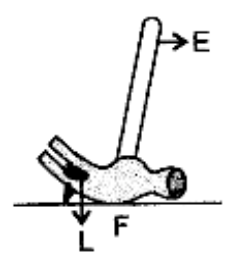
In the diagram shown alongside a claw hammer, mark the fulcrum (F) and indicate the directions of load (L) and effort (E) with arrows. What class of lever is it? Give one more example of this class of lever.
Image
Answer
Claw-hammer is the lever of the first order. One more example of this class of lever is a see-saw. In the following diagram, F indicates the position of the fulcrum. The arrows labelled L and E respectively indicate the directions of load and effort.
View full question & answer
Question 183 Marks
A crowbar of length 120 cm has its fulcrum situated at a distance of 20 cm from the load. Calculate the mechanical advantage of the crowbar.
Answer
Total length of crowbar = 120 cm
Load arm = 20 cm
Effort arm = 120 − 20 = 100 cm
Mechanical advantage M.A =
$\frac{\text { Effort arm }}{\text { Logd arm }}$
$M \cdot A=\frac{100}{20}=5$
View full question & answer
Question 193 Marks
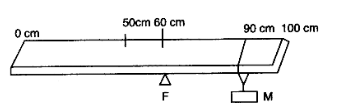
A uniform metre scale is kept in equilibrium when supported at the $60 \ cm$ mark and a mass M is suspended from the $90 \ cm$ mark as shown in the figure. State with reasons, whether the weight of the scale is greater than, less than or equal to the weight of mass M.
Image
Answer
Let M be load.
$\therefore$ Load arm $=90-60=30 cm$
Since wt. of scale will act at centre of gravity of scale which is the midpoint of the scale.
$\therefore$ Effort arm $=60-50=10 cm$
Let wt. of scale be W
By principal of moments $L \times d_L=E \times d_E$
$M \times 30=W \times 10$
$W=3 M$
$\therefore$ Since the weight of scale is three times that of M.
$\therefore$ The weight of the scale is greater than the weight of $M$.
View full question & answer
Question 203 Marks
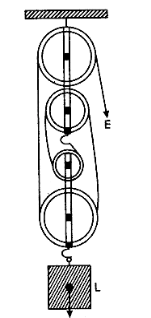
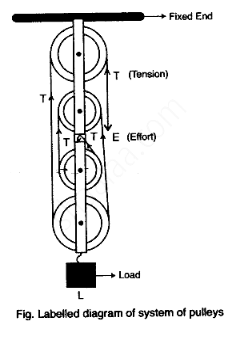
Diagram given below shows an arrangement of four pulleys. A load L is attached to the movable lower block and effort E is applied at the free end of the string.
Copy the diagram; and
Image
(i) Draw arrows to indicate tension in each part of the string; and
(ii) Calculate the mechanical advantage of the system.
Answer
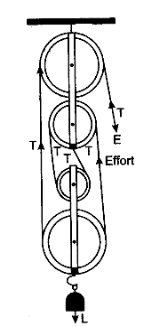
The following diagram shows a block and tackle system of 4 pulleys.
(i) The tension in each string is shown by the arrow marked as T.
(ii) If we neglect the friction of the pulleys and weight of the pulleys in the lower block, then
L = 4T and E = T
Image
$\therefore$ Mechanical advantage $=\frac{ L }{ E }$
$=\frac{4 T }{ T }$
= 4
View full question & answer
Question 213 Marks
A block and tackle system of pulleys has a velocity ratio of 4.
(i) Draw a labelled diagram of the system indicating clearly the points of application and directions of load and effort.
(ii) What is the value of the mechanical advantage of the given pulley system if it is an ideal pulley system?
Answer
(i)
Image
(ii) M.A. = 4 for an ideal pully system.
View full question & answer
Question 223 Marks
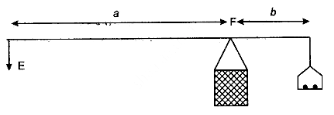
(i) Calculate the mechanical advantage of the lever shown in the figure.
(ii) How do you define the mechanical advantage of a machine?
Image
Answer
(i) Clockwise moment = b × L; and Anti-clockwise moment = a × E
∴ Clockwise moment = Anti-clockwise moment
∴ b × L = a × E
or $\frac{ L }{ E }=\frac{ a }{ b }$
(ii) Mechanical advantage is the ratio of the load lifted to the effort applied.
M.A. $=\frac{ L }{ E }=\frac{ a }{ b }$
View full question & answer
[3 Mark Question Answer] - Physics STD 10 Questions - Vidyadip