Questions

[2 Mark Question Answer]

🎯

Test yourself on this topic

44 questions · timed · auto-graded

Question 12 Marks
Two sounds A and B are of same amplitude, same wave forms but of frequencies f and 2f respectively. Then:

  • B differs in quality from A

  • B is grave, A is shrill

  • B is shrill, A is grave

  • B is louder than A

Answer
B is shrill, A is grave

Explanation: Shrillness or pitch of a sound is directly proportional to the frequency of the sound wave. Greater the frequency, shriller will be the note.
View full question & answer
Question 22 Marks
Two sounds of same loudness and same pitch produced by two different instruments differ in their:

  • Amplitudes

  • Frequencies

  • Waveforms

  • All of the above.

Answer
Waveforms

Explanation: The waveform of a sound depends on the number of the subsidiary notes and their relative amplitude along with the principal note. The resultant vibration obtained by the superposition of all these vibrations gives the waveform of sound.

View full question & answer
Question 32 Marks
How is loudness of sound related to the intensity of wave producing it?
Answer
Relationship between loudness L and intensity I is given as: L = K log I, where K is a constant of proportionality.
View full question & answer
Question 52 Marks
State one difference between a musical note and a noise.
Answer
Musical note is pleasant, smooth and agreeable to the ear while noise is harsh, discordant and displeasing to the ear. In musical note, waveform is regular while in noise waveform is irregular.
View full question & answer
Question 62 Marks
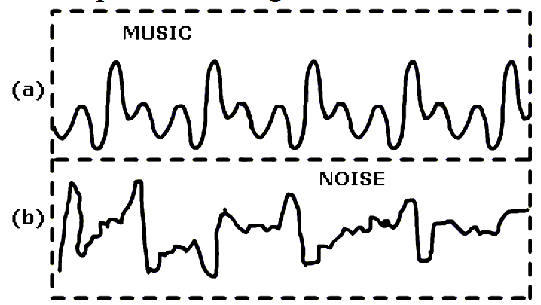
In what respect does the wave pattern of a noise and a music differ? Draw diagram to explain your answer.
Answer
Wave pattern is regular in music while it is quite irregular in noise.

View full question & answer
Question 72 Marks
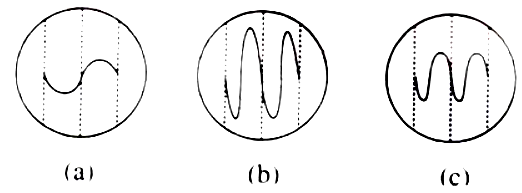
A microphone is connected to the Y-input of a C.R.O Three different sounds are made in turn in front of the microphone. Their traces (a), (b) and (c) produces on the screen are shown in following figure .


(i) which trace is due to the loudest sound? Give reason for your answer.
(ii) Which trace is due for the sound with the lowest pitch? Explain your answer.
Answer
(i) b, since amplitude is largest
(ii) a, since frequency is lowest
View full question & answer
Question 82 Marks
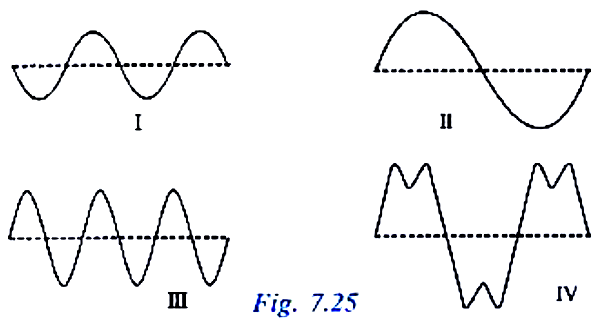
The sketches I to IV in following Figure show sound waves, all formed in the same time interval.


Which diagram shows
(i) a note from a musical instrument
(ii) a soft (not loud) note,
(iii) a bass (low frequency) note.
Answer
(i) IV
(ii) I
(iii) II
View full question & answer
Question 92 Marks
(a) Which of the following quality determines the loudness of a sound wave?
(i) wavelength (ii) frequency and (iii) amplitude
(b) How is loudness related to the quantity mentioned above in part(a)?
Answer
(a) Amplitude - The louder sound corresponds to the wave of large amplitude.
(b) Loudness is directly proportional to the square of amplitude.
View full question & answer
Question 102 Marks
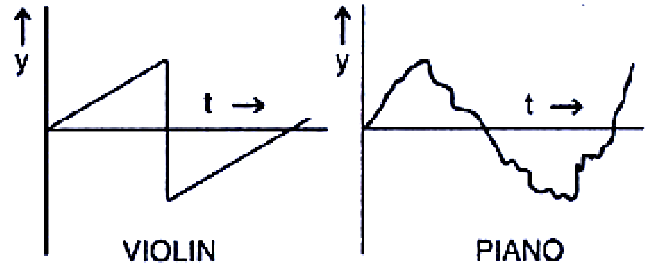
Two musical notes of the same pitch and same loudness are played on two different instruments. Their wave patterns are as shown in following Figure.


Explain why the wave patterns are different.
Answer
Different instruments emit different subsidiary notes. A note played on one instrument has a large number of subsidiary notes while the same note when played on other instrument contains only few subsidiary notes. So they have different waveforms.
View full question & answer
Question 112 Marks
How is it possible to detect the filling of a bottle under a water tap by hearing the sound at a distance?
Answer
As the water level in a bottle kept under a water tap rises, the length of air column decreases, so the frequency of sound produced increases i.e., sound becomes shriller and shriller. Thus by hearing sound from a distance, one can get the idea of water level in the bottle.
View full question & answer
Question 122 Marks
Name and define the characteristic which enables one to distinguish two sounds of same loudness, but of different frequencies, given by the same instrument.
Answer
Pitch is the characteristic of sound which enables us to distinguish different frequencies sound. Pitch is the characteristic of sound by which an acute note can be distinguished from a grave or flat note.
View full question & answer
Question 132 Marks
What determines the pitch of a sound?
Answer
Pitch of sound is determined by its wavelength or the frequency. Two notes of the same amplitude and sounded on the same instrument will differ in pitch when their vibrations are of different wavelengths or frequencies.
View full question & answer
Question 142 Marks
What is meant by noise pollution?
Answer
The disturbance produced in the environment due to undesirable loud and harsh sound of level above 120 dB from the various sources such as loudspeaker, moving vehicles etc. is called noise pollution.
View full question & answer
Question 152 Marks
A tuning fork of frequency 256 Hz will resonate with another tuning fork of frequency:

  • 128 Hz

  • 256 Hz

  • 384 Hz

  • 512 Hz

Answer
A tuning fork of frequency 256 Hz will resonate with another tuning fork of frequency 256 Hz.

Hint: Resonance occurs when the frequency of an externally applied periodic force on the body is equal to its natural frequency.

View full question & answer
Question 162 Marks
A wire stretched between two fixed supports, is plucked exactly in the middle and then released. It executes (neglect the resistance of the medium):

  • Resonant vibrations

  • natural vibrations

  • Damped vibrations

  • Forced vibrations

Answer
It executes natural vibrations.

Hint: The periodic vibrations of a body of constant amplitude in the absence of any external force on it are called free vibrations.

View full question & answer
Question 172 Marks
How does the frequency of sound given by a stretched string depend on its (a) length, (b) tension?
Answer
(a) The frequency of sound is inversely proportional to the length of the string.
f $\alpha \frac{1}{\iota}$
(b) The frequency of sound is directly proportional to the square root of the tension in the string.
f $\alpha \sqrt{ T }$

View full question & answer
Question 182 Marks
State one condition for a body to execute free vibrations.
Answer
The free vibrations of a body occur only in vacuum because the presence of medium offer some resistance due to which the amplitude of the vibration does not remain constant, but it continuously decreases.
View full question & answer
Question 192 Marks
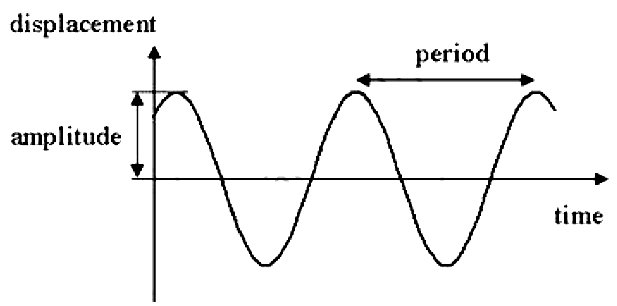
Draw a graph between displacement from mean position and time for a body executing free vibrations in vacuum.
Answer


Displacement-time graph for the free vibrations
View full question & answer
Question 202 Marks
A vibrating tuning fork held over an air column of a given length with its one end closed, produces a loud audible sound. Name the phenomenon responsible for it and explain the observation.
Answer
The phenomenon responsible for producing a loud audible sound is named resonance. The vibrating tuning fork causes the forced vibrations in the air column. For a certain length of air column, a loud sound is heard. This happens when the frequency of the air column becomes equal to the frequency of the tuning fork.
View full question & answer
Question 212 Marks
State the condition for the occurrence of resonance.
Answer
Condition for resonance:
Resonance occurs when the frequency of the applied force is exactly equal to the natural frequency of the vibrating body.
View full question & answer
Question 222 Marks
What is meant by resonance?
Answer
Resonance is a special case of forced vibrations. When the frequency of an externally applied periodic force on a body is equal to its natural frequency, the body rapidly begins to vibrate with an increased amplitude. This phenomenon is known as resonance.
View full question & answer
Question 232 Marks
Distinguish between the free (or natural) and forced vibrations.
Answer
(i) The vibrations of a body in the absence of any resistive force are called the free vibrations. The vibrations of a body in the presence of an external force are called forced vibrations.
(ii) In free vibrations, the frequency of vibration depends on the shape and size of the body. In forced vibrations, the frequency is equal to the frequency of the force applied.
View full question & answer
Question 242 Marks
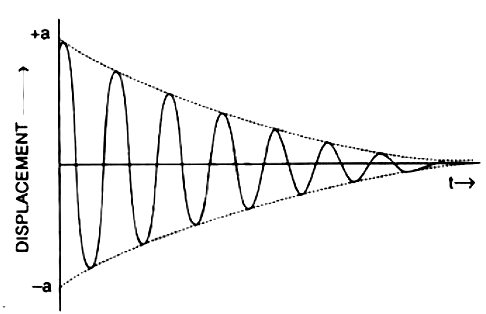
Draw a sketch showing the displacement of a body executing damped vibrations against time.
Answer


Displacement time graph of damped vibrations.
View full question & answer
Question 252 Marks
How does the medium affect the amplitude of free vibrations of a body?
Answer
The presence of the medium offers some resistance to motion, so the vibrating body continuously loses energy due to which the amplitude of the vibration continuously decreases.
View full question & answer
Question 262 Marks
Explain why strings of different thicknesses are provided on a stringed instrument.
[Hint : Natural frequency of vibration of a stretched string is inversely proportional to the radius (or thickness) of string so notes of different frequencies can be produces by vibrating different strings.]
Answer
Strings of different thickness are provided on a stringed instrument to produce different frequency sound waves because the natural frequency of vibration of a stretched string is inversely proportional to the radius (thickness) of the string.
View full question & answer
Question 272 Marks
A person standing between the two vertical cliffs produces a sound. Two successive echoes are heard at $4$ s and $6$ s. Calculate the distance between the cliffs.
(speed of sound in air $= 320 m s^{-1})$
Answer
The distance of first cliff from the person, $2 \times D1 =$ velocity x time
$D1 = 320 × 4 / 2 = 640 m$
Distance of the second cliff from the person, $D2 = 320 × 6 / 2 = 960 m$
Distance between cliffs $= D1 + D2 = 640 + 960 = 1600 m$
View full question & answer
Question 282 Marks
A ship on the surface of water sends a signal and receives it back froma a submarine inside water after $4 s$. Calculate the distance of the submarine from the ship. (The speed of sound in water is $1450 m s^{-1})$
Answer
$2 D =$ velocity × time
$D = (velocity \times time) / 2 = 1450 \times 4 / 2 = 2900 m = 2.9 km$
View full question & answer
Question 292 Marks
A man standing $48 \ m$ away from a wall fires a gun calculate the time after which an echo is heard. (The speed of sound in air is $320 m s ^{-1}).$
Answer
Velocity $= 2 \times$ D/Time
Time after which an echo is heard $= 2$ D/Velocity $= 2 \times 48 / 320 = 0.3$ seconds
View full question & answer
Question 302 Marks
A man standing $25 \ m$ away from a wall produces a sound and receives the reflected sound. (a) Calculate the time after which he receives the reflected sound if the speed of the sound in air is $350 m s ^{-1}$. (b) will the man be able to hear a distinct echo? Explain the answer.
Answer
(a) Velocity $=2 D /$ Time
$\text { Time }=\frac{2 \times 25}{350}=0.143 \text { seconds }$
(b) Yes, because the reflected sound reaches the man 0.1 seconds after the original sound is heard and the original sound persists only for 0.1 seconds.
View full question & answer
Question 312 Marks
What should be the minimum distance between source and reflector in water so that echo is heard distinctly?
(The speed of sound in water $= 1400 m s^{-1})$
Answer
Velocity = 2D/Time
$1400 = 2 \times D/ 0.1$
$D = 1400 \times 0.1/ 2 = 70 m$
View full question & answer
Question 322 Marks
Calculate the minimum distance in air required between the source of sound and the obstacle to hear an echo. Take speed of sound in air $= 350 m s^{-1}$​​​​​​​
Answer
Velocity = 2D/Time
$350 = 2 \times D/ 0.1$
$D = 350 \times 0.1 / 2 = 17.5 m$
View full question & answer
Question 332 Marks
The wavelength of waves produces on the surface of water is $20 \ cm$. If the wave velocity is $24 \ m s-1$, calculate: $(i)$ the number of waves produces in one second , and $(ii)$ the time in which one wave is produced.
Answer
(i)Frequency or the number of waves produced per second
= Velocity/Wavelength
$= 24 / 20 \times 10^{-2}$
$=120$
(ii)Time = 1/ frequency $= 1/ 120= 8.3 \times 10-3$ seconds
View full question & answer
Question 342 Marks
State two applications of echo.
Answer
The applications of echo:
(i) Dolphins detect their enemy and obstacles by emitting the ultrasonic waves and hearing their echo.
(ii) In medical science, the echo method of ultrasonic waves is used for imaging human organs such as the liver, gall bladder, etc. This is called ultrasonography.
View full question & answer
Question 352 Marks
A man is standing at a distance of 12 m from a cliff. Will he be able to hear a clear echo? Give a reason for your answer.
Answer
t = 2d/V = 2 × 12/340 = 24/340 < 0.1 seconds so the man will not be able to hear the echo. This is because the sensation of sound persists in our ears for about 0.1 second after the exciting stimulus ceases to act.
View full question & answer
Question 362 Marks
What is the condition necessary for an echo to be heard distinctly?
Answer
Echo is a reflected sound heard after the original sound strikes a rigid obstacle... The conditions are-
1- The reflecting surface should have a larger reflecting surface than the wavelength of the sound
2- The minimum distance to hear the echo should be $17 m$ in the air or as described by the formula $\frac{V t}{2} \ldots$
View full question & answer
Question 372 Marks
What is meant by an echo?
Answer
If a person stands at some distance from a wall or a hillside and produces a sharp sound, he hears two distinct sounds: one is original sound heard almost instantaneously and the other one is heard after reflection from the wall or hillside, which is called echo.
View full question & answer
Question 382 Marks
State two differences between the light and sound waves.
Answer
(i) The light waves can travel in vacuum while sound waves need a material medium for propagation.
(ii) The light waves are electromagnetic waves while sound waves are the mechanical waves.
View full question & answer
Question 392 Marks
State two factors on which the speed of a wave travelling in a medium depends.
Answer
Two factors on which the speed of a wave travelling in a medium depends are:
(i) Density: The speed of sound is inversely proportional to the square root of density of the gas.
(ii) Temperature: The speed of sound increases with the increase in temperature.
View full question & answer
Question 402 Marks
Define frequency term in relation to a wave.
Answer
Frequency: The number of vibrations made by a particle of the medium in one second is called the frequency of the waves.
It is also defined as the number of waves passing through a point in one second. Its S.I. unit is hertz (Hz).
View full question & answer
Question 412 Marks
State the use of echo in medical science.
Answer
In medical science, echo method of ultrasonic waves is used for the imaging of human organs such as liver, gall bladder, uterus, womb; which is called ultrasonography.
View full question & answer
Question 422 Marks
What is sonar? State the principle on which it is based.
Answer
Sonar is sound navigation and ranging. Ultrasonic waves are sent in all directions from the ship and they are received on their return after reflection from the obstacles. They use the method of echo.
View full question & answer
Question 432 Marks
Why are the waves mentioned by you not audible to us?
Answer
>

The range of audible sound waves is 20 Hz to 20,000 Hz, whereas ultrasonic waves have a frequency of more than 20,000 Hz. Hence, ultrasonic waves are not audible to humans.

View full question & answer
Question 442 Marks
Name the waves used for sound ranging. State one reason for their use.
Answer
Ultrasonic waves are used for sound ranging. Ultrasonic waves can travel undefeated through a long distance and so they are used for sound ranging.
View full question & answer
[2 Mark Question Answer] - Physics STD 10 Questions - Vidyadip