Questions

[2 Mark Question Answer]

🎯

Test yourself on this topic

32 questions · timed · auto-graded

Question 12 Marks
Give two examples of forced vibrations.
Answer
Examples of forced vibrations:
1. When the stem of a vibrating tuning fork is pressed against the top of a table, the tuning fork forces the table top to vibrate with its own frequency. The vibrations produced in the table top are forced vibrations.
2. When a guitar is played, the vibrations produced by the strings of the guitar are the forced vibrations.
View full question & answer
Question 22 Marks
What is meant by the natural frequency of vibration of a body?
Answer
A body clamped at one point, if disturbed slightly from its position of rest starts vibrating. The vibrations so produced are called natural vibrations of the body. The natural period or frequency of such vibrations is called frequency of vibration of a body. This frequency depends upon the shape and size of the body.
View full question & answer
Question 32 Marks
What do you mean by wave motion?
Answer
The propagation of wave through a medium due to the repeated oscillatory motion of the particles of the medium about their mean position, the motion being handed over from one particle of the medium to the next particle progressively is referred to as wave motion.
View full question & answer
Question 42 Marks
Explain why strings of different thicknesses are provided on a stringed instrument.
[Hint : Natural frequency of vibration of a stretched string is inversely proportional to the radius (or thickness) of string so notes of different frequencies can be produces by vibrating different strings.]
Answer
Strings of different thickness are provided on a stringed instrument to produce different frequency sound waves because the natural frequency of vibration of a stretched string is inversely proportional to the radius (thickness) of the string.
View full question & answer
Question 52 Marks
How does the medium affect the amplitude of free vibrations of a body?
Answer
The presence of the medium offers some resistance to motion, so the vibrating body continuously loses energy due to which the amplitude of the vibration continuously decreases.
View full question & answer
Question 62 Marks
When a troop crosses a suspension bridge the soldiers are asked to break steps. Explain the reason.
Answer
When a troop crosses a suspension bridge, the soldiers are asked to break steps. The reason is that when soldiers march in steps, all the separate periodic forces exerted by them are in same phase and therefore forced vibrations of a particular frequency are produced in the bridge. Now, if the natural frequency of the bridge happens to be equal to the frequency of the steps, the bridge will vibrate with large amplitude due to resonance and suspension bridge could crumble.
View full question & answer
Question 72 Marks
State any two ways of increasing the frequency of vibration of a stretched string.
Answer
Frequency of vibration of a stretched string can be increased by:
1. By increasing the tension in the string.
2. By decreasing the length of the string.
View full question & answer
Question 82 Marks
Differentiate between forced vibrations and resonance.
Answer
When an oscillatory system is made to oscillate under the action of an externally applied periodic force, it is said to execute forced vibrations. In this case the external frequency may or may not be equal to the natural frequency of the body.
In case of resonance, the externally applied periodic force has the same frequency as the natural frequency of oscillation of the given oscillatory system.
View full question & answer
Question 92 Marks
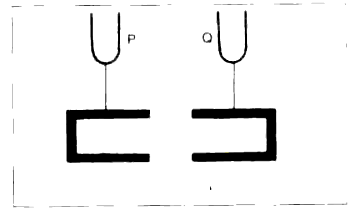
In fig. shows two tuning forks P and Q of the same frequency mounted on separate sound boxes with their open ends facing each other. The fork A is set into vibration. (i) Describe your observation. (ii) State the principle illustrated by this experiment.
Answer
(i) If the tuning fork A is set into vibration, the other fork B also starts vibrating and a loud sound is heard.
The vibrating tuning fork A produces the forced vibrations in the air column of its sound box. These vibrations are of large amplitude because of large surface area of the air in the sound box and they are communicated to the sound box of the fork B. The air column of B starts vibrating with the frequency of fork A. Since the frequency of these vibrations is same as the natural frequency of the fork B, the fork B starts vibrating due to resonance.
(ii) The principle of 'resonance' is illustrated by this experiment.
Statement: When the frequency of the forced vibration is equal to the natural frequency of a body nearby or an integer multiple of it then the body vibrates with a large amplitude. This phenomenon is called resonance.
View full question & answer
Question 102 Marks
What is sonar? State the principle on which it is based.
Answer
Sonar is sound navigation and ranging. Ultrasonic waves are sent in all directions from the ship and they are received on their return after reflection from the obstacles. They use the method of echo.
View full question & answer
Question 112 Marks
State the use of echo by a bat, dolphin and fisherman.
Answer
Bats, dolphins and fishermen use the principle of echo for locating obstacles and prey.
They produce and sent ultrasonic waves in all directions. When these waves are reflected back from the obstacles or prey, they hear the echo. From the time taken to hear the echo and from the nature of the sound received, bats, dolphins and fishermen are able to gauge the distance and type of surroundings.
View full question & answer
Question 122 Marks
How do bats avoid obstacles in their way, when in flight?
Answer
Bats make a series of twittering sound, so high pitched that human ear can not hear. These sound waves strike against the obstacles less in their path of flight and send back echoes to the bat’s ear. The echoes tell the bats, how they must turn in the air to avoid colliding with the obstacles or with one another.
View full question & answer
Question 132 Marks
Explain how the principle of echo is used by
The dolphin to locate small fish as its prey
Answer
Dolphins detect their enemies and small fishes by emitting ultrasonic waves in all directions and then hearing their reflected sound i.e. echo. Dolphins can judge the nature of obstacles or of small fish by hearing the echo and catch their prey.
View full question & answer
Question 142 Marks
Explain how the principle of echo is used by
The bat during its flight at
Answer
Bats can produce and detect the sound of very high frequency. The bats fly with speed much lower than the speed of sound. The sounds produced by flying bats get reflected from any obstacle in front of it. By hearing the echoes, bats come to know where the obstacles are, even in the dark. So, they can fly safely without colliding with the obstacles. This process of detecting obstacles is called sound ranging.
View full question & answer
Question 152 Marks
What are the conditions necessary for the formation of echo?
Answer
Conditions necessary for echo formation are:
1. The minimum distance between the source of sound and its reflector should be 17 m.
2. Reflected sound should reach the person atleast 0.1 second after the original sound is heard.
View full question & answer
Question 172 Marks
How is loudness of sound related to the intensity of wave producing it?
Answer
Loudness of a sound (L) and its intensity (I) are related as:
L = k log (I/Io),
Here, I/Io is the intensity level of the sound or the ratio between its intensity I and the threshold intensity Io, and k is the constant of proportionality depending upon the unit chosen.
View full question & answer
Question 192 Marks
What determines the pitch of a sound?
Answer
Pitch of sound is determined by its wavelength or the frequency. Two notes of the same amplitude and sounded on the same instrument will differ in pitch when their vibrations are of different wavelengths or frequencies.
View full question & answer
Question 202 Marks
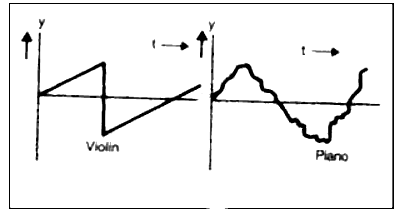
In fig. 2 two musical notes of the same pitch and same loudness are played on a violin and on a piano. Their wave forms are as shown in the diagram below. Explain why the wave patterns are different.
Answer
The number, and nature of harmonics and overtones present, affects the quality of sound. The different combinations of number and nature of harmonics and overtones present in the 'notes' gives these different wave patterns.
View full question & answer
Question 212 Marks
Why do the quantities of sound of the same pitch differ when produced by different instruments?
Answer
Quality of sound of the same pitch differs when produced by different instruments because of the difference in their waveforms. Different instrument emit different subsidiary notes due to the presence of mixture of subsidiary vibrations along with the principal vibration. The subsidiary vibrations present in the musical note make the wave form complex and thus we can easily distinguish between the sound so different instruments, though they may be of same pitch.
View full question & answer
Question 222 Marks
What distinguish is the sound from two musical instruments even if they are of the same pitch and same loudness?
Answer
Sound from two musical instruments of same pitch and same loudness can be distinguished by their different quality or timbre. The quality of a musical sound depends on the wave form and the wave form of an instrument depends on the presence of the subsidiary vibrations along with the principal vibrations and the relative amplitudes of the various subsidiary vibrations in relation to the principal vibration. 
View full question & answer
Question 232 Marks
What change do you expect in the characteristics of a musical sound if
(i) Its frequency is increased,
(ii) Its amplitude is increased?
Answer
(i) If frequency of a musical sound is increased, its pitch will increase.
(ii) If amplitude of a musical sound is increased, its loudness will also increase.
View full question & answer
Question 242 Marks
Define the terms velocity and wavelength applied to sound wave and state the relation between velocity, frequency and wavelength.
Answer
Wave- velocity: It is the velocity with which a wave propagates in a particular medium.
Wavelength: The wavelength is the distance between two successive crests or two successive troughs on a transverse wave.
It is also equal to the distance between any two points where the particles are passing through their respective mean positions in the same direction.
It is also the distance between two successive compressions or two successive rarefactions on a longitudinal wave.
Wave-velocity = wavelength x frequency
View full question & answer
Question 252 Marks
Explain how is the principle of echo used by
(a) The bat during its flight at night,
(b) The dolphin to locate small fish as its prey.
Answer
(a) Bats can produce and detect the sound of very high frequency. The bats fly with speed much lower than the speed of sound. The sounds produced by flying bats get reflected from any obstacle in front of it. By hearing the echoes, bats come to know where the obstacles are, even in the dark. So, they can fly safely without colliding with the obstacles. This process of detecting obstacles is called sound ranging.
(b) Dolphins detect their enemies and small fishes by emitting ultrasonic waves in all directions and then hearing their reflected sound i.e. echo. Dolphins can judge the nature of obstacles or of small fish by hearing the echo and catch their prey.
View full question & answer
Question 262 Marks
A girl claps and hears the echo after reflection from a cliff which is $660 \ m$ away. If the velocity of sound is $330 ms^{-1}$​​​​​​​, calculate the time taken for hearing the echo.
Answer
$\text { Velocity of sound }=\frac{\text { distance travelled }}{\text { time taken }}=\frac{2 \mathrm{~d}}{\mathrm{t}} $
$\mathrm{t}=\frac{2 \mathrm{~d}}{\mathrm{v}}=\frac{2 \times 660}{330}=4 \mathrm{~s} $
Thus, the girl hears the echo after $4 \mathrm{~s}$.
View full question & answer
Question 272 Marks
A boy fires a gun and hears the echo 2 seconds later. If he is 480 m away from a wall, calculate the velocity of sound in air.
Answer
$\begin{aligned} & \text { Velocity of sound }=\frac{\text { distance travelled }}{\text { time taken }}=\frac{2 d}{t} \\ & \therefore \text { Velocity of sound }=\frac{2 \times 480}{2}=480 \mathrm{~m} / \mathrm{s}\end{aligned}$
View full question & answer
Question 282 Marks
Give scientific reason for the following:
When a nail is hammering appears to get higher and higher in pitch.
Answer
When a nail is hammered into a piece of wood, its length outside wood gradually decreases. As the length decreases, the frequency of vibrations increases and hence the pitch being directly proportional to the frequency also increases
View full question & answer
Question 292 Marks
Give scientific reason for the following:
Windows sometimes rattle when the low notes of a pipe organ are sounded.
Answer
When the windows rattle, at that moment, its natural frequency corresponds with the frequency with which the low notes of a pipe organ are sounded. Thus, resonance takes place which makes the windows to vibrate violently.
View full question & answer
Question 302 Marks
Differentiate between the following:
Free and forced vibrations.
Answer
Free vibrations Farced vibrations
1. When a body vibrates with its natural frequency and ti me period which is characteristic of the body itself, it is said to have free vibrations. 1. When a body is set into vibrations with the help of a strong periodic force then the vibration is said to be forced vibration. The frequency of such vibrations may not be equal to the natural frequency of the body.
2. It is difficult to realize such vibrations in practice. They can take place only in vacuum. 2. Such vibrations can be realized in practice.
View full question & answer
Question 312 Marks
State the characteristics of a musical note on which its pitch, loudness and quality depend.
Answer
Pitch of a musical noted depends on its wavelength or frequency. Higher the frequency, higher the pitch.
Loudness depends upon the amplitude of the wave. Loudness is directly proportional to the square of amplitude.
Quality of a musical depends on the wave form.
View full question & answer
Question 322 Marks
What is the wavelength of sound waves produced in air by a vibrating tuning fork whose frequency is $256 \ Hz$ when the velocity of sound in air is $330 ms^{-1}?$
Answer
$ \text { Given velocity }=330 \mathrm{~m} / \mathrm{s} \text { frequency }=256 \mathrm{~Hz} $
$ \text { Wave }- \text { length }=\frac{\text { velocity }}{\text { frequency }}=\frac{330}{256}=1.3 \mathrm{~m}$
View full question & answer
[2 Mark Question Answer] - Physics STD 10 Questions - Vidyadip