Questions

[5 Mark Question Answer]

🎯

Test yourself on this topic

5 questions · timed · auto-graded

Question 15 Marks
What is the wavelength of the wave whose frequency is $10^{12} Hz?$ Name the electromagnetic wave.
Answer
Frequency of the wave $= 10^{12} Hz.$
Velocity of electromagnetic wave $= 3 \times 10^8 m/sec.$
$\therefore$ Wavelength of the wave $=\frac{ v }{ f }=\frac{3 \times 10^8}{10^{12}}$
$= 3 \times 10^{−4} m$
$= 3 \times 10^{−2} cm.$
These waves are heat waves or infra-red waves whose wavelength varies from $10^{−2} to 10^{−4} cm.$
View full question & answer
Question 25 Marks
Write three conditions necessary to obtain a pure spectrum on a screen. Name the instrument in which the conditions stated by you are fulfilled.
Answer
The three conditions necessary to obtain a pure spectrum on a screen are:
(i) A narrow parallel beam of light should be made incident on the prism.
(ii) The prism should be placed in the position of minimum deviation.
(iii) The emergent parallel beam should be focussed on the screen.
These conditions are fulfilled in the spectrometer.
View full question & answer
Question 35 Marks
How will you investigate the existence of the radiation beyond the red and violet extremes of the spectrum?
Answer
If a blackened bulb thermometer is moved from the violet end towards the red end, first a steady rise in temperature is observed, but as the thermometer goes beyond the red end, there is a rapid rise in temperature. This shows the existence of some kind of radiation producing the heating effect beyond the red end of the spectrum.
If the radiations from the red end to the violet end are made to fall on the silver chloride solution, it almost remains unaffected beyond the violet end of the spectrum.
View full question & answer
Question 45 Marks
A prism causes dispersion of white light while a rectangular glass block does not. Explain.
Answer
In a prism, the refraction of light takes place at the two slant surfaces. The dispersion of white light occurs at the first surface of the prism where its constituent colours have deviated through different angles. At the second surface, these split colours suffer the only refraction and they get further separated. But in a rectangular glass block, the refraction of light takes place at the two parallel surfaces. At the first surface, although the white light splits into its constituent colours on refraction, these split colours on suffering refraction at the second surface emerge out in form of a parallel beam, which gives an impression of white light.
View full question & answer
Question 55 Marks
Comment on the statement: ‘When any ray of white light is incident on a glass prism, it simply disperses it into its seven constituent colours.
Answer
Before making any comment, the following simple experiment should be performed.

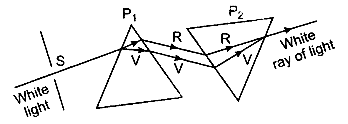
Arrangement is shown in the diagram. $P _1$ and $P _2$ are two glass prisms exactly similar and placed at some distance from each of the such that their refracting surfaces are parallel to each other and the base of the prism $P _2$ is upwards and vertex downwards. S is a narrow slit through which a ray of white light is incident on the refracting face of the prism $P _1$. It is dispersed by it into its seven constituent colours.
When this dispersed light falls on the refracting surface of the prism $P_2$, having its base upwards so that the rays have deviated in a direction different from the first, we see on the screen only a white spot of light. It is evident that the second prism $P _2$ recombines these colours to form white light acting as a 'recombination prism' while the first prism acts as a 'dispersing prism'.
View full question & answer
[5 Mark Question Answer] - Physics STD 10 Questions - Vidyadip