Questions

[3 Mark Question Answer]

🎯

Test yourself on this topic

9 questions · timed · auto-graded

Question 13 Marks
How would the sky appear when seen from the space (or moon)? Give reason for your answer.
Answer
On the moon, since there is no atmosphere, therefore there is no scattering of sun light incident on the moon surface. Hence to an observer on the surface of the moon (space), no light reaches the eye of the observer except the light directly from the sun. Thus the sky will have no colour and will appear black to an observer on the moon surface.
View full question & answer
Question 23 Marks
The danger signal is red. Why?
Answer
Since the wavelength of red light is the longest in the visible light, the light of red colour is scattered the least by the air molecules of the atmosphere and therefore the light of red colour can penetrate to a longer distance. Thus red light can be seen from the farthest distance as compared to other colours of same intensity. Hence it is used for danger signal so that the signal may be visible from the far distance.
View full question & answer
Question 33 Marks
What are ultraviolet radiations? How are they detected? State one use of these radiations.
Answer
The electromagnetic radiations of wavelength from 100Å to 4000Å are called the ultraviolet radiations.
Detection: If the different radiations from the red part of the spectrum to the violet end and beyond it, are made incident on the silver-chloride solution, it is observed that from the red to the violet end, the solution remains unaffected. However just beyond the violet end, it first turns violet and finally it becomes dark brown. Thus there exist certain radiations beyond the violet end of the spectrum, which are chemically more active than visible light, called ultraviolet radiations.
Use: Ultraviolet radiations are used for sterilizing purposes.
View full question & answer
Question 43 Marks
What are infrared radiations? How are they detected? State one use of these radiations.
Answer
Infrared radiations are the electromagnetic waves of wavelength in the range of 8000Å to 107Å.
Detection: If a thermometer with a blackened bulb is moved from the violet end towards the red end, it is observed that there is a slow rise in temperature, but when it is moved beyond the red region, a rapid rise in temperature is noticed. It means that the portion of spectrum beyond the red end has certain radiations which produce a strong heating effect, but they are not visible. These radiations are called the infrared radiations.
Use: The infrared radiations are used for therapeutic purposes by doctors.
View full question & answer
Question 53 Marks
The frequency range of visible light is from $3.75 \times 10^{14} Hz \rightarrow 7.5 x 10^{14} Hz$ Calculate its wavelength range. Take speed of light $=3 \times 10^8 m / s ^{-1}$
Answer

$\begin{aligned} & \text { Speed of light, } c =3 \times 10^8 m / s \\ & \text { Frequency range }=3.75 \times 10^{14} Hz \text { to } 7.5 \times 10^{14} Hz \text {. } \\ & \text { Speed of light }=\text { frequency } \times \text { wavelength } \\ & \text { For frequency }=3.75 \times 10^{14} Hz \end{aligned}$
$\Lambda=\frac{c}{v}=\frac{3 \times 10^8 m / s }{3.75 \times 10^{14} Hz }=8 \times 10^{-7} m =8000 Å$
For frequency $=7.5 \times 10^{14} Hz$
$
\Lambda=\frac{c}{v}=\frac{3 \times 10^8 m / s }{7.5 \times 10^{14} HZ }=4 \times 10^{-7} m =4000 Å
$
Wavelength range $=4000 Å$ to $8000 Å$

View full question & answer
Question 63 Marks
Calculate the frequency of yellow light of wavelength $550 nm$. The speed of light is $3 \times 10^8 m / s ^{-1}$
Answer
Given, wavelength $\lambda=550 nm =550 \times 10^{-9} m$
Speed of light, $c =3 \times 10^8 m / s$
We know that,
$
\text { Frequency }=\frac{\text { speed of light }}{\text { wave length }}
$
Or, frequency $=\frac{3 \times 10^8}{550 \times 10^{-} 9}=5.4 \times 10^{14} HZ$

View full question & answer
Question 73 Marks
Name three factors on which the deviation produces by a prism depends and state how does it depend on the factors stated by you.
Answer
The deviation produced by the prism depends on the following four factors:
(a) The angle of incidence - As the angle of incidence increases, first the angle of deviation decreases and reaches to a minimum value for a certain angle of incidence. By further increasing the angle of incidence, the angle of deviation is found to increase.
(b) The material of prism (i.e., on refractive index) - For a given angle of incidence, the prism with a higher refractive index produces a greater deviation than the prism which has a lower refractive index.
(c) Angle of prism- Angle of deviation increases with the increase in the angle of prism.
(d) The colour or wavelength of light used- Angle of deviation increases with the decrease in wavelength of light.
View full question & answer
Question 83 Marks

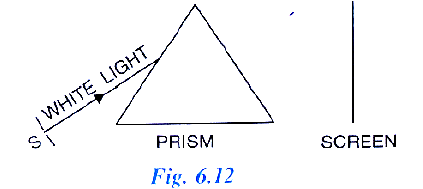
In following figure shows a thin beam of white light from a source S striking on one face of a prism.


Complete the diagram to show effect of prism on the beam and to show what is seen on the screen.

Answer
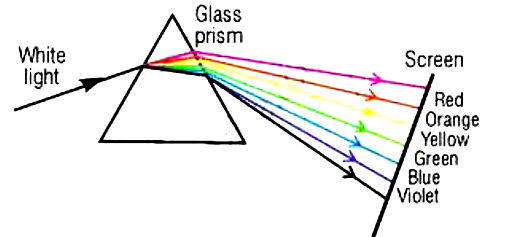
Constituent colours of white light are seen on the screen after dispersion through the prism.

View full question & answer
Question 93 Marks

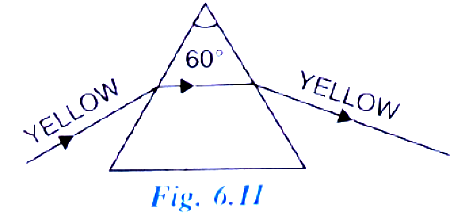
The following diagram shows the path taken by a narrow beam of yellow monochromatic light passing through an equiangular glass prism. Now the yellow light is replaced by a narrow beam of white light incident at the same angle. Draw another diagram to show the passage of white light through the prism and label it to show the effect of prism on the white light.

View full question & answer
[3 Mark Question Answer] - Physics STD 10 Questions - Vidyadip