Questions

[5 Mark Question Answer]

🎯

Test yourself on this topic

4 questions · timed · auto-graded

Question 15 Marks
The colour of sky, in direction other than of the sun, is blue. Explain.
Answer
As the light travels through the atmosphere, it gets scattered in different directions by the air molecules present in its path. The blue light due to its short wavelength is scattered more as compared to the red light of long wavelength. Thus the light reaching our eye directly from the sun is rich in red colour, while the light reaching our eye from all other directions is the scattered blue light. Therefore, the sky in a direction other than in the direction of the sun is seen blue.
View full question & answer
Question 25 Marks
The clouds are seen white. Explain
Answer
The clouds are nearer the earth surface and they contain dust particles and aggregates of water molecules of sizes bigger than the wavelength of visible light. Therefore, the dust particles and water molecules present in clouds scatter all colours of incident white light from sun to the same extent and hence when the scattered light reaches our eye, the clouds are seen white.
View full question & answer
Question 35 Marks
Why does the sun appear red at sunrises and sunset?
Answer
At the time of sunrise and sunset, the light from sun has to travel the longest distance of atmosphere to reach the observer. The light travelling from the sun loses blue light of short wavelength due to scattering, while the red light of long wavelength is scattered a little, so is not lost much. Thus blue light is almost absent in sunlight reaching the observer, while it is rich in red colour.
View full question & answer
Question 45 Marks
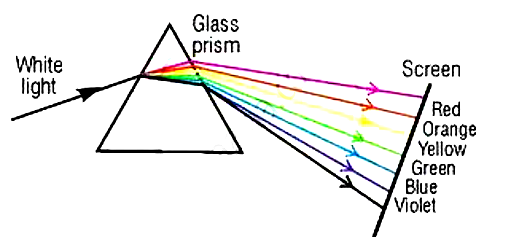
Explain briefly, with the help of a neat labelled diagram, how white light gets dispersed by a prism.
Answer
When white light is incident on the first surface of a prism and enters in glass, light of different colours due to different speeds in glass, is refracted or deviated through different angles. Thus the dispersion of white light into its constituent colours takes place at the first surface of prism.


On the second surface, only refraction takes place and different colours are deviated through different angles. As a result, the colours get further separated on refraction at the second surface (violet being deviated the most and red the least).
View full question & answer
[5 Mark Question Answer] - Physics STD 10 Questions - Vidyadip