Questions

[2 Mark Question Answer]

🎯

Test yourself on this topic

32 questions · timed · auto-graded

Question 12 Marks
State one important advantage and disadvantage each of using nuclear energy for producing electricity.
Answer
Advantage: A very small amount of nuclear fuel (such as uranium-235) can produce a tremendous amount of energy.

Disadvantage: The waste obtained from nuclear plants causes environmental
pollution.
View full question & answer
Question 22 Marks
What is mean by background radiation?
Answer
Background radiations are the radioactive radiations to which we all are exposed even in the absence of an actual visible radioactive source. It total does is not very large, so it oes not cause any serious biological damage to us.
View full question & answer
Question 32 Marks
Give any two important sources of background radiation.
Answer
Two sources of background radiations are:
(i) Potassium present in our body.
(ii) Cosmic rays coming from outer space.
View full question & answer
Question 42 Marks
Explain, why radium paint, consisting of zinc sulphide and a trace of radium salt, glows in the dark?
Answer
Radium is a radioactive substance. It gives out radioactive radiations which show fluorescence in zinc sulphide. Zinc sulphide is a fluorescent material, so it glows in dark.
View full question & answer
Question 52 Marks
Explain why alpha and beta particles are deflected in an electric or a magnetic field, but gamma rays are not deflected in such a field.
Answer
α and β are positive and negative charged particles respectively, therefore these are deflected in electric or magnetic field whereas γ radiations are not charged particles so does not deflect.
View full question & answer
Question 62 Marks
What are beta rays and gamma rays?
Answer
β-rays are a stream of electrons emitted by the nucleus of an atom and γ-rays are electromagnetic waves of high frequency given off by nuclei.
View full question & answer
Question 72 Marks
What do you mean by electron emission?
Answer
Free electrons leave the metal surface only if sufficient energy is supplied to the metal. This emission of electrons from metal surface is called the electron emission.
View full question & answer
Question 82 Marks
Two radioactive nuclei are represented by ${ }_x A^p$ and ${ }_y A^q$ and when $p$ and $q$ are mass numbers and $x , y$ are the atomic number. How can the products be represented, i .e., what are the new values of $p, q$. $x$ and $y$ after the emission of an $\alpha$-particle and a $\beta$-particle from $A$ and $B$ respectively.
Answer
(i)
${ }_a^p A \xrightarrow[ He _2{ }^\alpha]{\alpha-\text { paricles }}{ }_{a-2}^{p-4} A$
Its mass number decreases by 4 and atomic number decreases by 2.
(ii)
${ }_y^q B \xrightarrow{\text {-particles }}{ }_{y+1}^q B$
Its mass number remains the same but the atomic number increases by 1.
View full question & answer
Question 92 Marks
What are isobars? Give one example.
Answer
Isobars: the atoms of different elements which have the same mass number $A$, but differ in their atomic number $Z$ are called isobars.
Example:
$
{ }_{11}^{23} Na
$
\&
$
{ }_{12}^{23} Mg
$
View full question & answer
Question 102 Marks
The nucleus of an atom does not contain electrons. Explain how is it possible for the nucleus to emit a beta particle which is fast moving electron.
Answer
The nucleus emits a beta particle when a neutron inside it changes into a proton. The reaction is
$
\underset{\text { neutrons }}{1 n } \longrightarrow \underset{\text { proton }}{{ }_1^1 p }+\underset{\beta \text {-paricles }}{{ }_{-1}^0 e }+\underset{\text { anti-neutrino }}{ V }
$
View full question & answer
Question 112 Marks
The isotope of $_{92}U^{235}$ decays by alpha emission to an isotope of Thorium (Th). The Thorium isotope decays by beta emission to an isotope of Protactaminum (Pa). Write down the equations to represent these two nuclear changes.
Answer
$\begin{gathered}{ }_{92} U ^{238}-\underset{(\alpha \text {-particles })}{ }{ }_2 He ^4 \\ { }_{90} Th ^{234} \\ { }_{90} Th ^{234}-\underset{\substack{- \text {-paricles }}}{ } \longrightarrow{ }_{91} Pa ^{234}\end{gathered}$
View full question & answer
Question 122 Marks
Justify with reason, whether the following nuclear reactions are allowed or not.
$
{ }_{ Z }^{ A } X \longrightarrow{ }_{ Z -2}^{ A } X +{ }_2^4 He
$
Answer
This reaction is not allowed because even though charge (atomic number) is conserved in it, the mass number [= A on the L H.S. and equal to (A + 4)] on the R.H.S. is not conserved.
View full question & answer
Question 132 Marks
A certain nucleus has a mass number 20 and atomic number 9. Find the number of neutrons and protons present in it.
Answer
(i) Number of neutrons = Mass number – Atomic number
= 20 – 9 = 11
(ii) Number of protons = Atomic number = 9.
View full question & answer
Question 142 Marks
Are all the radiations viz. α, β and γ emitted in a single radioactive decay?
Answer
All the above radiations are not emitted in a single decay. There will be either an α emission or a β emission, which may be accompanied by γ-emission.
View full question & answer
Question 152 Marks
What is radioactivity? Name two radioactive substances.
Answer
Radioactivity is a nuclear phenomenon. It is the process of spontaneous emission of α or β and γ radiations from the nuclei of atoms during their decay.
Example: uranium, radium.
View full question & answer
Question 162 Marks
What do you understand by the term radioactivity?
Answer
The process of self, spontaneous and random emission of a or P and y radiations from the nucleus of elements of atomic number higher than 82, is called radioactivity.
View full question & answer
Question 172 Marks
How is a cathode ray tube used to convert an electrical signal into a visual signal?
Answer
In a CRT, the external P.D. refers to the electrical signal. The P.D. controls the deflection of electrons beam which strikes in the desired fashion direction and converts the electrical signal to visual signal.
View full question & answer
Question 182 Marks
In a cathode ray tube state. How is it possible to increase the rate of emission of electrons.
Answer
(i) Decrease work function.
(ii) Coating the cathode with a layer of alkaline earth metallic oxides (or) hydrides.
View full question & answer
Question 192 Marks
In a cathode ray tube state the purpose of the fluorescent screen.
Answer
Fluorescent screen helps to obtain images on the screen by converting electrical signals to light (or) visual signals by ionizing radiations to light waves.
View full question & answer
Question 202 Marks
Define free electrons.
Answer
Electrons in outer orbits are weakly bound with the nucleus. In solids these weakly bound electrons leave their individual atom and become a part of it. These electrons are known as free electrons.
View full question & answer
Question 212 Marks
In a cathode ray tube state the purpose of covering cathode by thorium and carbon.
Answer
Purpose of covering cathode by thorium and carbon is to reduce its work function, decrease its melting point.
View full question & answer
Question 222 Marks
Why are materials of low work function preferred as thermionic cathode materials?
Answer
By using materials of low work functions, the emission of electrons from such a surface takes place at relatively low temperature (at 1700°C in instead of 2500°C approximately).
View full question & answer
Question 232 Marks
State two characteristics of the substance used as thermionic emitter.
Answer
(i) The substance must have high melting point.
(ii) The work function of the substance should be low so that electrons may be emitted even at low temperature.
View full question & answer
Question 242 Marks
Define bound electrons.
Answer
As nucleus is positively charged it strongly attracts the negative charged electrons. The electron orbit close to the nucleus are tightly bound by strong attractive force of nucleus. These electrons are known as bound electrons.
View full question & answer
Question 252 Marks
 An isotope of uranium is ${ }_{92} Y ^{238}$, i.e., it has mass number $235$ and atomic number $92.$
Do all isotopes have the same number of neutrons?
Answer
No. of isotopes of an element have the same atomic number but they differ in their atomic masses, and hence in such isotopes, the number of neutrons will be different.
View full question & answer
Question 262 Marks
An isotope of uranium is $_{92}Y^{238}$, i.e., it has mass number $235$ and atomic number $92.$
Find the number of protons and neutrons in its nucleus.
Answer
Atomic mass = Number of protons + Number of neutronsor 235 = 92 + Number of neutrons
∴ Number of neutrons = 235 - 92 = 143
View full question & answer
Question 272 Marks
An isotope of uranium is ${ }_{92} Y ^{238}$, i.e., it has mass number $235 $and atomic number $92 .$
Find the number of electrons in the neutral atom of this isotope.
Answer
Since it is a neutral atom, the number of proton will be equal to the number of electrons.Number of protons = Atomic number = $92$
$\therefore$ Number of electrons $= 92$
View full question & answer
Question 282 Marks
An element ${ }_{92} U ^{238}$ losses one alpha particle, and then one $\beta$-particle and then again one $\beta$-particle to get the final nucleus bQa.
(i) Write down the values of $a$ and $b$.
(ii) State the relationship between the nuclei $P$ and $Q .$
Answer
(i) Calculation:
$ { }_b Q ^a \text { and }{ }_{92} Q ^{234}$
being same. Hence $a=243$ and $b=92$
(ii) On examining $P$ and $Q$, we find that their mass number are different, i.e., 238 and 234, but both have the same atomic number i.e., 92, hence $P$ and $Q$ isotopes of $P$.
View full question & answer
Question 302 Marks
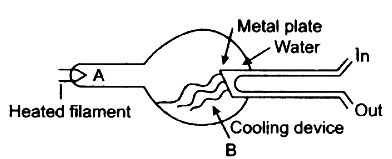
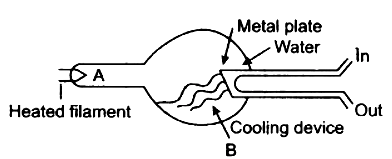
Answer the question with respect to the following diagram:

State two uses of radiation B.
Answer
Uses:
(a) In the field of medical science (X-rays photography used in surgery)
(b) In scientific work (to study crystal structure).
View full question & answer
Question 312 Marks
Answer the question with respect to the following diagram:

State two factors on which the wavelength of radiation B depends.
Answer
The wavelength of radiation B depends upon:
(a) The potential difference applied between cathode and anode.
(b) The material of the target.
View full question & answer
Question 322 Marks
Answer the question with respect to the following diagram:

State two properties of radiation B different from those of visible light.
Answer
The properties of radiation B differ from those of visible light are:
(a) These radiations can penetrate through the substances which are opaque to visible light.
(b) They destroy living cells.
View full question & answer
[2 Mark Question Answer] - Physics STD 10 Questions - Vidyadip