Questions

MCQ

🎯

Test yourself on this topic

46 questions · timed · auto-graded

MCQ 11 Mark
A pendulum is oscillating on either side of its rest position. The correct statement is : ________ .
  • A
    It has only the kinetic energy at its each position.
  • B
    It has the maximum kinetic energy at its extreme position.
  • C
    It has the maximum potential energy at its mean position.
  • The sum of its kinetic and potential energy remains constant throughout the motion.
Answer
Correct option: D.
The sum of its kinetic and potential energy remains constant throughout the motion.
Hint: In accordance with law of conservation of mechanical energy, whenever there is an interchange between the potential energy and kinetic energy, the total mechanical energy remains constant.
View full question & answer
MCQ 21 Mark
A ball of mass m is thrown vertically up with an initial velocity so as to reach a height h. The correct statement is : ________ .
  • A
    Potential energy of the ball at the ground is mgh.
  • B
    Kinetic energy to the ball at the ground is zero.
  • C
    Kinetic energy of the ball at the highest point is mgh.
  • Potential energy of the ball at the highest point is mgh
Answer
Correct option: D.
Potential energy of the ball at the highest point is mgh
Potential energy of the ball at the highest point is mgh.
Hint: At the highest point, the ball momentarily comes to rest and thus its kinetic energy becomes zero.
View full question & answer
MCQ 31 Mark
In an electric cell which in use, the change in energy is from : ________ .
  • A
    Electrical to mechanical
  • B
    Electrical to chemical
  • C
    Chemical to mechanical
  • Chemical to electrical
Answer
Correct option: D.
Chemical to electrical
Hint: When current is drawn from an electric cell, the chemical energy stored in it changes into electrical energy.
View full question & answer
MCQ 41 Mark
A body at a height possesses : ________ .
  • A
    Kinetic energy
  • Potential energy
  • C
    Solar energy
  • D
    Heat energy
Answer
Correct option: B.
Potential energy
Potential energy
Hint: P.E. is the energy possessed by a body by virtue of its position.
View full question & answer
MCQ 51 Mark
kWh is the unit of : ________ .
  • A
    Power
  • B
    Force
  • Energy
  • D
    None of these
Answer
Correct option: C.
Energy
The unit kWh is the unit of energy.
View full question & answer
MCQ 71 Mark
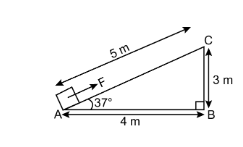
A force ' $F$ ' moves a load from $A$ to $C$ as shown in the figure below. For the calculation of the work done, which of these lengths would you use as the displacement?
Image
  • A
    3 m
  • B
    4 m
  • 5 m
  • D
    7 m
Answer
Correct option: C.
5 m
(c)
5m
Explanation:
As displacement in the direction of force is used.
View full question & answer
MCQ 81 Mark
When a bell fixed on a cycle rings, then the energy conversion that takes place is:
  • A
    gravitational potential energy to sound energy
  • kinetic energy to sound energy
  • C
    sound energy to electrical energy
  • D
    sound energy to mechanical energy
Answer
Correct option: B.
kinetic energy to sound energy
(b)
kinetic energy to sound energy
Explanation:
The reason for this is that ringing the bell usually involves moving a component of bell such as a clapper or a lever. These components are initially moved by the mechanical forces. As the clapper moves, this mechanical force converts into kinetic energy and when it hits the bell the kinetic energy converts into sound energy.
View full question & answer
MCQ 91 Mark
The energy of an electron is given as 2.5 eV . When converted to Joules, this energy equals:
  • A
    $1.6 \times 10^{-19}$
  • $4.0 \times 10^{-19}$
  • C
    $3.2 \times 10^{-19}$
  • D
    $0$
Answer
Correct option: B.
$4.0 \times 10^{-19}$
(b)
momentum
Explanation:
The conversion factor from electron volts to Joules is $1 eV =1.6 \times 10^{-19}$ Joules. Therefore, 2.5 eV converts to $2.5 \times 1.6 \times 10^{-19}=4.0 \times 10^{-19} Joules.$
View full question & answer
MCQ 101 Mark
If A coolie lifts a load to the roof of a bus in 1 minute, and $B$ takes 2 minutes to lift the same load, the work done by the second coolie is:
  • Equal to the work done by the A
  • B
    Greater than the work done by the A
  • C
    Less than the work done by the A
  • D
    None of the above
Answer
Correct option: A.
Equal to the work done by the A
(a)
Equal to the work done by the A
Explanation:
The amount of work done depends only on the force applied and the displacement achieved, not on the time taken. Since both coolies lift the same load to the same height, the work done by both is equal, regardless of the time difference
View full question & answer
MCQ 111 Mark
What is the work done by the force of gravity when a ball is thrown upwards to a height $h$ ?
  • A
    $mg h$
  • $- mg h$
  • C
    mg
  • D
    $mg h 2$
Answer
Correct option: B.
$- mg h$
(b)
-mgh
Explanation:
As the ball moves upwards against the direction of gravitational force, the displacement is opposite to the force. The work done by gravity is therefore negative, calculated as $W =- mg h$, indicating that gravitational force does wor against the motion of the ball.
View full question & answer
MCQ 121 Mark
What is the work done when a body moves along a circular path in a horizontal plane?
  • A
    Positive
  • B
    Negative
  • Zero
  • D
    Maximum
Answer
Correct option: C.
Zero
(c)
Zero
Explanation:
In circular motion, the displacement over a complete cycle returns to the starting point, making the net displacement zero. Since work done is calculated as the product of force and displacement along the direction of the force, it results in zero work for a complete revolution.
View full question & answer
MCQ 131 Mark
To achieve the maximum work done, what should be the angle between the force applied and the displacement?
  • A
    $0^{\circ}$
  • B
    $30^{\circ}$
  • C
    $45^{\circ}$
  • D
    $90^{\circ}$
Answer

(a)
$0^{\circ}$
Explanation:
Maximum work is done when the force applied is in the same direction as the displacement, i.e., when the angle between the force and displacement is $0^{\circ}$. This condition aligns with the equation for work, $W = F . d . cos \theta$, where $\cos 0^{\circ}=1$.

View full question & answer
MCQ 141 Mark
The kinetic energy of a given body depends on the:
  • A
    position
  • B
    centre of gravity of the body.
  • momentum
  • D
    displacement
Answer
Correct option: C.
momentum
(c)
momentum
Explanation:
Kinetic Energy $=\frac{p^2}{2 m}$
View full question & answer
MCQ 151 Mark
When the speed of a moving object is doubled, then its kenetic energy:
  • A
    remains the same
  • B
    decreases
  • C
    is doubled
  • becomes four times
Answer
Correct option: D.
becomes four times
(d)
becomes four times
Explanation :
Kinetic energy $(k) \propto(\text { velocity } v)^2$
Now $\frac{k^{\prime}}{k}=\frac{(2 v)^2}{(v)^2}$
$
\Rightarrow k^{\prime}=4 k
$
View full question & answer
MCQ 161 Mark
The energy conversion, when an oscillating pendulum moves from mean to extreme position is ____________ .
  • Kinetic to potential
  • B
    Potential to kinetic
  • C
    Potential to kinetic to potential
  • D
    Kinetic to potential to kinetic
Answer
Correct option: A.
Kinetic to potential
(a)
Kinetic to potential
Explanation:
At extreme position, the potential energy of an oscillating pendulum is maximum and kinetic energy goes to zero whereas at mean position potential energy becomes zero and kinetic energy is maximum.
View full question & answer
MCQ 171 Mark
Which of the following is the correct expression for gain in kinetic energy, if initial velocity is not zero?
  • A
    $k=\frac{1}{2} m v^2$
  • B
    $k=\frac{m v^2}{4}$
  • C
    $k=\frac{m v^2}{2 t}$
  • $k=\frac{1}{2} m\left(v^2-u^2\right)$
Answer
Correct option: D.
$k=\frac{1}{2} m\left(v^2-u^2\right)$
(d)
$k=\frac{1}{2} m\left(v^2-u^2\right)$
Explanation:
Let $u$ and $v$ are initial and final velocity of an object.
Then initial kinetic energy $k_i=\frac{1}{2} m u^2$
Final kinetic energy $k_f=\frac{1}{2} m v^2$
$\therefore$ Gain in kinetic energy $k=k_f-k_i$
$
k=\frac{1}{2} m\left(v^2-u^2\right)
$
View full question & answer
MCQ 181 Mark
The figure shows a girl pulling 5 balloons in her hand for 12 m with a force of 1 N at an angle of $60^{\circ}$ below horizontal. How much work does the girl do on the balloons?
Image
  • A
    -10 J
  • 6 J
  • C
    -6 J
  • D
    12 J
Answer
Correct option: B.
6 J
(b)
6 J
Explanation :
Work done $= F \cos \theta \times s$.
Here, $\theta=60^{\circ}, s=12 m, F =1 N$
So, $W =1 \times \cos 60^{\circ} \times 12$
$
\therefore W=6 J
$
View full question & answer
MCQ 191 Mark
A construction worker holds a heavy tool box. How much work is done by the worker?
Image
  • A
    $m g h$
  • B
    $\frac{1}{2} m v^2$
  • zero
  • D
    none of the above
Answer
Correct option: C.
zero
(c)
zero
Explanation :
No displacement hence no work.
View full question & answer
MCQ 201 Mark
A weight lifter lifts a load of 250 N while a coolie lifts same load on his head. If the height of weight lifter and coolie is same, compare the work done?
Image
  • A
    work done is same
  • B
    work done by coolie is more
  • work done by weight lifter is more
  • D
    none of the above
Answer
Correct option: C.
work done by weight lifter is more
(c)
work done by weight lifter is more
Explanation:
Displacement of load is more in case of weight lifter so more work is done.
View full question & answer
MCQ 211 Mark
A spring is compressed by a ping pong ball of mass 100 g . On its release it flies with a velocity of $20 ms^{-1}$. Find the elastic potential energy possessed by spring.
  • A
    200 J
  • 20 J
  • C
    2000 J
  • D
    2 J
Answer
Correct option: B.
20 J
(b)
20 J
Explanation:
Elastic potential energy
$=$ Kinetic energy of the ping pong ball
$
\begin{array}{l}
=\frac{1}{2} m v^2=\frac{1}{2} \times 0.1 \times 400 \\
=20 J
\end{array}
$
View full question & answer
MCQ 221 Mark
A body possesses a linear momentum of $20 kgms ^{-1}$ and mass of 2 kg . Calculate kinetic energy of the body :
  • A
    10 J
  • B
    5 J
  • 100 J
  • D
    500 J
Answer
Correct option: C.
100 J
(c)
100 J
Explanation:
$
\begin{array}{l}
KE=\frac{p^2}{2 m} \\
=\frac{(20)^2}{2 \times 2}=100 J
\end{array}
$
View full question & answer
MCQ 231 Mark
A heart of a rabbit beats 100 times in a minute when a fox chases it during which the work performed is 1.5 J . Find the power of the heart :
  • 2.5 W
  • B
    25 W
  • C
    0.25 W
  • D
    none of these
Answer
Correct option: A.
2.5 W
(a)
2.5 W
Explanation:
$
P=\frac{\text { Work }}{\text { Time }}=\frac{1.5}{(60 / 100)}=2.5 W
$
View full question & answer
MCQ 241 Mark
A body possesses kinetic energy of ' $X$ ' J. If the mass of body increases 49 times, determine its final velocity if kinetic energy remains constant:
  • A
    $1 / 5^{\text {th }}$ the original velocity
  • B
    $1 / 2$ the original velocity
  • $1 / 7^{\text {th }}$ the original velocity
  • D
    $1 / X$ the original velocity.
Answer
Correct option: C.
$1 / 7^{\text {th }}$ the original velocity
(c)
$1 / 7^{\text {th }}$ the original velocity
Explanation:
$
KE=\frac{1}{2} m_1 v_1^2=\frac{1}{2} m_2 v_2^2
$
Given that $m_2=49 \times m_1$ and K.E. is constant
$
\begin{array}{l}
m_1 v_1^2=49 m_1 v_2^2 \\
v_1^2=49 v_2^2 \\
v_1=7 v_2 \\
v_2=\frac{1}{7} v_1
\end{array}
$
View full question & answer
MCQ 251 Mark
The bullet weighing 100 g is released from the barrel of an air gun with a velocity of $4 ms^{-1}$. Calculate the potential energy of the spring :
  • 0.8 J
  • B
    800 J
  • C
    8 J
  • D
    0.08 J
Answer
Correct option: A.
0.8 J
(a)
0.8 J
Explanation:
KE of the bullet is potential energy of spring.
$
\begin{array}{l}
PE=KE \\
=\frac{1}{2} m v^2=0.8 J
\end{array}
$
View full question & answer
MCQ 261 Mark
Calculate the height through which a crane can lift a load of 4 tonne when a motor of 1000 W is operating for 20 sec.:
  • A
    4 m
  • B
    2 m
  • C
    1 m
  • 0.5 m
Answer
Correct option: D.
0.5 m
(d)
0.5 m
Explanation:
Power $=m g h /$ time
$
P=\frac{4000 \times 10 \times h}{20}
$
$
\begin{array}{l}
1000=2000 h \\
h=0.5 m
\end{array}
$
View full question & answer
MCQ 271 Mark
If a body of mass 5 kg is lifted from the ground level to a height of 5 m then ratio of its inertia is _____________ .
  • $1: 1$
  • B
    $2: 1$
  • C
    $1: 2$
  • D
    none of these
Answer
Correct option: A.
$1: 1$
(a)
1:1
Explanation:
Inertia is independent of height.
View full question & answer
MCQ 281 Mark
For a given mass and velocity the kinetic energy remains constant if _____________ .
  • mass is four times and velocity is $\frac{1}{2}$.
  • B
    mass is $\frac{1}{2}$ and velocity is doubled.
  • C
    mass and velocity both are squared.
  • D
    mass is $\frac{1}{2}$ and velocity is $\frac{1}{2}$.
Answer
Correct option: A.
mass is four times and velocity is $\frac{1}{2}$.
(a)
mass is four times and velocity is $\frac{1}{2}$.
Explanation:
$
KE=\frac{1}{2} m v^2
$
$KE \propto m v^2$
View full question & answer
MCQ 291 Mark
1000 watt = __________ MW
  • A
    $10^6$
  • B
    $10^9$
  • C
    $10^{-12}$
  • $10^{-3}$
Answer
Correct option: D.
$10^{-3}$
(d)
$10^{-3}$
Explanation:
1 watt $=10^{-6} MW$
$1000 W=10^{-3} MW$
View full question & answer
MCQ 301 Mark
$1 J=$ ________ kWh
  • A
    $3.6 \times 10^6$
  • $0.278 \times 10^{-6}$
  • C
    $3.6 \times 10^{-6}$
  • D
    $0.278 \times 10^{-7}$.
Answer
Correct option: B.
$0.278 \times 10^{-6}$
(b)
$0.278 \times 10^{-6}$
Explanation:
$
\begin{array}{l}
1 kWh=3.6 \times 10^6 J \\
\frac{1}{3.6 \times 10^6}=0.278 \times 10^{-6} kWh
\end{array}
$
View full question & answer
MCQ 311 Mark
A parrot exerts a force of 10 N to fly vertically upward to a height of 300 m above sea level. How much work does it do?
  • does no work
  • B
    does work equal to 3000 J
  • C
    does negative work
  • D
    does positive work
Answer
Correct option: A.
does no work
(a)
does no work
Explanation:
Flapping of wings applies force in the downward direction and displacement is horizontal so angle is $90^{\circ}$ and hence work done is zero.
View full question & answer
MCQ 321 Mark
When camphor sublimes ___________ .
  • A
    chemical energy changes into heat energy
  • B
    PE gets converted into KE
  • it simply converts into gaseous state without attaining the liquid state
  • D
    entire energy is lost to the surroundings
Answer
Correct option: C.
it simply converts into gaseous state without attaining the liquid state
(c)
it simply converts into gaseous state without attaining the liquid state
Explanation:
Sublimation process $=$ Solid state converts to gaseous state without the intermediate liquid state.
View full question & answer
MCQ 331 Mark
In a washing machine the electrical energy is converted into ______________ .
  • A
    sound energy
  • B
    vibrational energy
  • C
    kinetic energy
  • mechanical kinetic rotational energy.
Answer
Correct option: D.
mechanical kinetic rotational energy.
(d)
mechanical kinetic rotational energy.
View full question & answer
MCQ 341 Mark
During free fall the total energy at $3 / 4^{\text {th }}$ the height is _____________ .
  • constant
  • B
    zero
  • C
    gravitational potential energy at the top
  • D
    $3 / 4^{\text {th }}$ the initial potential energy.
Answer
Correct option: A.
constant
(a)
constant
Explanation:
At three-fourths the height, the potential energy will have decreased compared to the top, but the kinetic energy will have increased by an equivalent amount, keeping the total energy constant throughout the fall.
View full question & answer
MCQ 351 Mark
During energy transformation some form of energy is given out without it being used anywhere, such an energy is called _______________ .
  • A
    backup energy
  • B
    stored energy
  • C
    wasteful energy
  • dissipated form of energy
Answer
Correct option: D.
dissipated form of energy
(d)
dissipated form of energy
Explanation:
Dissipated energy is energy wasted during a process, typically as heat or sound, not used for productive work. It's inherent to all energy transformations.
View full question & answer
MCQ 361 Mark
In an oscillating pendulum the __________ energy is maximum at extremes.
  • potential
  • B
    vibrational
  • C
    gravitational potential
  • D
    kinetic
Answer
Correct option: A.
potential
(a)
potential
Explanation:
As it has attained a certain height about its mean position.
View full question & answer
MCQ 371 Mark
In an oscillating pendulum, KE is __________ at extremes.
  • zero
  • B
    negative
  • C
    positive
  • D
    variable
Answer
Correct option: A.
zero
(a)
zero
Explanation:
As pendulum is at rest at extremes.
View full question & answer
MCQ 381 Mark
The two basic forms of mechanical energy are:
  • PE and KE
  • B
    Sound and light
  • C
    Heat and tidal
  • D
    Solar and wind
Answer
Correct option: A.
PE and KE
(a)
PE and KE
Explanation:
Where PE stands for potential energy, which is energy stored in an object due to its position or state and KE stands for kinetic energy, which is the energy an object possesses due to its motion.
View full question & answer
MCQ 391 Mark
Energy is __________ .
  • A
    the capacity to use power.
  • B
    capacity to produce power
  • capacity to do work
  • D
    capacity to do work per unit time.
Answer
Correct option: C.
capacity to do work
(c)
capacity to do work
Explanation:
In physics, energy is defined as the scalar physical quantity that denotes the ability to perform work.
View full question & answer
MCQ 401 Mark
Power efficiency of a pump =
  • A
    power output $\times$ power input
  • B
    power input / power out put
  • C
    power output / time
  • power output / power input
Answer
Correct option: D.
power output / power input
(d)
power output / power input
Explanation:
The power efficiency of a pump is a measure of how effectively the pump converts input power into output power.
View full question & answer
MCQ 411 Mark
Kinetic energy of a body is independent of:
  • A
    force applied
  • B
    time for which force is applied
  • elasticity of the body
  • D
    none of the above
Answer
Correct option: C.
elasticity of the body
(c)
elasticity of the body
Explanation:
Whether rigid or elastic, the kinetic energy does not have any influence.
View full question & answer
MCQ 421 Mark
Gravitational potential energy $=$ _____________ .
  • $m g h$
  • B
    $\frac{1}{2} m v^2$
  • C
    $2 m g h$
  • D
    $\frac{1}{2} m g h$.
Answer
Correct option: A.
$m g h$
(a)
$m g h$
Explanation:
Gravitational potential energy $=$ work done in reaching a height $=$ force $\times$ displacement
$
=m g \times h=m g h
$
View full question & answer
MCQ 431 Mark
Work done is positive when ___________ .
  • A
    distance is positive
  • B
    maximum distance travelled along direction of force applied
  • displacement is in direction of force applied
  • D
    distance is negative
Answer
Correct option: C.
displacement is in direction of force applied
(c)
displacement is in direction of force applied
Explanation:
Positive work occurs when the force applied to an object results in a displacement in the same direction as the force.(c)
displacement is in direction of force applied
Explanation:
Positive work occurs when the force applied to an object results in a displacement in the same direction as the force.
View full question & answer
MCQ 441 Mark
1 dyne- $cm =$ ___________ .
  • A
    1 erg
  • B
    $10^{-5}$ newton cm
  • C
    10 newton cm
  • both (a) and (b)
Answer
Correct option: D.
both (a) and (b)
(d)
both (a) and (b)
View full question & answer
MCQ 461 Mark
Work done $=$ force $\times$ __________ .
  • A
    distance
  • B
    time
  • C
    velocity
  • displacement
Answer
Correct option: D.
displacement
(d)
displacement
View full question & answer