Question 15 Marks
Answer
View full question & answer→(i) (a) Work is said to be done only when the force applied on a body causes a displacement of the body in the direction of force or any resolved component of the force.
(b) Conditions for doing work :
(i) There must be a force acting on the body.
(ii) The force acting on the body must cause a displacement.
(iii) The displacement must be in the direction of force or its resolved component.
(c) Mathematically, work is the product of force and the displacement in the direction of force.
$W=\overrightarrow{F} \overrightarrow{S}=FS \cos \theta$
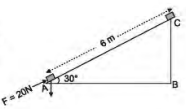
(ii) (a) Force of gravity acting on the body $=m g=1.5 kg \times 10 ms^{-2}=15 N$.
(b) Work done by the force in pulling body along inclined plane
$=\text { Force } \times \text { displacement }=20 N \times 6 m=120 J .$
(c) Work done against force of gravity $=$ Force of gravity $\times$ vertical height $=m g \times BC$
$=m g \times AC \sin 30^{\circ}=15 N \times 6 m \times \frac{1}{2}=45 J .$
(d) The difference in work done $(120 J-45 J)=75 J$ is the work done against the force of friction between the body and the inclined plane.
(iii) Let initial velocity =$V$
$\therefore KE=\frac{1}{2} m V^2$...(i)
When mass increases 25 times, let velocity be $V_1$,
$\therefore KE=\frac{1}{2} \times 25 m V_1^2$....(ii)
As KE remains the same,
$\therefore \frac{1}{2} \times 25 m V_1^2=\frac{1}{2} m V^2 \Rightarrow 25 V_1^2=V^2 \text { or } V_1=\frac{V}{5}$
(b) Conditions for doing work :
(i) There must be a force acting on the body.
(ii) The force acting on the body must cause a displacement.
(iii) The displacement must be in the direction of force or its resolved component.
(c) Mathematically, work is the product of force and the displacement in the direction of force.
$W=\overrightarrow{F} \overrightarrow{S}=FS \cos \theta$
(ii) (a) Force of gravity acting on the body $=m g=1.5 kg \times 10 ms^{-2}=15 N$.
(b) Work done by the force in pulling body along inclined plane
$=\text { Force } \times \text { displacement }=20 N \times 6 m=120 J .$
(c) Work done against force of gravity $=$ Force of gravity $\times$ vertical height $=m g \times BC$
$=m g \times AC \sin 30^{\circ}=15 N \times 6 m \times \frac{1}{2}=45 J .$
(d) The difference in work done $(120 J-45 J)=75 J$ is the work done against the force of friction between the body and the inclined plane.
(iii) Let initial velocity =$V$
$\therefore KE=\frac{1}{2} m V^2$...(i)
When mass increases 25 times, let velocity be $V_1$,
$\therefore KE=\frac{1}{2} \times 25 m V_1^2$....(ii)
As KE remains the same,
$\therefore \frac{1}{2} \times 25 m V_1^2=\frac{1}{2} m V^2 \Rightarrow 25 V_1^2=V^2 \text { or } V_1=\frac{V}{5}$