Questions

[5 Mark Question Answer]

Take a timed test

4 questions · self-marked practice — reveal the answer and mark yourself.

Question 15 Marks
State briefly, the difference between white blood cells and the red blood cells.
Answer
RBC WBC
They do not have nucleus atmaturity They have a large characteristic nucleus.
They possess haemoglobin and are red They are colourless as they have no pigment
They help in transport of respiratory gases They help in defence mechanism
Life span is 120 days WBC have a short life.span of 5 to 20 days.
They are about $5 million / mm ^3$ of blood. They are about $7000 / mm ^3$ of blood.
In the embryonic stage the RBC are formed in the liver and spleen. But after birth, they are formed in the red bone marrow. WBC are formed in the red bone marrow.
View full question & answer
Question 25 Marks
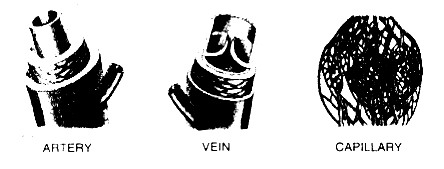
Name the three kinds of blood vessels found in human beings. With the help of suitable diagrams, differentiate between them.
Answer
The three kind of blood vessels found in human beings are arteries, veins and capillaries
  1. Arteries are the blood vessels that carry blood from the heart to the various parts of the body.
  2. Veins are the blood vessels that carry blood from the body parts to the heart
  3. Capillaries: These are the terminal branches of an artery, which rejoin to form a vein. A capillary is a very narrow tube whose walls have a single layer of cells with no muscles. Although the wall of a capillary is very thin, yet an exchange of nutrients, waste products and gases take place between the blood and the body fluids.

Differences:

Arteries
  1. Carry blood away from the heart.
  2. Have thick and more muscular walls.
  3. Carry oxygenated blood (except pulmonary artery which carries deoxygenated blood).
  4. The blood flows with jerks and under great force.
Veins
  1. Carry blood towards the heart.
  2. Have thin and less muscular walls.
  3. Carry deoxygenated blood (except pulmonary vein which carries oxygenated blood).
  4. The blood flows smoothly and under little pressure
Capillaries
  1. Arteries after entering an organ divide into number of smaller branches called arterioles which further divide repeatedly to form a network of fine branches called capillaries.
  2. The walls of the capillaries are very thin and are one cell deep.
  3. The Capillaries after the metabolic exchange unite to form larger vessels called venules, which again unite to form a vein.
View full question & answer
Question 35 Marks
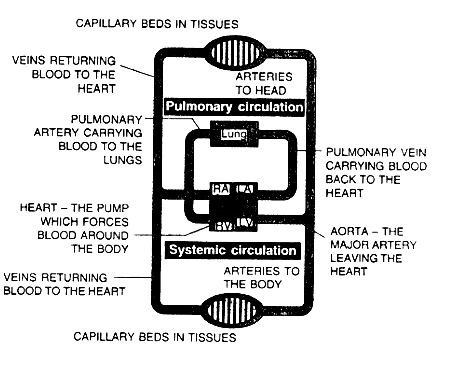
Blood in the human body circulates twice for making one complete round through the body. Explain.
Answer
The circulation of blood through the human heart takes place twice making one complete round through the body. This is called double circulation. The impure blood (deoxygenated blood) is collected from different body organs through two major veins (vena cava). The two veins empty blood into the right auricle. From here, it enters the right ventricle and is carried to lungs by pulmonary artery. Exchange of gases takes place in the lungs. Pulmonary vein then carries the pure (oxygenated) blood to the left auricle. From here, it enters the left ventricle and is then carried by an artery called aorta to all parts of the body.Double circulation can be summarised as:Circulation of blood between the heart and the lungs is called pulmonary circulation.
In this, the blood flows as follows:
Right ventricle → lungs → left auricle (through pulmonary veins)Circulation of blood between the heart and body organs (except lung) is called systemic (body) circulation.
Blood flows as following:
Left ventricle → body organs → right auricle (through vena cava)
View full question & answer
Question 45 Marks
What is the difference between pulmonary circulation and systemic circulation?
Answer
Pulmonary circulation Systemic circulation
This involves circulation of blood between the heart and the lungs. This involves circulation of blood between the heart and body organs (except lungs).
It is the function of the right side of the heart It is the function of the left side of the heart.
It carries deoxygenated blood to the lungs to receive oxygen. It carries oxygenated blood to the body organs.
It begins on the right ventricle and ends on left auricle. It starts at left ventricle and ends at the right auricle.
It returns oxygenated blood back to the heart. It returns deoxygenated blood back to the heart.
Blood flows as:
Right ventricle > deoxygenated blood > Lungs > oxygenated blood > Left auricle
Blood flows as:
Left ventricle > oxygenated blood > Body organs > deoxygenated blood > Right auricle
View full question & answer
[5 Mark Question Answer] - BIOLOGY STD 6 Questions - Vidyadip