Questions

[2 Mark Question Answer]

🎯

Test yourself on this topic

18 questions · timed · auto-graded

Question 12 Marks
Give two functions of a fruit.
Answer
Functions of fruit are:
  1. Fruit is a protective case for the seeds.
  2. Fruit is a temptation to animals and man to eat it and scatter the seeds
View full question & answer
Question 22 Marks
Differentiate between the following pair of terms:
Testa and tegmen.
Answer
Testa: The seed is protected by a thick outermost coat called the testa or seed coat.
Tegmen: Under the testa lies a very thin membrane called the tegmen.
View full question & answer
Question 32 Marks
Differentiate between the following pair of terms:
Ilium and micropyle.
Answer
IlIum: On one side of seed câat, there is a scar called hi hum, which marks the place where the seed was attached to the fiiüt wall.
Micropyle: Above the hilum is a small pore called micrope. The micropyle absorbs as much water as is required for germination
View full question & answer
Question 42 Marks
Differentiate between the following pair of terms:
Radicle and plumule.
Answer
Radicle: In a seed, the radicle lies downwards near the lower pointed end of the grain. It gives rise to the root.
Plumule: In a seed the plumule lies upward near the cotyledon and gives rise to the shoot.
View full question & answer
Question 62 Marks
State the location of the following in a flower:
Stigma
Answer
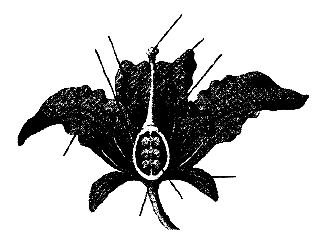
Stigma: It is the terminal knob-like part, it may be divided into two or more lobes and assume a feathery appearance. The stigma is covered with hair or with glandular papillae. It serves as the landing place grains for pollen during pollination.
View full question & answer
Question 72 Marks
State the location of the following in a flower:
Petals
Answer
Petals: Petals form the second whorl inner to the sepals. These are usually coloured, gaudy, or white in colour and scented and give a sweet smell. The value of a flower is due to the attractive colour of the petals. These attract the insects for pollination.
View full question & answer
Question 82 Marks
State the location of the following in a flower:
Sepals
Answer
Sepals: These are the outermost part of the flower. These are leaf-like and green in colour. This is the outer covering of the flower and forms the outer whorl in a flower. The Calyx (sepals) enclose the inner parts of the flower when it is a bud. It is protective in function.
View full question & answer
Question 92 Marks
Name the two types of pollination.
Answer
The two types of pollination found in flowering plants are.
  1. Self-pollination – that occurs within the same plant.
  2. Cross-pollination – that occurs between two flowers of two different plants but of the same kind.
View full question & answer
Question 102 Marks
Give the difference in the function between the following parts:
Pollen and Ovule
Answer
Pollen and Ovule: The function of pollen is to deliver male gametes (sperm) from the stamen of a plant to an ovule whereas the ovule when fertilized, well developed into a seed. It is a female reproductive cell.
View full question & answer
Question 112 Marks
Give the difference in the function between the following parts:
Filament and style
Answer
Filament and Style:
The filament is a stalk-like structure that attaches and supports the flower and supports the anther which is the structure that produces pollens whereas the style transfers the male gametes of the pollen grains into the ovary.
View full question & answer
Question 122 Marks
Give the difference in the function between the following parts:
Petal and sepal
Answer
Petal and Sepal:
Petals are colourful and attractive and help to attract insects for pollination whereas the main function of sepals is to provide protection to the growing bud.
View full question & answer
Question 132 Marks
Give the difference in the function between the following parts:
Ovary and ovule
Answer
Ovary and ovule:
1. The ovary is the female reproductive part of a flower and ovules are located inside the ovary.
2. Ovary after fertilization turns into a fruit whereas ovules turn into seeds of the fruit.
View full question & answer
Question 142 Marks
Mention the functions of the following:
Endosperm
Answer
Endosperm: The endosperm is the nutritive tissue surrounding the embryo in a seed which provides nourishment to the developing embryo in seed during germination.
View full question & answer
Question 152 Marks
Mention the functions of the following:
Cotyledons
Answer
Cotyledons: The cotyledons provide food for the embryo during the first stages of germination in dicot plants. They act as leaves and perform photosynthesis in a seedling. In monocots, it absorbs the food from the endosperm and transports it to the embryo.
View full question & answer
Question 162 Marks
Mention the conditions necessary for seed germination.
Answer
The conditions necessary for seed germination are:
  1. Water: It is needed for a seed to swell up and burst open. It is also needed to make the stored food soluble to feed the embryo inside a seed.
  2. Oxygen: Oxygen is required for respiration.
  3. Favourable temperature: Temperature ranging from 25°C to 35°C is suitable for germination.
View full question & answer
Question 172 Marks
Define the following:
Embryo
Answer
Embryo: In plants, an embryo is the baby plant present inside a seed which consists of a radicle, plumule, and cotyledons. It develops into a plant. In animals, the embryo is the early stage in the development of an organism. A fertilized egg develops into an embryo that grows into an adult plant or animal.
View full question & answer
Question 182 Marks
Give two differences in the following pairs :
Epigeal germination and hypogeal germination
Answer
Epigealgermination Hypogeal germination
1. Cotyledons are pushed above the ground 1. Cotyledons remain underground
2. It is shown by dicot 2. It is shown by monocot
View full question & answer
[2 Mark Question Answer] - BIOLOGY STD 6 Questions - Vidyadip