Questions

[5 Mark Question Answer]

Take a timed test

6 questions · self-marked practice — reveal the answer and mark yourself.

Question 15 Marks
Give the main difference between hypogeal and epigeal and germination.
Answer
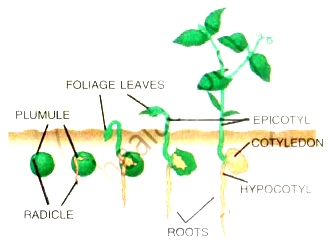
Epigeal germination—Epi means above; geo-means ground (soil). When the cotyledons in a growing seed come out of the soil it is an epigeal type of germination as in case of castor seed, bean seeds, pulses, tamarind cucumber. The cotyledons come out of the soil and turn green these are cotyledonary leaves and carry on the function of photosynthesis till new leaves arise in the growing seedling.
Hypogeal germination — Hypo-below, geo-soil it is that type of germination in which in the growing seed the cotyledons remain under the soil as in case of pea, gram, ground-nut, maize. The plumule forms the aerial shoot which later bears leaves and dies radicle gives rise to root. The tiny seedling gets food from the cotyledons till it establishes itself in the soil by its roots and starts getting water and minerals and as well the new leaves arise on the ascending axis and they start making food by the process of food making.
Differences—
Epigeal germination
  1. In this type of germination the cotyledons come out of the soil.
  2. The cotyledons turn green as they come out of the soil and serve as cotyledonary cotyledons leaves and carry on photo¬synthesis to make food for the growing seedling.
  3. The cotyledons become pale and fall off when the ascending axis bear leaves
Hypogeal germination
  1. In this type of germination the cotyledons remain under the soil.
  2. The cotyledons remain under the ground and the seedling gets food from the till it establishes in the soil.
  3. The cotyledons get rotten up in the soil when the seedling matures.
View full question & answer
Question 25 Marks
What are the three conditions necessary for the germination of seeds? How would you demonstrate this?
Answer
For successful germination of any viable seed, three external conditions are necessary: <
  1. Water or moisture
  2. Warmth or temperature
  3. Air or oxygen.
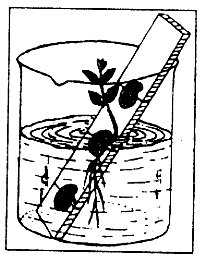
We can demonstrate this with the “Three seed experiment”. This is a simple experiment to demonstrate the necessity of these factors for proper germination .

Experiment: Three mature dried bean seeds are taken and tied on a wooden strip at three different positions (above the figure). This strip is placed in a beaker containing water in such a way that the lower seed is completely submerged in water, the middle seed is partially submerged inside the water and the top seed is kept above water. This set-up is left in a warm place for a few days.
It is observed that the middle seed shows germination and gives out radicle and shoot leaves. The top seed shows no growth and the bottom one shows negligible growth. The middle seed gets fully germinated due to the fact that this seed has all the favourable conditions required for germination i.e., air (oxygen), moisture, and warmth (favourable temperature), which are necessary for germination.
View full question & answer
Question 35 Marks
Define germination? Name the two types of germination. Explain with examples.
Answer
The growth and development of the embryo present in the seed into a seedling (or a young plant capable of independent existence) is called as seed germination. The embryo in a seed remains inactive or dormant. When the seed is put into the soil and given water and under suitable temperature, the embryo becomes active on absorbing the water and the embryo turns into a seedling.
Types of germination — There are three types of germinations.
(i) Epigeal
(ii)Hypogeal
(iii) Viviparous
(i) Epigeal germination — Epi means above; geo-ground (earth) When the cotyledons in growing seed come out of the soil it is an epigeal type of germination as in case of castor seed, cucumber, tamarind, bean seed the cotyledons come out of the soil and turn green. These are called cotyledonary leaves. This canyon photosynthesis till new leaves arise. .
(ii) Hypogeal germination—Hypo-below, gea soil. When in a growing seed the cotyledons remain under the ground as in the case of a gram, pea, groundnut, and maize. The plumule firms the aerial shoot to which bears leaves and the radicle gives rise to roots. The growing seedling gets food from the cotyledons. As the seedling grows the cotyledons die in the soil.
(iii) Viviparous germination—This is a special type of germination. This occurs in plants growing along the sea coasts and in salt lakes. The seed starts growing while it is still attached to the plant as in mangrove plants. The embryo comes out of the fruit with a long, dart-like radicle. It falls directly into the soft, slushy, wet mud. The radicle gives root and establishes as a seedling and the plumule gives rise to shoot. This is in mangrove plants.
View full question & answer
Question 45 Marks
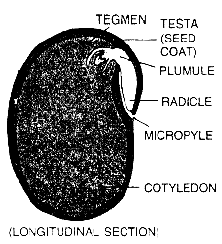
With the help of a suitable labelled diagram, describe the structure of a dicot seed.
Answer

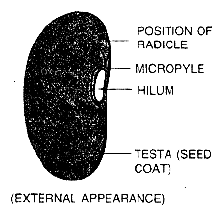
It is a dicotyledonous and non-endospermic seed. It is produced in a long cylindrical pod (fruit – phali) External characters. The seed is brown or whitish brown in colour. The seed is hard and smooth and kidney-shaped i.e. Convex on one side and concave on the other side. The concave side bears whitish scar called hilum. It is the place which is attached to the wall of the pod through a stalk called funicle. At one side of the hilum is a small pore called micropyle water enters through it.
Internal structure — The seed is covered by a hard, tough covering called testa. Inner to the tests is the embryo. The embryo consists of two cotyledons and embryo axis. The Embryo axis has plumule and radicle. The plumule is present in between the two cotyledons and its top bears two folded tiny leaves. It forms future shoot and leaves of the growing seed. Radicle is rod-shaped and is out of the two cotyledons. It forms the root of the growing seed. When the seed grows the two cotyledons come out of the soil and form cotyledonary leaves and turn green in colour. Cotyledons give food to the growing seedling as it has food. The germination in this seed is epigeal as cotyledons come outside the soil in the growing seed.
View full question & answer
Question 55 Marks
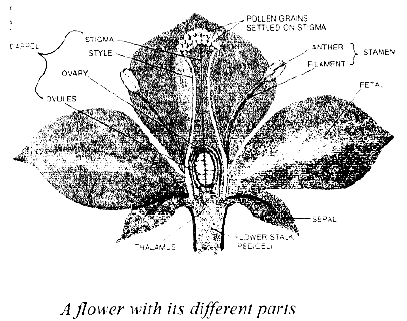
What is a flower? Draw a typical flower and label its different parts.
Answer

A flower is a reproductive part of a plant. It helps in sexual reproduction as it has male parts and female parts.
A fully opened flower has the following parts:
Stalk—A flower is attached to the shoot by means of stalk or pedicel stalk. The tip of the stalk is swollen or flattened. This is called toms or thalamus or receptacle. The different parts of a flower are inserted on the thalamus. There are usually four whorls as Calyx
  • (Sepals)
  • Corolla (Petals)
  • Androecium (stamens)
  • Gynoecium (Carpels)
  • Present on the thalamus.
1. Sepals (Calyx): These are the outermost part of the flower. These are leaf-like and green in colour. This is the outer covering of the flower and forms outer whorl in a flower. The Calyx (sepals) enclose the inner parts of the flower when it is a bud. It is protective in function.
2. Corolla (Petals): Petals form the second whorl inner to the sepals. These are usually coloured, gaudy, or white in colour and scented and give a sweet smell. The value of a flower is due to the attractive colour of the petals. These attract the insects for pollination.
3. Stamens (Androecium): The third whorls inner to the petals are stamens. This third whorl is called Androecium. These are the male parts of the flower. Each stamen is formed of a long narrow, hair-like structure called a filament. On its tip, it bears a rounded broad sac-like structure called the anther. Each anther has two anther lobes. Each anther lobe has two pollen sacs which have powdery mass called pollen grains.
4. Carpels (Gynoecium): Carpels are the innermost or fourth whorl in a flower. It is lodged on the thalamus and forms the female part of a flower. This whorl of carpels is called gynoecium. Each carpel or pistil has three parts,
  1. The lowermost, swollen part is an ovary. It is attached to the thalamus
  2. The middle part is a style which is narrow, thread-like
  3. Stigma: The style ends in a knob-like, a rounded structure which is sticky in nature to receive the pollen grains. The ovaries contain ovules which later turn into seeds after fertilization and the ovary wall forms the fruit sometimes the thalamus also becomes a part of the fruit as in apple.
View full question & answer
Question 65 Marks
Describe the process of germination in bean and maize seeds.
Answer
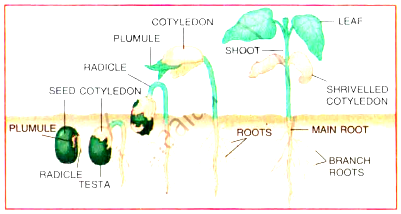
Germination in bean seed is called epigeal germination. It occurs as follows:
  1. Germination starts with the uptake of water, which bursts the seed coat, and the radicle comes out and grows downwards.
  2. The region of plumules elongates and the seed comes out of the soil. The plumule emerges between the two cotyledons.
  3. The plumule forms two green leaves.
  4. The food stored in the cotyledons is used for growth and cotyledons shrivel and fall off.
  5. The radicle gives rise to the root system while the plumule forms the shoot.

Germination in maize seed is called hypogeal germination. It occurs as follows:
  1. The seeds absorb water and swell.
  2. Radicle comes out of the seed and forms the primary root.
  3. The plumule comes out forming the leaves.
  4. The food stored in the endosperm is used for growth
  5. The cotyledons remain below the ground.
View full question & answer
[5 Mark Question Answer] - BIOLOGY STD 6 Questions - Vidyadip