Questions

[2 Mark Question Answer]

🎯

Test yourself on this topic

15 questions · timed · auto-graded

Question 12 Marks
Write the two main functions of leaves
Answer
The two main functions of leaves are –
1. Photosynthesis:
Green leaves contain chlorophyll which, in the presence of sunlight, manufacture food using carbon dioxide and water.
2. Transpiration:
The surface of leaves has minute pores which help in the loss of water by evaporation. It has a cooling effect making roots absorb more water due to suction.
View full question & answer
Question 22 Marks
Describe the modifications of leaf in any one insectivorous plant.
Answer
Modification of leaves in Venus flytrap (an insectivorous plant) The leaves of Venus flytrap have long pointed hair. It is divided into two parts having midrib in between like a hinge. When an insect visits the leaf, it closes its two parts and traps the insect. The insect is then digested by secreting digestive juices.
View full question & answer
Question 32 Marks
What are the four functions of the roots?
Answer
  1. It fixes the plant in the soil.
  2. Absorbs water and minerals from the soil for the entire plant.
  3. It acts as a storage part for food materials for certain plants.
  4. It binds the soil together so that it does not get washed away during rain or blown over by the wind.
View full question & answer
Question 42 Marks
Differentiate between the following:
Simple Leaf and compound leaf
Answer
Simple Leaf
  1. The Lamina is undivided and is a single piece.
  2. Example: mango, banana, banyan, etc.
Compound Leaf
  1. The leaf blade or lamina is divided into smaller units called leaflets.
  2. Example: Rose, Neem, and Palm Trees
View full question & answer
Question 52 Marks
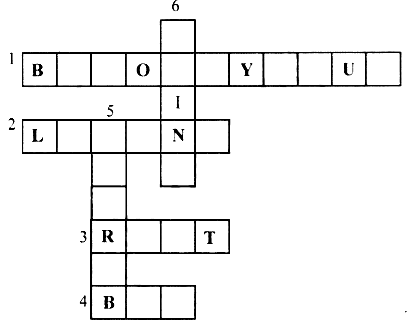
Complete the crossword using the clues given below. Check your performance with the correct solutions given below

Clues across:
1. The plant that bears buds in leaves for propagation.
2. The flattened green part of the leaf.
3. Underground plant part.
4. The structure that develops into flower.
Clues down:
5. The central big vein of a leaf.
6. A modification seen in cactus.
View full question & answer
Question 62 Marks
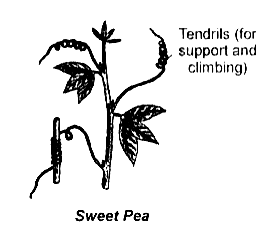
What is a tendril? Explain its use to the plant
Answer
A tendril is a specialized stem, leave, or petrol with a threadlike shop. They are sensitive to touch. As they touch any object, they coil around it and support the plant to climb up.
Example: Sweet pea (upper leaflets are modified into tendrils
View full question & answer
Question 72 Marks
In list some of the advantages of transpiration to green plants.
Answer
It helps to maintain the concentration of the sap inside the plant body: The roots continue to absorb water from the soil. If excess water does not evaporate through transpiration, the sap will become dilute, preventing further absorption of water and minerals from the soil.
Cooling effect: In transpiration, water gets evaporated from the plant. The heat required for evaporation of water is obtained from the plant itself and thus, the plant cools itself when it is hot outside.
View full question & answer
Question 82 Marks
What is the modification seen in the Bryophyllum. Explain
Answer
1. Bryophyllum is a plant whose leaves produce adventitious buds in their margin.
2. The adventitious buds grow into new plants when they fall off from the parent plant.
View full question & answer
Question 92 Marks
Define
Tranpiration
Answer
Tranpiration: This is the process by which there is a loss of water in the form of vapour by evaporation from the surface of leaves. It has a cooling effect, it causes the suction force to make roots absorb more water with mineral ions.
View full question & answer
Question 102 Marks
State various adaptations in the seeds dispersed by wind.
Answer
The seeds dispersed by wind have fluff or tufts of hair or wings to be easily dispersed by wind.
Seeds of some plants are so light that they get easily carried away by the slightest wind to long distances.
View full question & answer
Question 112 Marks
Answer the following in detail
What are the different agents of seed dispersal?
Answer
The different agents of seed dispersal are
1. Wind:
e.g. Cotton plant disperses its pollens into the air.
2. Insects: e.g. Lavender plant attracts bees to transmit their pollen from one flower to the next.
3. Water: e.g. Coconut fruit floats and gets carried away by water.
4. Animals: e.g. Hibiscus plant is pollinated by hummingbirds.
View full question & answer
Question 122 Marks
Answer the following in detail
Why are seeds produced in large quantities?
Answer
Seeds are produced in large quantities because not all of them grow into plants.
So to ensure that at least a few of them end in a favourable place for growth, plants produce more seeds than will ever become adult plants. If they don’t overproduce, the specie would die out.
View full question & answer
Question 132 Marks
Answer the following in detail
Write two important functions of the stem.
Answer
Two important functions of the stem are
1. The stem bears all the aerial parts like leaves, flowers, and fruits.
2. It conducts water and minerals upwards i.e. from roots to the leaves and transports food from leaves to all parts of the plant.
View full question & answer
Question 142 Marks
Differentiate between the following:
Simple Leaf and compound leaf
Answer
Simple Leaf
  1. The Lamina is undivided and is a single piece.
  2. Example: mango, banana, banyan, etc.
Compound Leaf
  1. The leaf blade or lamina is divided into smaller units called leaflets.
  2. Example: Rose, Neem, and Palm Trees
View full question & answer
Question 152 Marks
Differentiate between
terminal bud and axillary bud
Answer
Terminal bud:
1. The buds that grow at the tips of the stems or its branches are called terminal or apical buds.
2. They lead to an increase in the length of the stem.
Axillary bud:
1. These buds are present in the axil of a leaf i.e.-between a leaf and a stem.
2. They give rise to new branches.
3. Simple leaf and compound leaf
View full question & answer