Questions

[5 Mark Question Answer]

🎯

Test yourself on this topic

6 questions · timed · auto-graded

Question 15 Marks
Match the compounds in List I – 1 to 20 with their correct formulas from in List II-A to T.
  List I   List II
1 Hydrochloric acid $A$ $NaCI$
2 Potassium Hydroxide $B$ $NaOH$
3 Sulphuric Acid $C$ $KCI$
4 Zinc Hydroxide $D$ $Ca(OH)_2$
5 Sodium Chloride $E$ $CaS$
6 Nitric Acid $F$ $CuSO_4$
7 Calcium Hydroxide $G$ $CaCO_3$
8 Carbonic Acid $H$ $NH_4CI$
9 Sodium hydroxide $I$ $HCI$
10 Copper sulphate $J$ $ZnO$
11 Potassium Chloride $K$ $$HNO_3$$
12 Calcium Carbonate $L$ $H_2CO_3$
13 Magnesium Sulphide $M$ $MgS$
14 Zinc Sulphate $N$ $MgO$
15 aluminium Hydroxide $O$ $KOH$
16 Sodium Carbonate $P$ $ZnSO_4$
17 Calcium Sulphide $Q$ $Na_2CO_3$
18 Magnesium Oxide $R$ $H_2SO_4$
19 Zinc Oxide $S$ $AI(OH)_3$
20 Ammonium Chloride $T$ $Zn(OH)_2$
Answer
  List I   List II
1 Hydrochloric acid $I$ $HCI$
2 Potassium Hydroxide $O$ $KOH$
3 Sulphuric Acid $R$ $H_2SO_4$
4 Zinc Hydroxide $T$ $Zn(OH)_2$
5 Sodium Chloride $A$
$NaCI$
6 Nitric Acid $K$ $HNO_3$
7 Calcium Hydroxide $D$ $Ca(OH)_2$
8 Carbonic Acid $L$ $H_2CO_3$
9 Sodium hydroxide $B$ $NaOH$
10 Copper sulphate $F$ $CuSO_4$
11 Potassium Chloride $C$ $KCI$
12 Calcium Carbonate $G$ $$CaCO_3$$
13 Magnesium Sulphide $M$ $MgS$
14 Zinc Sulphate $P$ $ZnSO_4$
15 aluminium Hydroxide $S$ $AI(OH)_3$
16 Sodium Carbonate $Q$ $Na_2CO_3$
17 Calcium Sulphide $E$ $CaS$
18 Magnesium Oxide $N$ $MgO$
19 Zinc Oxide $J$ $ZnO$
20 Ammonium Chloride $H$ $NH_4CI$
View full question & answer
Question 25 Marks
Match the statements in List I – 1 to 10 correct answers in List II-A to J.
List I LIst II
1 Fluorine and chlorine A Nitrogen
2 A diatomic molecule B Boron
3 A molecule containing the elements hydrogen and oxygen. C Reactants
4 A metalloid - showing properties of both metals and non-metals. D Chemical Formula
5 The term used for the substances which take part in the chemical reaction E Halogens
6 The term represents a substance by means of symbols. F Water
7 The term used for the substances formed as a result of a chemical reaction G Nitric Acid
8 A compound containing one atom of zinc and two atoms of chlorine. H Products
9 The chemical name for nitrogen monoxide. I Phosphorus
10 A polyatomic molecule. J Zinc Chloride

Answer
List I LIst II
1 Fluorine and chlorine E Halogens
2 A diatomic molecule A Nitrogen
3 A molecule containing the elements hydrogen and oxygen. F Water
4 A metalloid - showing properties of both metals and non-metals. B Boron
5 The term used for the substances which take part in the chemical reaction C Reactants
6 The term which represents a substance by means of symbols. D Chemical Formula
7 The term used for the substances formed as a result of a chemical reaction H Products
8 A compound containing one atom of zinc and two atoms of chlorine. J Zinc Chloride
9 The chemical name for nitrogen monoxide. G Nitric Oxide
10 A polyatomic molecule. I Phosporis

View full question & answer
Question 35 Marks
Match the non-metallic elements – with their correct symbols. Non-metallic elements are:
Non-Metallic elements Symbol
(a) Carbon (1) O
(b) Chlorine (2) I
(c) Oxygen (3) Si
(d) Phosphorus (4) C
(e) Hydrogen (5) Cl
(f) Nitrogen (6) P
(g) Iodine (7) F
(h) Bromine (8) H
(i) Fluorine (9) S
(j) Silicon (10) Br
(k) Sulphur (11) N
Answer
Non-Metallic elements Symbol
(a) Carbon C
(b) Chlorine Cl
(c) Oxygen O
(d) Phosphorus P
(e) Hydrogen H
(f) Nitrogen N
(g) Iodine I
(h) Bromine Br
(i) Fluorine F
(j) Silicon Si
(k) Sulphur S
View full question & answer
Question 45 Marks
Match the metallic elements – with their correct symbols Metallic elements
Metallic elements Symbol
(a) Potassium (1) Ca
(b) Sodium (2) Zn
(c) Calcium (3) Pb
(d) Magnesium (4) Hg
(e) Zinc (5) Cu
(f) Aluminum (6) Au
(g) Iron (7) K
(h) Lead (8) Fe
(i) Copper (9) Al
(j) Mercury (10) Na
(k) Silver (11) Mg
(l) Platinum (12) Pt
(m) Gold (13) Ag
Answer
Metallic elements Symbol
(a) Potassium K
(b) Sodium Na
(c) Calcium Ca
(d) Magnesium Mg
(e) Zinc Zn
(f) Aluminum Al
(g) Iron Fe
(h) Lead Pb
(i) Copper Cu
(j) Mercury Hg
(k) Silver Ag
(l) Platinum Pt
(m) Gold Au
View full question & answer
Question 55 Marks
Match the formulas of the following gases with their correct names :

Gases - $(a) H_2 (b) N_2(c) O_2 (d) Cl_2 (e) HCI (f) NH_3 (g) CO (h) CO_2 (i) SO_2 (j) NO (k) NO_2.$

Names:

(1) Ammonia (2) Nitrogen Dioxide (3) Oxygen (4) Hydrogen (5) Nitrogen (6) Chlorine (7) Carbon Monoxide (8) Sulphur Dioxide (9) Nitrogen Monoxide (10) Carbon Dioxide (11) Hydrogen Chloride
Answer
  Gases Names
(a) $H_2$ (4) Hydrogen
(b) $N_2$ (5) Nitrogen
(c) $O_2$ (3) Oxygen
(d) $Cl_2$ (6) Chlorine
(e) $HCI$ (11) Hydrogen Chloride
(f) $NH_3$ (1) Ammonia
(g) $CO$ (7) Carbon Monoxide
(h) $CO_2$ (10) Carbon Dioxide
(i) $SO_2$ (8) Sulphur Dioxide
(j) $NO$ (9) Nitrogen Monoxide
(k) $NO_2$ (2) Nitrogen Dioxide
View full question & answer
Question 65 Marks
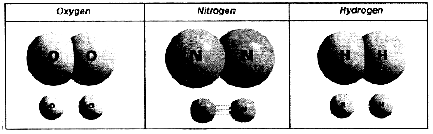
Explain the term – molecules. Give three examples of atoms of the same element forming a molecule. State the atomicity of the same.
Answer
Atoms of the same element or different elements combine to form a molecule.
Atoms of the same element forming a molecule
1. Oxygen
2. Nitrogen
3. Hydrogen.

Atomicity is the number of atoms present in one molecule of the element.
Element Molecule Atomicity
Hydrogen H H_(2) 2
Nitrogen N N_(2) 2
Oxygen O O_(2) 2
View full question & answer
[5 Mark Question Answer] - CHEMISTRY STD 6 Questions - Vidyadip