Questions

[5 Mark Question Answer]

🎯

Test yourself on this topic

9 questions · timed · auto-graded

Question 15 Marks
What are the causes of floods and drought?
Answer
Problems cause by floods:
1. A rise in the level of water in dams, rivers, lakes, etc.
2. Heavy rainfall also causes floods.
3. Floods cause extensive damage to crops, property, animals, and human life.
4. Crop-fields, villages, and many low-lying areas get submerged under floodwater.
5. Rains/floods also affect smaller animals living in the soil.
Problems cause by drought :
1. Crops may die, fodder may become scarce.
2. Living organisms of the soil die.
3. Animals may die, plants and trees will not survive.
4. Soil becomes dry, the water level in rivers, lakes, dams, etc. may fall. The ground water-level falls.
5. Drought displaces people from a large number of villages and towns.
View full question & answer
Question 25 Marks
Name the steps involved in the purification of drinking water supplied in cities and towns
Answer
The water source for our towns and cities are river, lakes or underground water which contains suspended and dissolved impurities.
To remove these impurities steps involved are:
1. Loading and sedimentation: to settle the suspended impurities to form sediment for this purpose potash alum is added.
2. Filtration: The water still contains lighter suspended impurities which are removed by filtration through sand and gravel. In cities, groundwater is drawn from a tube well or submersible pumps which have filters fitted in them. This clear water still contains germs.
3. Chlorination: To kill germs water is passed into the chlorination tank where it is treated with chlorine to kill germs. Water is now potable i.e. safer for drinking and supplied to homes.
View full question & answer
Question 35 Marks
Why is water important for plants and animals?
Answer
Importance of water for plants:
1. Plants need water to prepare their food, for germination and growth to produce fruits, flowers, etc.
2. For conduction of food prepared by plants to other-parts of plant i.e., for translocation.
3. Large number of plants live in water; water provides nutrients and oxygen for their survival. Crops need water for their growth. Water in the form of rain, washes the dust and smoke deposited on leaves by vehicles and helps the stomata in exchanging gases.
Importance of water for animals:
1. Lot of water is lost by the body of animals by sweating, in the form of urine and evaporation while doing various activities, so to make up for the lost water animals consume a lot of water in the form of drinking.
2. Water keeps the animals fresh and is a natural medicine for their many ailments.
3. Water is a good solvent and helps in the process of digestion, blood circulation, excretion, etc. in the body of organisms.
4. Water is essential for the cleanliness of animals and their surroundings
View full question & answer
Question 45 Marks
Explain the term water cycle. State the main points to show how water moves from the earth’s surface to the atmosphere and back to the earth’s surface as rain
Answer

The water cycle is a natural process by which the circulation of water takes place from the earth’s surface to the atmosphere and back to the earth’s surface as rainwater. The Process of the water cycle is discussed below :
FROM THE EARTH’S SURFACE – TO THE ATMOSPHERE
1. Evaporation— The sun’s rays fall on the earth & warm its surface & the air above it. The heat evaporates the water from the streams, rivers & the sea.
2. Water[mainly in the form of water vapour] is also added to the atmosphere by
(a) Respiration by living organisms Glucose + Oxygen → carbon dioxide + water + energy
(b) Burning of fossil fuels —
Fuel+Oxygen
$\xrightarrow{\text { heat }}$
carbon dioxide + water +energy.
3Formation of clouds— The water vapour along with the warm air rises upwards, where at higher altitudes it condenses into small droplets of water forming clouds.
BACK TO THE EARTH’S SURFACE – AS RAINWATER
1.Formation of rain— The clouds float in the atmosphere & when the size of the water droplets increases they fall down on the earth as rainwater.
2. Rainwaterfalls into streams— The rainwater is absorbed by the soil collects underground & flows into streams.
3.Stream water enters rivers & seas— The stream water finds its outlets into rivers & later enters into the seas & oceans.
4.River & seawater evaporates forming cloudsand thus continuing the water.


View full question & answer
Question 55 Marks
State what is meant by the term ‘conservation of water’.
State a few water-saving methods, which may be used in the home to conserve water.
Answer
Conservation of water is the means of preventing wastage of water so that clean water can be obtained by preventing pollution of water and by protecting the sources of water.
Need for conservation — Inspite of large quantities of water on the earth’s surface only a small percentage is potable water fit for human consumption and household purposes. The need for water is ever-increasing and hence all sources of water need to be conserved.
The various methods to conserve the water are :
1. Well should be covered and washing and cleaning should be prevented near a well.
2. Water-saving devices must be used in homes :
(a) such as closing running taps and using smaller cisterns in toilets.
(b) checking all leakages in household pipes.
(c) turning off the water tap while brushing teeth and while washing hands.
(d) using less electricity, since power plants also consume a substantial amount of water.
View full question & answer
Question 65 Marks
State some important steps to avoid pollution of water.
Answer
Steps to avoid pollution of water are :
(a) Harmful wastes such as oils & chemicals should not enter into the water.
(b) Proper toilets & sewage systems should be used to prevent human excreta, containing disease-causing organisms to enter into the water.
(c) Washing of clothes & bathing should be avoided near water sources.
(d) Planting of trees near water sources including river banks also minimizes pollution.
(e) To minimize thermal pollution the water should be cooled before being discharged as a waste.
(f) The man should be made aware through various awareness programs & media about the harmful effects of water pollution & ways to control it.
View full question & answer
Question 75 Marks
Differentiate between chemical pollution and thermal pollution.
Answer
(a)
Chemical pollution:

A large number of industrial chemicals which include chemicals from paint, textile & dyestuff industry & various acids & salt solutions enter into the water when discharged as industrial wastes.
Chemical pollutants include — Metallic salt solutions of mercury & lead which cause heavy devastation of marine & plant life.
Agricultural wastes include — Poisonous pesticides namely fungicides & insecticides which may also enter underground water through the soil.
(b)
Thermal pollution:
Certain industries such as the iron & steel industry & numerous chemical plants use large amounts of water for varied functions.
The discharged wastewater after going through technical processes is rendered hot & on entering streams of natural water enhances the growth of harmful biological organisms.
View full question & answer
Question 85 Marks
If ‘X’ g. of potassium nitrate is added to 100 g. of water at 60°C and the salt dissolves completely then :
(a) is ‘X’ g. the solubility of potassium nitrate at 60°C.
(b) is the solution formed – saturated or unsaturated
(c) if on addition ‘X’ + ‘Y’ g. of potassium nitrate to the same amount of water at the same temperature and the solute now just remains behind after stirring then –
(d) is the solution now – saturated or unsaturated
(e) is ‘X’ + ‘Y’ g. the solubility of potassium nitrate.
Answer
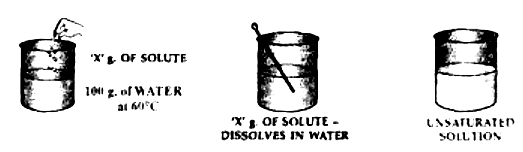
Add ‘X’ g. of solute i.e. potassium nitrate to 100 g. of water 60°C.
1. Stir the solute i.e. potassium nitrate in water thoroughly.
2. ‘X’ g. of the solute completely dissolves in water.
3. Add more solute and again stir thoroughly.
4. The solute continues to dissolves.
5. Water i.e. the solvent can dissolve more of the solute at the given temperature.
6. The solution is, therefore, is said to be unsaturated.


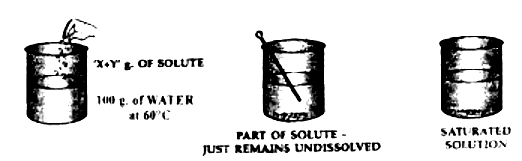
Add more solute to water till on adding an amount ‘X + Y’ g. of the solute i.e. potassium nitrate to 100 g. of water at 60°C.
1. The solute just remains behind after stirring.
2. The solution is now saturated.

A saturated solution cannot dissolve more of the solute at a given

Add ‘X’ g. of solute i.e. potassium nitrate to 100 g. of water 60°C.

1. Stir the solute i.e. potassium nitrate in water thoroughly.
2. ‘X’ g. of the solute completely dissolves in water.
3. Add more solute and again stir thoroughly.
4. The solute continues to dissolves.
5. Water i.e. the solvent can dissolve more of the solute at the given temperature.
6. The solution is, therefore, is said to be unsaturated.

Add more solute to water till on adding an amount ‘X + Y’ g. of the solute i.e. potassium nitrate to 100 g. of water at 60°C.
1. The solute just remains behind after stirring.
2. The solution is now saturated.

A saturated solution cannot dissolve more of the solute at a given temperature.temperature.

View full question & answer
Question 95 Marks
State the sources of water :
on the earth’s surface
Answer
Sources of water on the earth’s surface are :
1. Snow, frost: Snow and frost are the natural forms of water present. They are found in the solid-state.
2. Rainwater: The purest form of natural water almost free from impurities is rainwater. Rainwater may dissolve oxygen, nitrogen & carbon dioxide gas forming weak acids. In industrial regions, nitrogen dioxide and sulphur dioxide evolved may dissolve in rainwater forming nitric acid & sulphuric acid which causes acid rain.
3. River water: — It is one of the impure forms of natural water since most forms of surface water enter into the river water. It contains impurities such as sand particles, organic matter, bacteria, mineral salts which dissolve after soil erosion & dissolved gases.
4. Lake water: It is another impure form of natural water which also contains impurities and other soluble salts.
5. Seawater:The most impure form of natural water containing over 3% soluble salts including sodium chloride. It also contains salts of calcium & magnesium.
View full question & answer
[5 Mark Question Answer] - CHEMISTRY STD 6 Questions - Vidyadip