Questions

[5 marks sum]

🎯

Test yourself on this topic

9 questions · timed · auto-graded

Question 15 Marks
The angles A, B, C and D of a quadrilateral are in the ratio 2:3: 2 : 3. Show this quadrilateral is a parallelogram.
Answer
Given, Angles of a quadrilateral are in the ratio 2: 3: 2: 3
i.e. A : B : C : D are in the ratio
2: 3: 2: 3
To prove: Quadrilateral ABCD is a parallelogram
Proof: Let us take ∠A = 2x, ∠B = 3x, ∠C = 2x and ∠D = 3x
We know, that the sum of interior angles of a quadrilateral = 360°
⇒ ∠A + ∠B + ∠C + ∠D = 360°
⇒ 2x + 3x + 2x + 3x = 360°
⇒ 10x = 360°
$\Rightarrow x=\frac{360^{\circ}}{10}=36^{\circ}$
∴ ∠A = ∠C = 2x = 2 × 360° = 72°
∠B = ∠D = 3x = 3 × 36° = 360°
Now, A quadrilateral ABCD is considered as a parallelogram.
(i) When opposite angles are equal,
i.e. ∠A = ∠C = 72° and ∠B = ∠D = 108°
(ii) When adjacent angles are supplementary
i.e. ∠A + ∠B = 180°
and ∠C = ∠D = 180°
⇒ 72° + 108° and 72° + 108° = 180°
⇒ 180° = 180° and 180° = 180°
Since quadrilateral ABCD fulfills the conditions.
∴ Quadrilateral ABCD is a parallelogram.
View full question & answer
Question 25 Marks
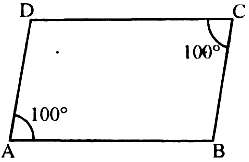
Two opposite angles of a parallelogram are 100° each. Find each of the other two opposite angles.
Answer
Given: Two opposite angles of a parallelogram are 100° each.

∵ Adjacent angles of a parallelogram are supplementary,
∴ ∠A + ∠B = 180°
⇒ 100° + ∠B = 180°
⇒ ∠B = 180° – 100°
⇒ ∠B = 80°
Also, opposite angles of a parallelogram are equal
∴∠D = ∠B = 80°
∴∠B = ∠D = 80°
View full question & answer
Question 35 Marks
The angles A, B, C and D of a trapezium ABCD are in the ratio 3: 4: 5: 6. Le. ∠A : ∠B : ∠C : ∠D = 3:4: 5 : 6. Find all the angles of the trapezium. Also, name the two sides of this trapezium which are parallel to each other. Give reason for your answer.
Answer
As the trapezium ABCD is a quadrilateral,
∴ Sum of its interior angles = 360°
⇒ ∠A + ∠B + ∠C + ∠D = 360°
⇒ 3x + 4x + 5x + 6x = 360°
⇒ 18x = 360°
$\Rightarrow x=\frac{360^{\circ}}{18}=20^{\circ}$
∴ ∠A = 3x = 3 × 20° = 60°
and ∠B = 4x = 4 × 20° = 80°
and ∠C = 5x = 5 × 20° = 100°
and ∠D = 6x = 6 × 20° = 120°
AB is parallel to DC.
∵ ∠A + ∠D = 180°
∠A and ∠D are co-interior angles whose sum = 180°
View full question & answer
Question 45 Marks
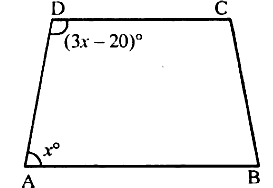
In a trapezium ABCD, side AB is parallel to side DC. If ∠A = x° and ∠D = (3x – 20)°; find the value of x.
Answer
∵ AB || DC and BC is transversal
∴ ∠A and ∠B are Co-interior angles with their sum = 180°
i.e. ∠A + ∠D = 180°

⇒ x° + (3x – 20)° = 180°
⇒ x° + 3x° – 20° = 180°
⇒ 4x° = 180° + 20°
$x^{\circ}=\frac{200}{4}=50^{\circ}$
∴ Value of x = 50°
View full question & answer
Question 55 Marks
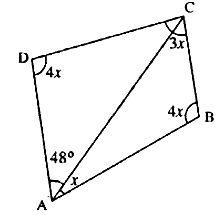
From the following figure find ;
(i) x
(ii) ∠ABC
(iii) ∠ACD
Answer
(i) In Quadrilateral ABCD,
x + 4x + 3x + 4x + 48° = 360°
12x = 360° – 48°
12x = 312
$x=\frac{312}{12}=26^{\circ}$
(ii) ∠ABC = 4x4 × 26 = 104°
(iii) ∠ACD = 180° - 4x - 48°
= 180° - 4 × 26° - 48°
= 180° - 104° - 48°
= 180° - 152° = 28°
View full question & answer
Question 65 Marks
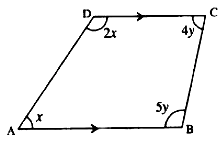
In quadrilateral ABCD, side AB is parallel to side DC. If ∠A : ∠D = 1 : 2 and ∠C : ∠B = 4 : 5
(i) Calculate each angle of the quadrilateral.
(ii) Assign a special name to quadrilateral ABCD
Answer

∵ ∠A : ∠D = 1 : 2
Let ∠A = x and ∠B = 2x
∵ ∠C : ∠B = 4 : 5
Let ∠C = 4y and ∠B = 5y
∵ AB || DC
∴ ∠A + ∠D = 180°
x + 2x = 180°
3x = 180°
x = 60°
∴ A = 60°
∠D = 2x = 2 × 60 = 120°
Again ∠B + ∠C = 180°
5y + 4y = 180°
9y = 180°
y = 20°
∴ ∠B = 5y = 5 20 = 100°
∠C = 4y = 4 20 = 80°
Hence ∠A = 60°; ∠B = 100°; ∠C = 80°
and ∠D = 120°
View full question & answer
Question 75 Marks
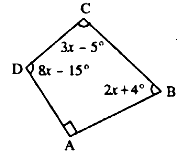
Use the information given in the following figure to find :
(i) x
(ii) ∠B and ∠C
Answer
∵ ∠A = 90°    (Given)
∠B = (2x + 4°)
∠C = (3x - 5°)
∠D = (8x - 15°)
∠A + ∠B + ∠C + ∠D = 360°
90° + (2x + 4°) + (3x - 5°) + (8x - 15°) = 360°
90° + 2x + 4° + 3x - 5° + 8x - 15° = 360°
⇒ 74° + 13x = 360°
⇒ 13x = 360° - 74°
⇒ 13x = 286°
⇒ x = 22°
∵ ∠B = 2x  4 = 2 × 22° + 4 = 48°
∠C = 3x - 5 = 3 × 22° - 5 = 61°
Hence (i) 22° (ii) ∠B = 48°, ∠C = 61°
View full question & answer
Question 85 Marks
Angles of a quadrilateral are (4x)°, 5(x+2)°, (7x – 20)° and 6(x+3)°. Find :
(i) the value of x.
(ii) each angle of the quadrilateral.
Answer
Angles of quadrilateral are,
(4x)°, 5(x+2)°, (7x – 20)° and 6(x+3)°
∴ 4x + 5(x + 2) + (7x - 20) + 6(x + 3) = 360°
4x + 5x + 10 + 7x - 20 + 6x + 18 = 360°
22x + 8 = 360°
22x = 360° - 8°
22x = 352°
x = 16°
Hence angles are,
(4x)° = (4 × 16)° = 64°
5(x + 2)° = 5(16 + 2)° = 90°
(7x - 20)° = (7 × 16 - 20)° = 92°
6(x + 3)° = 6(16 + 3) = 114°
View full question & answer
Question 95 Marks
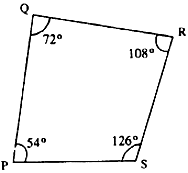
In quadrilateral PQRS, ∠P : ∠Q : ∠R : ∠S = 3 : 4 : 6 : 7.
Calculate each angle of the quadrilateral and then prove that PQ and SR are parallel to each other
(i) Is PS also parallel to QR?
(ii) Assign a special name to quadrilateral PQRS.
Answer

∵ ∠P : ∠Q : ∠R : ∠S = 3: 4: 6: 7
Let ∠P = 3x
∠Q = 4x
∠R = 6x
∠S = 7x
∴ ∠P + ∠Q + ∠R + ∠S = 360°
3x + 4x + 6x + 7x = 360°
20x = 360°
x = 18°
∴ ∠P = 3x = 3 × 18 = 54°
∠Q = 4x = 4 × 18 = 72°
∠R = 6x = 6 × 18 = 108°
∠S = 7x = 7 × 18 = 126°
∠Q + ∠R = 72° + 108° = 180°
or ∠P + ∠S = 54° + 126° = 180°
Hence PQ || SR
As ∠P + ∠Q = 72° + 54° = 126°
Which is ≠ 180°
∴ PS and QR are not parallel.
PQRS is a Trapezium as its one pair of opposite side is parallel.
View full question & answer