Questions

[3 Mark Question Answer]

🎯

Test yourself on this topic

12 questions · timed · auto-graded

Question 13 Marks
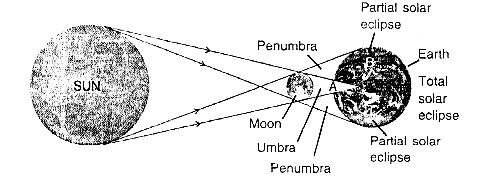
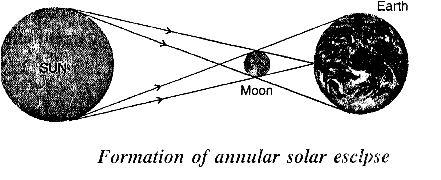
What is the annular solar eclipse? Draw a labelled diagram to show its formation.
Answer
An annular solar eclipse occurs when only the tip of the umbra of the moon falls on the earth. From point D, the sun will appear to be completely obstructed by the moon, only the outer rim of the sun, called the corona, is then visible for a very short time which is known as the diamond ring. The formation of the annular solar eclipse is shown below.
View full question & answer
Question 23 Marks
When does a solar eclipse take place? Does it occur on even’ new moon’s day?
Answer
On a certain moon’s day, the moon happens to come in between the sun and the earth. They come in a straight line. In such a situation, the moon being smaller in size casts its shadow only on a limited region on the earth. In these regions of the earth, the solar eclipse occurs.
View full question & answer
Question 33 Marks
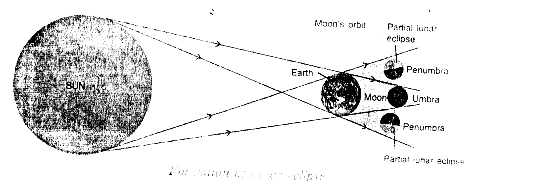
When does a lunar eclipse take place? Does it occur on every full moon’s night?
Answer
A lunar eclipse occurs when the earth comes in between the sun and moon and casts its shadow on the moon. On a full moon night, the moon rises in the east after sunsets in the west. On such a night, the sun and moon are on the opposite sides of the earth. The shadow of the earth falls on the surface of the moon therefore moon's not visible to us. This is a lunar eclipse as shown in the figure.
View full question & answer
Question 43 Marks
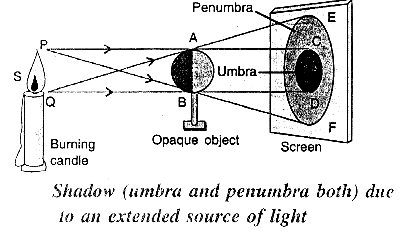
Draw a ray diagram to show the formation of umbra and penumbra both. Label the parts umbra and penumbra in your diagram.
Answer
If you move the screen away from the object, the shadow increases in size. Formation of umbra and penumbra both.
View full question & answer
Question 53 Marks
State two differences between an umbra and a penumbra.
Answer
Umbra
  1. It is the portion of shadow where no light reaches from the source of light due to the opaque object.
  2. It is completely dark.
Penumbra
It is the portion of shadow where a portion of light from the source of light reaches the shadow even in the presence of the opaque object in between them.
It is not completely dark but is dim (or less bright).
View full question & answer
Question 63 Marks
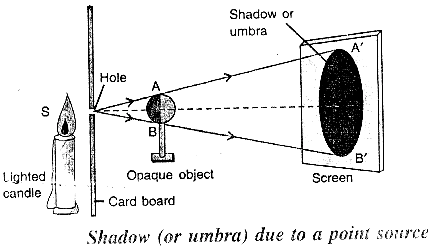
Draw a ray diagram to show the formation of the shadow of an opaque object by a point source of light. How is the size of shadow affected if the screen is moved away from the object?
Answer

If we move the screen away from the object, the shadow increases in size.
View full question & answer
Question 73 Marks
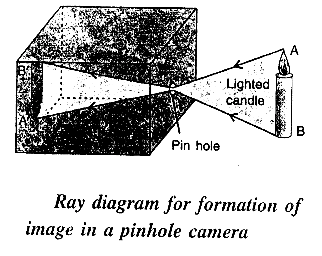
What is a pinhole camera? Draw a neat and labelled diagram to show the formation of an image of a lighted candle by it.
Answer
The pinhole camera is a simple application of the rectilinear propagation of light.
View full question & answer
Question 83 Marks
Define the terms: a ray of light and a beam of light.
Answer
The light traveling in any one direction in a straight line is called a ray of light.

A group of light rays given out from a source is called a beam of light
View full question & answer
Question 93 Marks
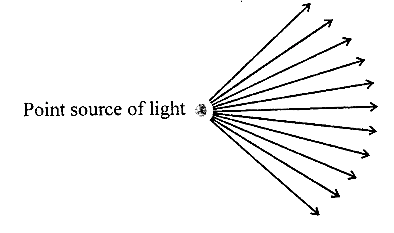
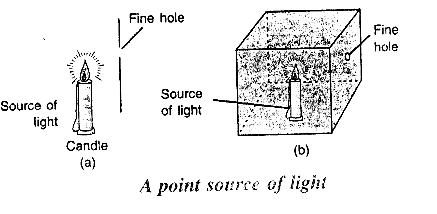
How can you obtain a point source of light?
Answer
A point source of light is obtained either by placing a screen having a fine hole, in front of die luminous body, or by placing the luminous body inside a box having a fine hole on one of its sides.
View full question & answer
Question 103 Marks
Explain the difference between a transparent, a translucent, and an opaque medium. Give two examples of each.
Answer
1. Transparent objects:Those objects through which light can pass easily are called transparent objects. e.g. Water, glass, air.
2. Translucent object:The object through which light can pass partially are called translucent object, e.g. tracing paper, waxed paper.
3. Opaque object: The objects which do not allow the light to pass through are called opaque objects, e.g. wood.
View full question & answer
Question 113 Marks
Answer the following.
Distinguish between transparent, translucent, and opaque objects.
Answer
  1. Transparent objects:Those objects through which light can pass easily are called transparent objects, e.g. Water, glass, air.
  2. Translucent object: The object through which light can pass partially are called translucent object, e.g. tracing paper, waxed paper.
  3. Opaque object:The objects which do not allow the light to pass through are called opaque objects, e.g. wood.
View full question & answer
Question 123 Marks
From among the following objects, list out the opaque, translucent, and transparent bodies in the space provided below:
A glass strip, an ordinary paper, greased paper, tracing paper, polythene sheet, wooden piece, steel plate, glycerine, kerosene oil, mustard oil, grounded glass, stone, book, water, and milk.
Opaque Transparent Translucent
Answer
Opaque Transparent Translucent
an ordinary paper A glass strip greases paper
wooden piece kerosene oil kerosene oil
steel plate water polythene sheet
stone glycerine
book mustard oil
milk grounded glass
View full question & answer
[3 Mark Question Answer] - PHYSICS STD 6 Questions - Vidyadip