Questions

[3 Mark Question Answer]

🎯

Test yourself on this topic

10 questions · timed · auto-graded

Question 13 Marks
What are the forces of cohesion and adhesion?
Answer
The force of attraction between the molecules of a similar kind is called a force of cohesion.
Example:The forces between water molecules.
This force of cohesion keeps the molecules of the substance bind together.
The force of attraction between different types of molecules is called a force of adhesion.
Example: When a glass filled with water is emptied some water particles remain stuck to the glass due to the adhesion between water molecules and glass.
View full question & answer
Question 23 Marks
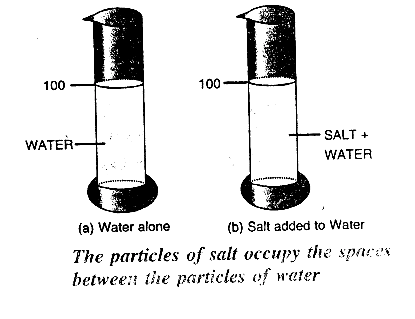
Describe a simple experiment to illustrate the existence of inter-molecular spacing.
Answer
Take 100 ml of water in a measuring cylinder. Add 20 grams of salt in the water gently and stir it well so as to dissolve the salt well in water. It is noticed that the level of water does not change. It shows that the particles of salt occupy spaces between the particles of water.
View full question & answer
Question 33 Marks
Distinguish between solids, liquids, and gases on the basis of their following properties :
(a) compressibility
(b) fluidity
(c) rigidity
(d) expansion on heating
Answer
Solids Liquids

Gases

(a) Compressibility Not compressible Negligibly compressible Highly compressible
(b) Fluidity Not possible Can flow Can flow
(c) Rigidity Highly rigid Less rigid Not rigid
(d) expansion on heating Low More than solids More than liquids
View full question & answer
Question 43 Marks
Name the three states of matter.
Answer
The three states of matter are solids, liquids, and gases.
Solids: A solid has a definite shape and definite volume.
Example: wood, stone, iron, ice, etc
Liquid: A liquid has a definite volume but no definite shape.
Example: water, juice, milk, oil, etc.
Gases: A gas neither has definite shape nor a definite volume.
Example: air, hydrogen, oxygen, water vapour, etc.
View full question & answer
Question 53 Marks
A gas has neither a definite volume nor a definite shape. Describe the molecular model to explain it.
Answer
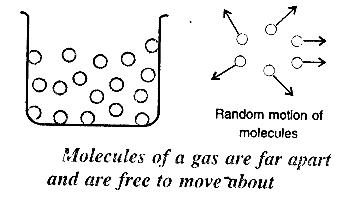
Here the molecules are far apart from each other i.e. have the greatest intermolecular distance which results in the weakest intermolecular forces of attraction. The molecules as are not

bound by any strong force move about freely and thus gases do not have a definite shape and also do not have any definite volume.
View full question & answer
Question 63 Marks
Describe the molecular model for a liquid. I-low does it explain that a liquid has no definite shape, but has a definite Volume?
Answer

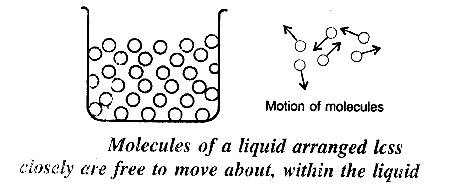
Here the molecules are less tightly packed as compared to solids and also there is the lesser force of intermolecular attraction. The intermolecular distance is greater than that in the solids. Thus, they do not have a definite shape but acquire the shape of the vessel in which they are contained but have a definite volume at a given temperature.
View full question & answer
Question 73 Marks
Give the molecular model for a solid and use it to explain why a solid has a definite volume and a definite shape.
Answer


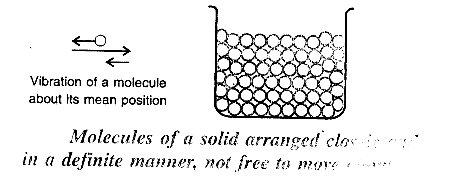
Here the molecules are very tightly packed that there is no or very less intermolecular space and there is a high intermolecular force of attraction (force of cohesion).
The molecules do not move about their mean position and thus solids have a definite shape and volume.
View full question & answer
Question 83 Marks
Describe a simple experiment to illustrate that molecules are not at rest, but they constantly move.
Answer
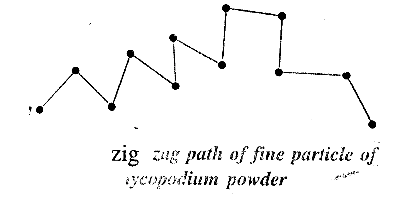
Take a beaker. Fill it partly with water. Add some lycopodium powder in the beaker containing water. Stir the contents of the beaker with a glass rod. Take out a few drops of this suspension on a glass plate. Place it on the table and illuminate it with a table lamp. Observe the glass plate through a microscope. It is found that the fine particles of lycopodium powder move rapidly in a random manner and their path is zig zag as shown in the figure below.
View full question & answer
Question 93 Marks
How do the solids, liquids, and gases differ in their following properties.
(a) Size
(b) Shape
(c) Density
Answer
Solids Liquids Gases
Size They have a definite size Indefinite Indefinite
Shape They havedefinite Shape Indefinite Indefinite
Density Highly dense Less dense than solids Less denser than liquids and solids
View full question & answer
Question 103 Marks
Differentiate between the following:
Liquids and gases
Answer
Liquids Gases
Liquids have a definite volume but no definite shape Gases have no definite shape or volume
The intermolecular force of attraction is weaker than that in solids The intermolecular force of attraction is the weakest (almost negligible)
Molecules are not as tightly packed as in solids and intermolecular space is more than that in solids. Intermolecular space is the maximum and the molecules are far apart.
Molecules have no fixed position can be compressed slightly are capable of flowing Molecules move around freely can be easily compressed can flow in all directions.
View full question & answer
[3 Mark Question Answer] - PHYSICS STD 6 Questions - Vidyadip