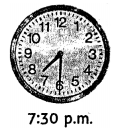
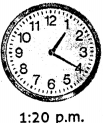
An aeroplane leaves Bengaluru at 23:50 hours and reaches Chennai at 00.40 hours. Rewrite the statement using a 12-hour time format. Also find the duration of the flight.
Answer
Aeroplane leaves Bengaluru at 11:50 p.m. and reaches Chennai at 12:40 a.m. Duration of the flight = 50 minutes
Amit dipped a stone tied with a string in a measuring cylinder filled with water. If the initial level of water was 56 mL and after dipping the stone the final level of water was 78 mL, find the volume of the stone.
Answer
Initial level of water = 56 mL Final level of water = 78mL Volume of the stone = ? Volume of the stone = Final reading – Initial reading = 78mL – 56 mL = 22 mL
We need to measure the quantities of most of the things around us to be able to take correct decisions regarding their utility. To find the exactness of an unknown quantity, we need its measurement.
Body parts should not be used for correct measurements of an object.
Answer
Body parts have different sizes from person to person and hence the value varies. Since, there is no uniformity or accuracy in the reading, body parts should not be used for correct measurement of an object.
What is the function of the bulb in a thermometer ?
Answer
The bulb in a thermometer is filled with mercuiy. When the bulb is heated, mercury in the bulb expands and rises up in the capillary tube. The height of the mercuiy gives the reading of temperature.
What do you understand by the term ‘mass’ ? Name any one instrument used for weighing.
Answer
The amount of matter present in an object is called its mass. Instruments used to measure mass are beam balance, spring balance, physical balance, electronic weighing machines, etc.
Mention any two advantages of the metric system over traditional units.
Answer
1. The metric units are accurate whereas the traditional units were not uniform. 2. The metric system is accepted globally whereas the traditional units had different values at different places.
What are derived physical quantities ? Give any two examples of derived physical quantities.
Answer
Physical quantities that are derived from one or more fundamental physical quantities are called derived physical quantities. Examples : area, volume, speed, density, etc.