Questions

[2 Mark Question Answer]

🎯

Test yourself on this topic

21 questions · timed · auto-graded

Question 12 Marks
The rainfall in a city on each day of a week is recorded below. Find the average rainfall for the week.
daymontuewedthursfrisatsun
rainfall
(in mm)
1.210.35.50.013.57.01.0
Answer
The sum of recorded rainfall
1.2 mm + 10.3 mm + 5.5 mm + 13.5 mm + 7 mm + 1mm = 38.5 mm Number of days = 7
Average rainfall of the week =$\frac{\text { sum of all observations }}{\text { number of days }}$
$=\frac{38.5}{7} mm =5.5 mm$
View full question & answer
Question 22 Marks
The masses of five marbles are 50 g, 55 g, 60 g, 65 g and 70 g. Find their average mass.
Answer
The sum of masses of all marbles
= 50 g + 55 g + 60 g + 65 g + 70 g = 300 g
Number of marbles = 5
Average mass of a marble$=\frac{\text { sum of mass }}{\text { no.of marbles }}$
$\frac{300}{5}$
= 60 g
View full question & answer
Question 32 Marks
A piece of wire is wound around a pencil 60 times. If the total width of all the turns is 4 cm, find the diameter of the wire.
Answer
Number of turns of wire = 60
Total width of turns of wire = 4 cm
Diameter of the wire =$\frac{\text { Total width of turns of wire }}{\text { Number of turns of wire }}$
$\frac{4}{60}=0.066 cm$
View full question & answer
Question 42 Marks
20 one-rupee coins are placed one above the other. If their total height is 32 mm, find the thickness of one coin.
Answer
Number of coins = 20
Total height of coins = 32 mm
Thickness of one coin = ?
Thickness of one coin = img
$\frac{32}{20}$= 1.6mm
View full question & answer
Question 52 Marks
Express :
a. 2.25 m in cm
b. 6 L in mL
c. 8000 g in kg
Answer
a. 2.25 m
= 2.25 x 100 cm [As lm = 100 cm]
= 225 cm
b. 6 l
= 6 x 1000 ml [As 1 l = 1000 ml]
= 6000 ml
c. 8000 g
= 8000 ÷ 1000 kg [As 1000 g = 1 kg]
= 8 kg
View full question & answer
Question 62 Marks
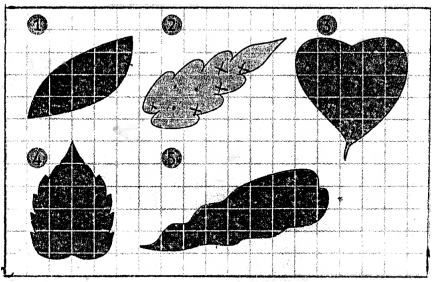
Image
Answer
The area of leaf $5$
$– 1 \times ($Number of complete squares$) \ cm^2$
$+ \frac{1}{2} \times ($Number of half or more than half squares$) \ cm^2$
$= 1 x 6 \ cm^2 + \frac{1}{2} \times 9 \ cm^2$
$= 6 \ cm^2 + 4.5 \ cm^2 = 10.5 \ cm^2$
View full question & answer
Question 72 Marks
Image
Answer
The area of leaf $4$
$= 1 \times($Number of complete squares$) \ cm^2$
$+ \frac{1}{2} \times ($Number of half or more than half squares$) \ cm^2$
$= 1 \times 6 \ cm^2 + \frac{1}{2} \times 8 \ cm^2$
$= 6 \ cm^2 + 4 \ cm^2 = 10 \ cm^2$
View full question & answer
Question 82 Marks
Image
Answer
The area of leaf $3$
$= 1 \times ($Number of complete squares$) \ cm^2$
$+ \frac{1}{2} \times ($Number of half or more than half squares$) \ cm^2$
$= 1 \times 7 \ cm^2 + \frac{1}{2} \times 9 \ cm^2$
$= 7 \ cm^2 + 4.5 \ cm^2 = 11.5 \ cm^2$
View full question & answer
Question 92 Marks
Image
Answer
The area of leaf $2$
$= 1 \times ($Number of complete squares$) \ cm^2 + 12 x ($Number of half or more than half squares$) \ cm^2$
$= 1 \times 3 \ cm^2 + 12 x 5 \ cm^2$
$= 3 \ cm^2 + 2.5 \ cm^2 = 5.5 \ cm^2$
View full question & answer
Question 102 Marks
Image
Answer
The area of leaf $1$
$= 1 \ \times ($Number of complete squares$) \ cm^2$
$+ 12 \ \times ($Number of half or more than half squares$) \ cm^2$
$= 1 \times 3 \ cm^2 + 12 x 5 \ cm^2$
$= 3 \ cm^2 + 2.5 \ cm^2 = 5.5 \ cm^2$
View full question & answer
Question 112 Marks
Describe any two means by which the actual capacity of a measuring container can be made less than the correct value by a dishonest trader.
Answer
(i) The base of the measuring container can be bend inwards by hammering which reduces the capacity of liquid it can hold.
(ii) Some lead can be poured into the measuring container.
View full question & answer
Question 122 Marks
Why is there a slight bend in the capillary tube of a clinical thermometer near the bulb ?
Answer
A slight bend or kink in the capillary tube of the clinical thermometer near the bulb ensures that the mercury does not move back into the bulb when the thermometer is taken out of a person’s mouth for reading.
View full question & answer
Question 132 Marks
Explain the working of an extension spring balance.
Answer
When a body to be weighed is attached to the hook, the coil is stretched downwards. The distance through which the spring gets stretched is measured by a pointer and a graduated scale attached to the spring. The reading on the scale gives the weight of the object.
View full question & answer
Question 142 Marks
Why are multiples and submultiples of SI units required?
Answer
Sometimes, the size of the SI unit is either too small or too big to measure a certain quantity. For example, a metre is too small a unit to measure the distance between two cities and too big a unit to measure the thickness of a wire. Hence, multiples and submultiples of units are required. Multiples are factors used to create larger forms whereas submultiples are factors used to create smaller forms of the SI units. For example, a centimetre is a submultiple and kilometre is a multiple of a metre.
View full question & answer
Question 152 Marks
Explain in detail why there was a need to standardize units.
Answer
The traditional units were not uniform as the length of a cubit, foot and handspan varied from person to person according to their body size. Similarly, there was no certainty that all grains were exactly the same weight. So these units could not be used.for scientific measurements where accuracy was. a prime concern. The development of a large number of systems of measurement also made it very difficult to conduct trade and commerce between different socities. Therefore, people felt the need to have standard units which could be used for accurate measurement and were accepted universally.
View full question & answer
Question 162 Marks
Explain by giving two examples why the measurement of a physical quantity is expressed as a combination of a numeral and a unit.
Answer
To measure a physical quantity, we need to compare it with a known fixed physical quantity of the same kind, i.e., a unit. Hence, the measurement of a physical quantity is always written as a combination of a numeral along with the unit. The numeral specifies the number of times the unit is repeated.
View full question & answer
Question 172 Marks
What are fundamental physical quantities ? Name any three fundamental physical quantities.
Answer
Basic physical quantities that do not depend upon other quantities are called fundamental physical quantities. There are seven fundamental quantities – length, mass, temperature, time, electric current, luminous intensity and amount of substance.
View full question & answer
Question 182 Marks
When are approximations necessary in daily life and when should they be avoided ?
Answer
An approximation or estimation is a reasonable guess about the measure of a physical quantity. For example, -we use approximation in adding salt to food while cooking. We use approximation when we try to figure out the time it would take to reach a certain place by car. In our daily life, we use approximations in many situations. They are useful as they save time. But, since they are not accurate in measurements, they should be avoided in scientific studies and experimentation.
View full question & answer
Question 192 Marks
What do you understand by the term temperature ? Distinguish between laboratory’ and clinical thermometers.
Answer
The degree of hotness or coldness of an object is called its temperature.
Laboratory thermometer :
  • It is used to measure temperatures for scientific purposes in a laboratory.
  • The kink is not present.
  • The lower fixed point is -10°C and upper fixed point is 110°C

    Clinical thermometer:
  • It is used to measure temperature of the human body.
  • A slight bend or kink is present near the bulb.
  • The lower fixed point is 35°C or 95° F and the upper fixed point is 42°C or 108° F.
View full question & answer
Question 202 Marks
Explain in detail why railways and airlines use the 24- hour clock format.
Answer
Railways and airlines use the 24-hour clock format as they operate round the clock (24 hour). The main features of 24- hour clock system are :
  • a.m. and p.m. are not used in order to avoid confusion.
  • Time is shown by’4 digits. The first two digits indicate the number of hours, and the next two digits indicate the number of minutes.
  • Time is expressed continuously from 00.00 (midnight) to 24:00.
View full question & answer
Question 212 Marks
What do you understand by the terms volume and capacity ? Which is the most suitable unit for measuring the volume of a/an
$a.$ glass filled with water
$b.$ swimming pool
$c.$ air inside an inflated balloon
$d.$ cylinder of a car engine
Answer
The total space occupied by an object is called its volume. The maximum volume of a liquid that a container can hold is known as its capacity. Capacity and volume have same units $–$ litres $(L)$ and millilitres $(mL).$
$(a)$ millilitre $(mL)$
$(b)$ cubic metre $(m^3)$
$(c)$ millilitre $(mL)$
$(d)$ cubic centimetre $(cc)$ or $cm^3$
View full question & answer