Questions

[2 Mark Question Answer]

🎯

Test yourself on this topic

25 questions · timed · auto-graded

Question 12 Marks
Convert the following quantity as indicated:
0.2 cm = mm
Answer
$\begin{aligned} & 1 cm =10 mm \\ & \therefore 0.2 cm =10 \times 0.2 mm \\ & =10 \times \frac{2}{10} mm =2 mm \\ & \therefore 0.2 cm =2 mm \end{aligned}$
View full question & answer
Question 22 Marks
Convert the following quantity as indicated:
0.2 km = m
Answer
$\begin{aligned} & 1 km =1000 m \\ & \therefore 0.2 km =1000 \times 0.2 m \\ & =1000 \times \frac{2}{10} m =200 m \\ & \therefore 0.2 km =200 m \end{aligned}$
View full question & answer
Question 32 Marks
Convert the following quantity as indicated:
4.2 m = cm
Answer
$\begin{aligned} & 1 m =100 cm \\ & \therefore 4.2 m =100 \times 4.2 cm \\ & =100 \times \frac{42}{10} cm =420 m \\ & \therefore 4.2 m =420 cm \end{aligned}$
View full question & answer
Question 42 Marks
Convert the following quantity as indicated:
20 cm = m
Answer
$\begin{aligned} & 100 cm 1 m \\ & \because 1 cm =\frac{1}{100} m \\ & \therefore 20 cm =\frac{1}{100} \times 20 m =0.2 m \\ & \therefore 20 cm =0.2 m \end{aligned}$
View full question & answer
Question 52 Marks
Define one metre, the S.I. unit of length. State it's one multiple and one submultiple.
Answer
One metre is defined as the distance travelled by light in the air in $\frac{1}{299,792,458}$ of a second
Multiple of metre $=$ Kilometre
Submultiple of metre $=$ Centimetre
View full question & answer
Question 62 Marks
What are the S.I. units of
  1. mass
  2. length
  3. time and
  4. temperature.
Write their names and symbols.
Answer
S.I. units are as follows:
Quantity S.I. unit Symbol of S.I. unit
(1) Length metre m
(2) Mass kilogram kg
(3) Time Second s.
(4) Temperature kelvin k
View full question & answer
Question 72 Marks
How is the unit of square yard related to the S.I. unit of area?
Answer
One square yard is the area of a square of each side $0.836$ metre
$1$ Square yard $= 1 yard\times 1 yard$
$= 0.9144 m \times 0.9144 m$
$= 0.836 m^2$​​​​​​​ ( or $0.84 m^2​​​​​​​$​​​​​​​ nearly)
View full question & answer
Question 82 Marks
Can a clinical thermometer be used to measure the temperature of the boiling water? Give the reason for your answer.
Answer
No, a clinical thermometer cannot be used to measure the temperature of boiling water.
The reasons are
  1. It has a very small range.
  2. It can break on cooling and on excess heating.
View full question & answer
Question 92 Marks
What is the normal temperature of the human body? How is it indicated in a clinical thermometer?
Answer
Normal temperature of a human body is 37°C or 98.6 °F.
To measure the temperature of a patient’s body, its bulb is kept either below the tongue or under the arm’s pit of the patient for about a minute. Then the thermometer is taken out and its reading is noted. When the temperature of a patient’s body is above 37°C, he is said to suffer from fever.
View full question & answer
Question 102 Marks
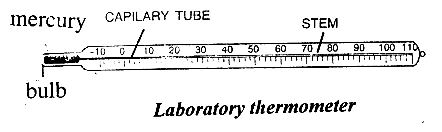
Name the instrument used for measuring the temperature of a person. Draw its labelled neat diagram.
Answer
The temperature is measured with a thermometer.
View full question & answer
Question 112 Marks
Express in second:
5 hour 2 minute 5 second.
Answer
1 minute = 60 second
2 minutes = 2 × 600 = 120 second .....…(1)
1 hour 3600 second
5 hour 3600 × 5 = 18000 second …............(2)
5 hour 2 minutes and 5 second
= 18000 + 120 + 5 = 18125 seconds
View full question & answer
Question 122 Marks
Name and define the S.I. unit of time. How is it related to (i) minute (ii) hour, (iii) day, and (iv) year?
Answer
The S.I. unit of time is second. In the short form, we write it as ‘ S ’.
One second is the time interval between the two consecutive ticks that you hear from the pendulum wall clock.
(i) $1$ min $= 60 s$
(ii) $1$ $h = 60$ min. $= 3600 s.$
(iii) $1$ day $= 24$ h $= 86400 s.$
(iv) $1$ year $= 365$ days $= 3.15 \times 10^7s.$
View full question & answer
Question 132 Marks
Convert the following quantity as indicated:
5 mg = ………. kg
Answer
$\begin{aligned} & 5 mg =5 \times 10^{-6} kg \\ & 5 mg =\frac{5}{1000} g \text { or } 5 \times 10^{-3} g \\ & \frac{5}{1000} g \text { or } 5 \times 10^{-3} g =\frac{5}{1000 \times 1000} \text { or } 5 \times 10^{-6} kg \end{aligned}$
View full question & answer
Question 142 Marks
Convert the following quantity as indicated:
0.01 kg = ………. g
Answer
$\begin{aligned} & 0.01 kg =10 g \\ & 1 kg =1000 g \\ & \therefore 0.01 kg =1000 \times 0.01 g \\ & =1000 \times \frac{1}{100} g =10 g \\ & \therefore 0.01 kg =10 g \end{aligned}$
View full question & answer
Question 152 Marks
Convert the following quantity as indicated:
250 g = …....... kg
Answer
$\begin{aligned} & 2500 g =2.5 kg \\ & 1000 g =1 kg \\ & 1 g =\frac{1}{1000} kg \\ & \therefore 2500 g =\frac{1}{1000} \times 2500 kg =2.5 kg \\ & \therefore 2500 g =2.5 kg \end{aligned}$
View full question & answer
Question 162 Marks
Convert the following quantity as indicated:
10 lb = ………. kg
Answer
$\begin{aligned} & 10 lb =4.5359 kg \\ & 1 lb =453.59 g \\ & =453.59 \times \frac{1}{1000} kg \ldots \ldots .[\therefore 1 kg =1000 g ] \\ & =0.45359 kg \\ & \therefore 10 lb =0.45359 kg \times 10 kg \\ & =4.5359 kg \\ & \therefore 10 lb =4.5359 kg \end{aligned}$
View full question & answer
Question 172 Marks
Convert the following quantity as indicated:
150 kg = quintal
Answer
$\begin{aligned} & 150 kg =1.5 \text { quintal } \\ & 100 kg =1 \text { quintal } \\ & 1 kg =\frac{1}{100} \text { quintal } \\ & 150 kg =\frac{1}{100} \times 150 \text { quintal } \\ & =1.5 \text { quintal } \\ & \therefore 150 kg =1.5 \text { quintal }\end{aligned}$
View full question & answer
Question 182 Marks
Convert the following quantity as indicated:
2500 kg = ………. metric tonne.
Answer
$2500 kg =2.5$ metric tonne.
$1000 kg =1$ metric tonne
$1 kg =\frac{1}{1000}$ metric tonne
$\therefore 2500 kg =\frac{1}{1000} \times 2500$ metric tonne
$\therefore 2500 kg =2.5$ metric tonne
View full question & answer
Question 192 Marks
Define mass. State its (1) S.I. (2) C.GS and (3) EP.S. units. How are they related?
Answer
The mass of a body is the quantity of matter contained in it. The S.I. unit of mass is the kilogram. In short form, it is written as kg.
In C.GS. the system, the unit of mass is the gram, (symbol g).
In F.P.S. system, the unit of mass is the pound (symbol lb)
View full question & answer
Question 202 Marks
Solve the following numerical problem.
The masses of five marbles are 50 g, 55 g, 60 g, 65 g, and 70 g. Find their average mass.
Answer
The sum of masses of all marbles
= 50 g + 55 g + 60 g + 65 g + 70 g = 300 g
Number of marbles = 5
Average mass of a marble = sum of mass / no. of marbles
= 300 / 5 g
= 60 g
View full question & answer
Question 212 Marks
Solve the following numerical problem.
Amit dipped a stone tied with a string in a measuring cylinder filled with water. If the initial level of water was 56 mL and after dipping the stone the final level of water was 78 mL, find the volume of the stone.
Answer
Initial level of water = 56 mL
Final level of water = 78mL
Volume of the stone =?
Volume of the stone = Final reading – Initial reading
= 78mL – 56 mL
= 22 m
View full question & answer
Question 222 Marks
Solve the following numerical problem.
A piece of wire is wound around a pencil 60 times. If the total width of all the turns is 4 cm, find the diameter of the wire.
Answer
Number of turns of wire $=60$
Total width of turns of wire $4 cm$
Diameter of the wire?
Diameter of the wire $=$ Total width of turns of wire $/$ Number of turns of wire
$
\begin{aligned}
& =\frac{4}{60} \\
& =0.066 cm
\end{aligned}
$
View full question & answer
Question 232 Marks
Solve the following numerical problem.
20 one – rupee coins are placed one above the other. If their total height is 32 mm, find the thickness of one coin.
Answer
Number of coins 20
Total height of coins $=32 mm$
Thickness of one coin?
Thickness of one coin $=$ Height of all coins $/$ Number of coins
$
\begin{aligned}
& =\frac{32}{60} \\
& =1.6 mm
\end{aligned}
$
View full question & answer
Question 242 Marks
Solve the following numerical problem.
The rainfall in a city on each day of a week is recorded below. Find the average rainfall for the week.
day Mon Tue Wed Thurs Fri Sat Sun
Rainfall
(in mm)
1.2 10.3 5.5 0.0 13.5 7.0 1.0
Answer
The sum of recorded rain fall
1.2 mm + 10.3 mm + 5.5 mm+ 13.5 mm + 7 mm+ 1mm = 38.5 mm
Number of days = 7
Average rainfall of the week = sum of all observations / number of days
= 38.5 / 7 mm = 5.5 mm
View full question & answer
Question 252 Marks
Answer the following in detail.
Explain in detail why railways and airlines use the 24-hour clock format.
Answer
Railways and airlines use the 24-hour clock format as they operate round the clock (24 hours).
The main features of the 24-hour clock system are:
  1. a.m. and p.m. are not used in order to avoid confusion.
  2. Time is shown by 4 digits. The first two digits indicate the number of hours, and the next two digits indicate the number of minutes.
  3. Time is expressed continuously from 00.00 (midnight) to 24:00.
View full question & answer
[2 Mark Question Answer] - PHYSICS STD 6 Questions - Vidyadip