Questions

[3 Mark Question Answer]

Take a timed test

10 questions · self-marked practice — reveal the answer and mark yourself.

Question 13 Marks
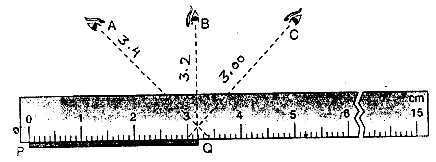
The diagram below shows a stick placed along a metre RULER. The length of the stick is measured keeping the eye at positions A, B, and C.
Answer
(a) Write the length of stick PQ as observed, for each position of the eye. Are they all same?
Ans. Length of stick PQ from
Position A =3.4 cm
Position B = 3.2cm
Position C = 3.00 cm
No, they are not the same.
(b) Which is the correct position of the eye? Write the correct length of the stick.
Ans. ‘B’ is the correct position of the eye. Correct length of the stick PQ = 3.2cm
View full question & answer
Question 23 Marks
Explain how you will measure the area of $(i)$ a square $(ii)$ a leaf?
Answer
The area of a square can be calculated by using the following formula:
i. Area of square of side l
= side x side
$= l \times l = L^2.$
ii. The area of a leaf is obtained by using a graph paper. A graph paper has small squares of each side 1 mm. The area of each big square is $1 cm^2.$
Procedure: Place the leaf on graph paper. Draw its outline on the paper and remove it. Now count the number of complete squares. To this add the number of incomplete squares which are half or more than half. Ignore the squares which are less than half. Thus,
Approximate area = (No. of complete squares + no. of half or more than half of incomplete squares) × area of one square.
View full question & answer
Question 33 Marks
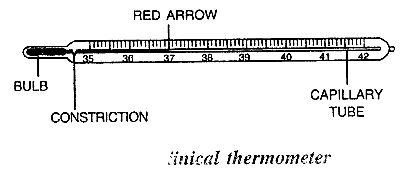
What is a clinical thermometer? State its special feature. Draw a labelled neat diagram of a clinical thermometer showing the range of temperature marked on it.
Answer
Doctors use a special thermometer called the clinical thermometer for measuring the temperature of the patient’s body. This thermometer has the markings from 35°C to 42°C. It has a slight bend or kink in the stem just above the bulb. This kink is called the constriction. This constriction prevents the mercury from falling back all by itself. The temperature of a healthy person is 37°C. This temperature is marked by a red arrow.
View full question & answer
Question 43 Marks
Name the instrument which is commonly used to measure the mass of a body. State how is it used?
Answer
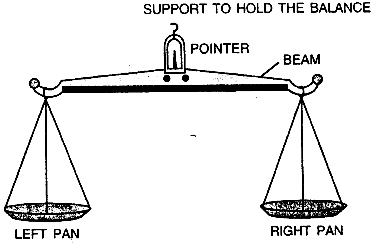
Instrument commonly used to measure the mass of a body is the beam balance.

When we hold up the balance, we observe that when there is nothing on either pan, the beam is horizontal. The body whose mass is to be measured is placed on the left pan. The standard weight is put on the right pan. They are so adjusted that the beam is again horizontal on holding the balance up. The total of the standard weights gives the mass of the given body.
View full question & answer
Question 53 Marks
Answer the following in detail.
When are approximations necessary in daily life and when should they be avoided?
Answer
An approximation or estimation is a reasonable guess about the measure of a physical quantity. For example, we use an approximation in adding salt to food while cooking. We use approximation when we try to figure out the time it would take to reach a certain place by car. In our daily life, we use approximations in many situations. They are useful as they save time. But, since they are not accurate in measurements, they should be avoided in scientific studies and experimentation.
View full question & answer
Question 63 Marks
Answer the following in detail.
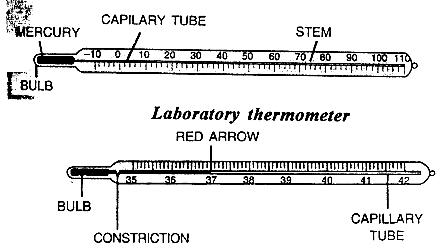
Distinguish between laboratory and clinical thermometers.
Answer
Laboratory thermometer Clinical thermometer
(1) It is used to measure temperatures for scientific purposes in a laboratory. (1) It is used to measure the temperature of the human body.
(2) The kink is not present. (2) A slight bend or kink is present near the bulb.
(3) The lower fixed point is - 10°C and the upper fixed point is 110°C. (3) The lower fixed point is 35°C or 95° F and the upper fixed point is 42°C or 108° F.
View full question & answer
Question 73 Marks
Answer the following in detail.
What do you understand by the term temperature?
Answer
The degree of hotness or coldness of an object is called its temperature.
View full question & answer
Question 83 Marks
Answer the following in detail.
Why are multiples and submultiples of SI units required?
Answer
Sometimes, the size of the SI unit is either too small or too big to measure a certain quantity. For example, a metre is too small a unit to measure the distance between two cities and too big a unit to measure the thickness of a wire. Hence, multiples and submultiples of units are required. Multiples are factors used to create larger forms whereas submultiples are factors used to create smaller forms of the SI units. For example, a centimetre is a submultiple and kilometre is a multiple of a metre.
View full question & answer
Question 93 Marks
Answer the following in detail.
Explain in detail why there was a need to standardize units.
Answer
The traditional units were not uniform as the length of a cubit, foot and handspan varied from person to person according to their body size. Similarly, there was no certainty that all grains were exactly the same weight. So these units could not be used for scientific measurements where accuracy was a prime concern. The development of a large number of systems of measurement also made it very difficult to conduct trade and commerce between different societies. Therefore, people felt the need to have standard units that could be used for accurate measurement and were accepted universally.
View full question & answer
Question 103 Marks
Answer the following in detail.
Explain by giving two examples of why the measurement of a physical quantity is expressed as a combination of a numeral and a unit.
Answer
To measure a physical quantity, we need to compare it with a known fixed physical quantity of the same kind, i.e., a unit. Hence, the measurement of a physical quantity is always written as a combination of a numeral along with the unit. The numeral specifies the number of times the unit is repeated.
Example :
  1. Using a centimeter scale, the length of the pencil box is found to be 20 centimeters (cm). 20 cm simply means that the length is 20 times a centimeter. (The centimeter forms the unit of length in a centimeter scale.) Here, the number 20 is the numeral (magnitude) and cm is the unit.
  2. Using a weighing (kilogram) scale, the weight of the box is found to be 2 kilograms (kg) 2 kg simply means that the mass of the box is 2 times a kilogram. (The kilogram forms the unit of mass in a kilogram scale). Here, the number 2 is the numeral (magnitude) and kg is the unit.
View full question & answer
[3 Mark Question Answer] - PHYSICS STD 6 Questions - Vidyadip