Questions

[5 Mark Question Answer]

🎯

Test yourself on this topic

4 questions · timed · auto-graded

Question 15 Marks
Describe in steps how would you measure the length of a pencil using a metre rule. Draw a diagram if necessary.
Answer
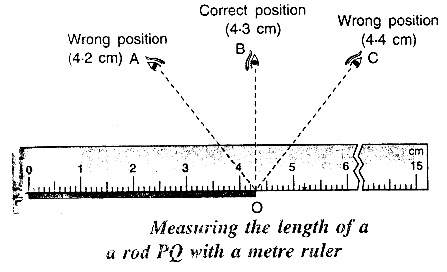
To measure the length of a pencil using a metre rule, place metre rule with its marking close to the object. Let PQ be a pencil.
The end P of the pencil coincides with the zero marks on the ruler. The end Q of the pencil is read by keeping the eye at the position ‘B’ vertically above the end Q. So the length of the pencil is 4.3 cm.
Explain with an example of how you will use the metre ruler in part (a) if the ends of a ruler are broken.
Ans. The ends of the ruler get damaged with use and its zero marks may not be visible. To measure the length of an object with such a ruler, the object is placed close to a specific marking on the ruler and positions of both ends of the object are read on the ruler.
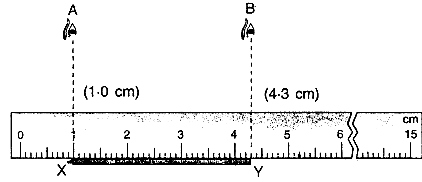
The difference between the two readings gives the length of the object. In fig. the reading on the ruler at the end X is 1.0 cm and at the end, Y is 4.3 cm. So the length of the rod XY is 4.3 — 1.0 = 3.3 cm.
View full question & answer
Question 25 Marks
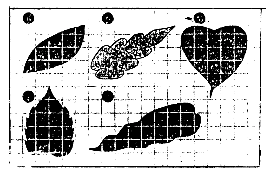
Find the area of these leaves, where 1 square on the graph paper represents $1 cm^2.$
Answer
(1) The area of leaf 1
$=1 \times$ (Number of complete squares) $cm ^2$
$+\frac{1}{2}$ (Number of half or more than half squares) $cm ^2$
$=1 \times 3 cm ^2+\frac{1}{2} \times 5 cm ^2$
$=3 cm ^2+2.5 cm ^2$
$=5.5 cm ^2$
(2) The area of leaf 2
$=1 \times$ (Number of complete squares) $cm ^2+\frac{1}{2} \times$ (Number of half or more than half squares) $cm ^2$
$ =1 \times 3 cm ^2+\frac{1}{2} \times 5 cm ^2$
$=3 cm ^2+2.5 cm ^2$
$=5.5 cm ^2 $
(3) The area of leaf 3
$=1 \times$ (Number of complete squares) $cm ^2$
$+\frac{1}{2} \times$ (Number of half or more than half squares) $cm ^2$
$=1 \times 7 cm ^2+\frac{1}{2} \times 9 cm ^2$
$=7 cm ^2+4.5 cm ^2$
$=11.5 cm ^2$
(4) The area of leaf 4
$ =1 \times \text { (Number of complete squares) } cm ^2$
$+\frac{1}{2} \times \text { (Number of half or more than half squares) } cm ^2$
$=1 \times 6 cm ^2+\frac{1}{2} \times 8 cm ^2$
$=6 cm ^2+4 cm ^2$
$=10 cm ^2 $
(5) The area of leaf 5
$=1 \times$ (Number of complete squares) $cm ^2$
$+\frac{1}{2} \times$ (Number of complete squares) $cm ^2$
$ =1 \times 6 cm ^2+\frac{1}{2} \times 9 cm ^2$
$=6 cm ^2+4.5 cm ^2$
$=10.5 cm ^2 $
View full question & answer
Question 35 Marks
Answer the following in short.
Explain the working of a beam balance.
Answer
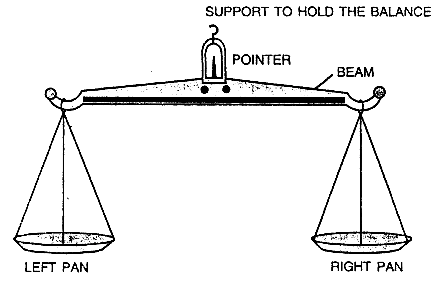
A beam balance is the simplest instrument to measure mass (weight). In a beam balance, the mass of an object is measured by comparing it with standard masses called standard weights. A simple beam balance consists of a straight beam of metal (generally iron), supported at its centre with the help of an iron loop. A pointer is fixed at the centre of the iron loop. Two identical pans are suspended at equal distances from the centre, at the two ends of the beam.
Working: The object whose mass has to be measured is placed on one of the pans (generally the right pan). Standard weights are placed on the other pan until the metallic beam becomes hori7ontal and the pointer becomes vertical. The sum total of all weights used gives the mass of the object.
View full question & answer
Question 45 Marks
Answer the following in detail.
State some common rules to write SI units correctly.
Answer
Guidelines for capitalization:
Guidelines Examples
Unit Names


Unit Symbols


Prefix Names


Prefix Symbols
If a unit is derived from the name of a person, its name is always written in small letters.
A unit not named after persons is written in small letters.
The symbol used for a unit is normally written in small letters.
If the symbol of the unit is derived from the name of a person, it is written in capital letters.
If a unit is represented by more than one letter, the first letter of the symbol is capitalized.


Prefix names are written in small letters unless they occur at the beginning of a sentence. No space or hyphen is used between the prefix and the unit name. So a prefix name and a unit name are taken together as a single word.

Prefix symbols are attached to unit symbols without any space between them. Prefix symbols up to the kilo level are written in small letters but the ones with larger values are written in capital letters.
newton (not Newton), joule (not joule)


metre (not Metre) second(not second)


metre : m (not M), second :s (not S) newton : N (not n), amphere : A (not a) pascal :Pa, hertz :Hz

milligram (not Milligram or milli-gram of a milligram), centimeter (not Centimetre or centimeter or) (centimeter) mg (milligram) M W (megawatt)
GuidelinPrefix Symbolses for Plurals
Guidelines Examples
The plural form is used only when the unit is written in full. Symbols of units are never written in the plural. So, 's' is not added to the symbol of a unit. 10 metres : 10 m(not 10 ms) 10 seconds : 10 s(not 10 ss)
Guidelines for punctuation
Guidelines Examples
A full stop is never put at the end of a unit symbol unless it occurs at the end of a sentence. "It is 50 cm long." but not "It is 50 cm. long."
View full question & answer
[5 Mark Question Answer] - PHYSICS STD 6 Questions - Vidyadip