Questions

[3 Mark Question Answer]

Take a timed test

10 questions · self-marked practice — reveal the answer and mark yourself.

Question 13 Marks
Name six simple machines. Give an example of each machine.
Answer
Simple Machines and their examples are as follows:
  1. The lever: Examples are a crowbar, claw hammer, a pair of pliers, etc.
  2. The Inclined plane: Examples are ramp, staircase, hilly roads, etc.
  3. The wedge: Examples are knife, axe, plough, nail, etc.
  4. Screw: Examples are A screw.
  5. The wheel and axle: Examples are steering wheel of a car, bicycle pedal, etc.
  6. The pulley: Examples are a pulley used in raising a load.
View full question & answer
Question 23 Marks
What is a wedge? Give two examples.
Answer
A wedge is a double inclined plane such that the two sloping surfaces taper to form either a sharp edge or a pointed edge.
Examples:
A knife, an ax, a chisel.
In some special cases, the number of inclined planes used can be more than two as well. In such cases, the sloping surfaces generally taper to form either a very sharp or a pointed edge to split or pierce materials. Pins, nails, and needles are examples of pointed wedges. The front end of a boat is shaped like a wedge so that it can easily cut across the flowing water.
The wedge works on a principle of an inclined plane.
View full question & answer
Question 33 Marks
Answer the following in detail.
What is the use of an inclined plane? Give two examples where it is used.
Answer
The mechanical advantage of an inclined plane is the ratio of the length of the plank to the vertical height of the load raised. Its value is greater than one. Therefore, an inclined plane acts as a force multiplier. Thus, it can be used to lift heavy loads.
Example: If a heavy box needs to be loaded on a lorry, it is far easier to push it over an inclined plane than to lift it up. Steeper the inclined plane, greater will be the effort required to push up the load.
Sloping ramps, flyovers, roads on hills and staircases are all examples of inclined planes.
View full question & answer
Question 43 Marks
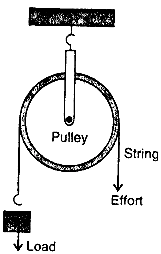
Draw a neat labelled diagram showing a pulley being used to lift a load. How are load and effort related in an ideal situation?
Answer
To raise a load, the load is attached to one end of the string and the effort is applied at the other end by pulling it is a downward direction . as shown in fig.
View full question & answer
Question 53 Marks
The mechanical advantage of an actual pulley is less than one. Give a reason. What is the justification for using the pulley then?
Answer
In an actual pulley due to friction, the mechanical advantage is less than 1 (i.e. the effort is more than the load).
The reason for using the pulley when its mechanical advantage is equal to 1 or less than 1 is that the pulley allows us to apply the effort downwards i.e. in a convenient direction. To raise a load directly upwards is difficult. But with the help of a pulley, the effort can be applied in the downward direction to move the load upwards. One can hang on it to make use of his own weight also in order to apply the effort.
View full question & answer
Question 63 Marks
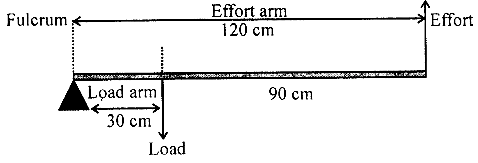
In a lever, the fulcrum is at one end at a distance of 30 cm from the load and effort is at the other end at a distance of 90 cm from the load. Find :
(a) the length of load arm,
(b) the length of effort arm, and
(c) the mechanical advantage of the lever.
Answer

Given,
$
\begin{aligned}
& \text { (a) Load arm }=30 cm \\
& \text { (b) Effort arm }=(90+30) cm =120 cm \\
& \text { (c) Mechanical advantage }=\frac{\text { Effort arm }}{\text { Load arm }} \\
& =\frac{120 cm }{30 cm } \\
& =4
\end{aligned}
$
View full question & answer
Question 73 Marks
Answer the following in detail.
What is the use of an inclined plane? Give two examples where it is used.
Answer
The mechanical advantage of an inclined plane is the ratio of the length of the plank to the vertical height of the load raised. Its value is greater than one. Therefore, an inclined plane acts as a force multiplier. Thus, it can be used to lift heavy loads.
Example: If a heavy box needs to be loaded on a lorry, it is far easier to push it over an inclined plane than to lift it up. Steeper the inclined plane, greater will be the effort required to push up the load.
Sloping ramps, flyovers, roads on hills and staircases are all examples of inclined planes.
View full question & answer
Question 83 Marks
Answer the following in detail.
What is a wedge? Explain the principle on which it works by giving suitable examples.
Answer
A wedge is a double inclined plane such that the two sloping surfaces taper to form either a sharp edge or a pointed edge. Examples: A knife, an ax, a chisel.
In some special cases, the number of inclined planes used can be more than two as well. In such cases, the sloping surfaces generally taper to form either a very’ shaip or a pointed edge to split or pierce materials. Pins, nails, and needles are examples of pointed wedges. The front end of a boat is shaped like a wedge so that it can easily cut across the flowing water.
The wedge works on a principle of an inclined plane.
View full question & answer
Question 93 Marks
Answer the following in short.
Mention any two methods by which we can take care of machines.
Answer
Taking care of machines: Some of the ways in which machines should be cared for are given below.
  1. Machines should be kept in a clean environment, which is free from dust and moisture.
  2. When not in use, machines should be kept covered to prevent the collection of dust on them.
  3. Machines made of iron should be protected from rust by coating them with paint.
  4. The moving parts of a machine should be regularly oiled with good-quality machine oil to reduce friction and wear and tear.
View full question & answer
Question 103 Marks
Answer the following.
What is a Class I lever?
Answer
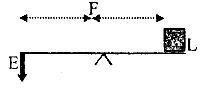
In Class I levers (also called levers of first order), the fulcrum lies between the load and the effort, i.e., the load and the effort are on the opposite sides of the fulcrum.
Examples: See-saw, pairs of scissors, pliers, beam balance, etc.
The mechanical advantage of a Class I lever is always greater than one. These levers act as force multipliers.
View full question & answer
[3 Mark Question Answer] - PHYSICS STD 6 Questions - Vidyadip