Questions

[3 marks Question Answer]

🎯

Test yourself on this topic

7 questions · timed · auto-graded

Question 13 Marks
Describe the structure of the kidney with the help of a labelled diagram.
Answer
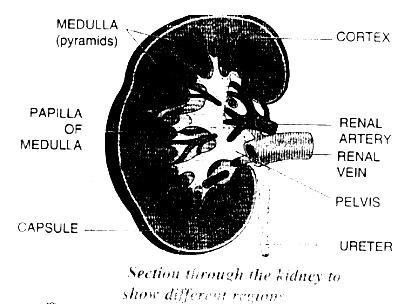
Section through the kidney to show different regions The kidneys are composed of:
  1. an outer darker area called Cortex
  2. an inner lighter area called Medulla.
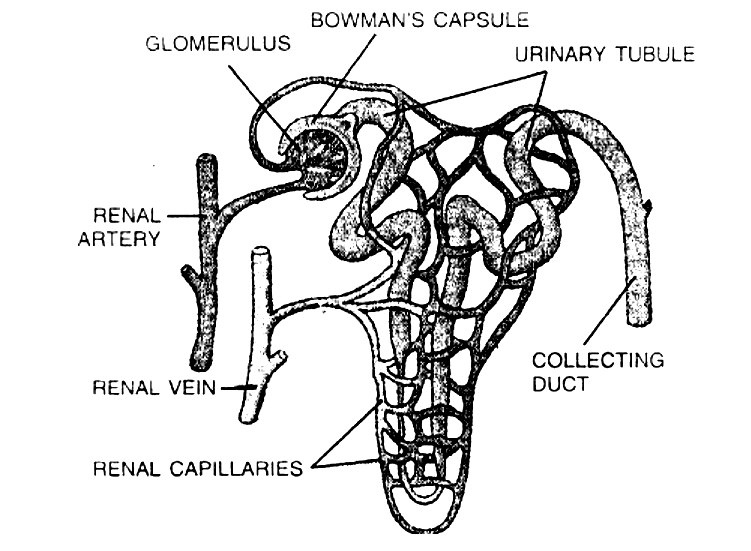
The microscopic structure of the kidney is formed of millions of tubules called renal tubules or nephrons.
View full question & answer
Question 23 Marks
Answer the following in detail.
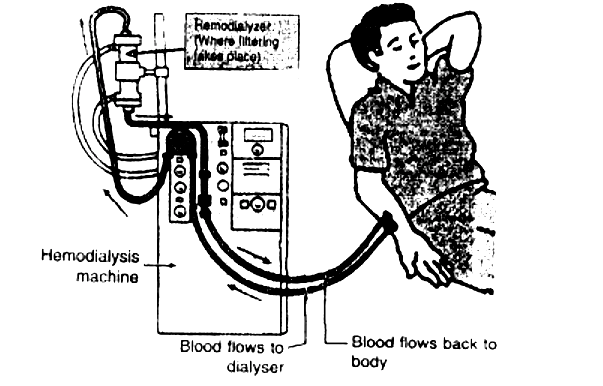
Write a short note on artificial kidneys.
Answer
Artificial kidneys: Kidneys play an important role not only by filtering the blood and getting rid of waste products but also by balancing salt levels in the body.

controlling blood pressure, and stimulating the production of red blood cells.
A person can lead a normal life with one kidney but when both of them stop functioning it could prove fatal if no treatment is provided. An artificial kidney or a dialyzer is a machine used to filter the blood of a patient whose kidneys are damaged. This process is called dialysis.
View full question & answer
Question 33 Marks
Answer the following in detail.
Explain the process of transpiration. Describe some factors that affect it.
Answer
Large quantities of water are absorbed by plants for photosynthesis and other processes. Excess of water is lost in the form of water vapour through the stomata and lenticels from the aerial parts of the plant by transpiration. It helps plants to maintain the concentration of sap inside the plant body. If plants do not remove excess water through transpiration, the dilute sap will prevent further absorption of water and minerals from the soil.
Factors affecting the rate of transpiration are :
  1. Sunlight: Rate of transpiration is more during the day as stomata are open. Stomata remain closed at night and thus no transpiration takes at night.
  2. Temperature: Transpiration is more on hot days than on cold days.
  3. Wind: Blowing wind removes water vapour faster from the leaves and hence transpiration rate increases.
  4. Humidity: If the air is humid, the rate of transpiration is low.
    In the rainy season, transpiration is less since humidity is more.
View full question & answer
Question 43 Marks
Differentiate between
excretion and transpiration
Answer
Excretion Transpiration
1 It is the process of removing or getting rid of waste matter from the body. 1 It is the process of losing excess water from aerial plant parts in the form of water vapour.
2 Excretion rate is independent of the time of the day. 2 The rate of transpiration is more during the day.
3 All living beings have special organs called excretory organs to get rid of their harmful wastes. 3 Plants lose water through stomata and lenticels.
4 It occurs both in plants and animals. 4 It occurs only in plants.
View full question & answer
Question 53 Marks
Answer the following in detail.
Describe the process of urine formation.
Answer
The process of urine formation takes place in the following steps :
  1. Glomerular Alteration – Blood containing waste material enters the kidneys through the renal artery. It then enters the glomerulus under high pressure. Water and small solutes are filtered in the Bowman’s capsule.
  2. Tubular reabsorption – Filterate passes through the thin walls of the Bowman’s capsule into the urinary or renal tubule. As it passes through the tubule, water, and many useful substances are reabsorbed by the renal blood capillaries.
  3. Tubular secretion – The remaining liquid, along with wastes such as urea, uric acid, etc is called urine and is collected in the urinary bladder.
  4. Excretion – Urine leaves the kidneys and passes into the urinary bladder through the ureters. When the urinary bladder is full, urine is passed out through the urethra.
View full question & answer
Question 63 Marks
Answer the following in detail.
Explain the structure of a nephron with the help of a diagram.
Answer
The microscopic filtering unit of the kidney is called nephron or uriniferous tubule. Each nephron consists of a cup-shaped structure at one end called Bowman’s capsule. Inside the cup is a network of blood capillaries called a glomerulus. The Bowman’s capsule and the glomerulus together form the Malpighian body. The Bowman’s capsule extends into a long tubule. These tubules are surrounded by a network of renal capillaries. The urinary tubules of the nephrons in each kidney join to form a common tube called a ureter.
View full question & answer
Question 73 Marks
Correct the sequence of the following steps to explain the process of urine formation.
1. Blood enters the glomerulus under high pressure.
2. The filtrate passes through the thin walls of the Bowman’s capsule into the renal tubule
3. As the filtrate, passes through the tubule, water, and many useful substances are reabsorbed by the walls of the blood capillaries.
4. Water and small solutes are filtered in the Bowman’s capsule.
5. The remaining liquid, along with waste is called urine and is collected in the urinary bladder.
6. Blood containing waste material enters the kidneys through the renal artery.
Answer
1. Blood containing waste material enters the kidneys through the renal artery.
2. Blood enters the glomerulus under high pressure.
3. Water and small solutes are filtered in the Bowman’s capsule.
4. The filtrate passes through the thin walls of the Bowman’s capsule into the renal tubule
5. As the filtrate, passes through the tubule, water, and many useful substances are reabsorbed by the walls of the blood capillaries.
6. The remaining liquid, along with waste is called urine and is collected in the urinary bladder.
View full question & answer
[3 marks Question Answer] - BIOLOGY STD 7 Questions - Vidyadip