Question 13 Marks
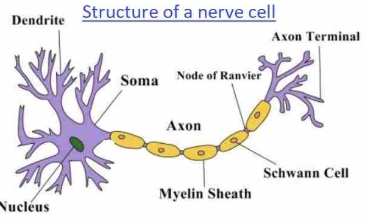
Draw the structure of a nerve cell.
Answer
View full question & answer→The structure of a nerve cell.
7 questions · timed · auto-graded
Blood | Lymph |
1. It is a reddish - colored fluid. | 1. It is a colourless fluid. |
2. Blood plasma has proteins, calcium, and phosphorus. | 2. Lymph plasma lacks proteins. |
3. Its purification takes place in the kidneys. | 3. Its purification takes place in lymph nodes. |
Cartilage | Bone |
1. It is flexible and non-porous. | 1. It is hard, flexible and porous. |
2. The matrix is hard but elastic, made up of protein | 2. The matrix is hard but made up of protein, magnesium, calcium and phosphate |
3. Blood vessels are absent. | 3. Blood vessels are present. |
Squamous epithelium | Columnar epithelium |
1. It is a type of Epithelial tissue that comprises the cells which are wider. | 1. lt is a type of Epithelial tissue that has taller cells. |
2. Squamous cells have flat layers of cells. | 2. Columnar cells have column-shaped cells. |
3. Nuclei are centrally located. | 2. Columnar cells have column-shaped cells. |
Skeletal muscle | Cardiac muscle |
1. These muscles are attached to the skeleton | 1. These muscles are found in heart only |
2. Its function is the movement of the body | 2. Its function is to pump blood. |
3. Skeletal Muscles are longer, compared to Cardiac Muscles. | 3. These muscles are shorter in size. |
Cells | Tissue |
1. This the smallest, structural, and functional unit of life. | 1 Tissues are defined as the distinct types of material consisting of specialized cells and their products. |
2. Cells are microscopic | 2. Tissues are macroscopic. |
3. The collection of the cells is called tissue. | 3. The collection of the tissues is called organ. |