Questions

[5 Mark Question Answer]

🎯

Test yourself on this topic

8 questions · timed · auto-graded

Question 14 Marks
Write five uses of nitrogen.
Answer
Uses of nitrogen :
  1. Synthesis of proteins by plants – Plants directly or indirectly use nitrogen from the air for making proteins.
  2. In the manufacture of ammonia – Nitrogen is used in the manufacture of ammonia by the Haber process.
  3. In the manufacture of explosives – Most of the chemical explosives contain nitrogen, for example, trinitrotoluene (TNT) and nitroglycerine.
  4. In hospitals – Liquid nitrogen in used in hospitals for storing and preserving blood, tissues, etc. as it provides a very low temperature.
  5. In the food industry – Because of its inert nature, nitrogen is used in food packaging. The containers used for storing food stuff are flushed with nitrogen to remove oxygen before they are sealed. It stops bacterial growth chances and preserve food. Liquid nitrogen is also used for preserving foods such as cakes and pastries.
  6. In the manufacture of fertilizers – such as urea, ammonium sulphate, ammonium phosphate.

View full question & answer
Question 24 Marks
Describe the laboratory preparation of nitrogen.
Answer
Nitrogen is prepared in the laboratory by the action of heat on a mixture of ammonium chloride and sodium nitrite. A saturated solution containing equal amounts of ammonium chloride $(NH_4Cl)$ and sodium nitrite $(NaNO_2)$ is taken in a round bottom flask and gently heated. On gently heating the reactants in the flask, a slow evolution of nitrogen gas takes place.Image
Image
View full question & answer
Question 34 Marks
What is greenhouse effect ? How is it related to global warming ?
Answer
The greenhouse effect is a natural process in which greenhouse gases trap heat radiated from the earth’s surface and reradiate it back to the earth’s surface. The major green house gases are carbon dioxide, methane and water vapour. The green house effect keeps the earth pleasantly warm. However, we are producing too many greenhouse gases that absorb more heat and warm the earth too much. Carbon dioxide is the most important greenhouse gas.
Due to excessive burning of fossil fuels and other carbon containing, fuels, and large scale deforestation, there has been an excessive release of carbon dioxide into the atmosphere. The increasing carbon dioxide level in the atmosphere has led to excessive heating of the earth’s surface. This phenomenon of increasing air temperatures near the earth’s surface is called global warming.
View full question & answer
Question 44 Marks
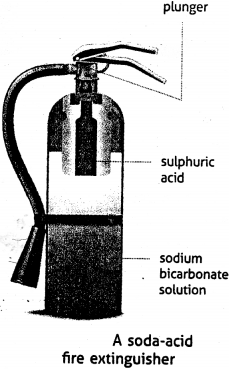
Describe soda-acid fire extinguisher.
Answer
Soda-acid fire extinguisher consists of a container filled with sodium bicarbonate solution. Sulphuric acid is also kept inside the container in a sealed glass bottle. To use the extinguisher, the glass bottle containing the acid is broken by striking the plunger. Sodium bicarbonate and sulphuric acid react to form carbon-dioxide, which rushes out through the nozzle. Carbon dioxide is directed towards the fire and it cuts off the supply of air by forming a layer on the fire, and finally the fire gets extinguished.

Image
Image
View full question & answer
Question 54 Marks
State any four ways for prevention of rusting.
Answer
Ways to prevent rusting of iron :
  1. Painting with red lead – Painting the iron surface with red lead does not allow it to come in contact with moist air and thus prevent rusting. For example, railings, lamp posts and window panes are painted to prevent them from rusting.
  2. Using grease or oil – Metallic tools and machine parts may be coated with a thin layer of grease or oil to prevent them from rusting.
  3. Galvanization – It involves coating iron with a thin layer of zinc to prevent iron from rusting. Articles that are exposed to
    extreme moiture such as roof sheets, tubs, buckets and water pipes are protected from rusting by galvanization.
  4. Alloying – Iron can be alloyed with chromium and nickel to form stainless steel which is lustrous and corrosion – resistant and is used to make cutting and surgical instruments, utensils, etc.
  5. Tin plating – Iron is coated with a protective layer of tin. Tin is non-toxic and less reactive than iron. Food cans are coated with tin prevent them from rusting.
View full question & answer
Question 64 Marks
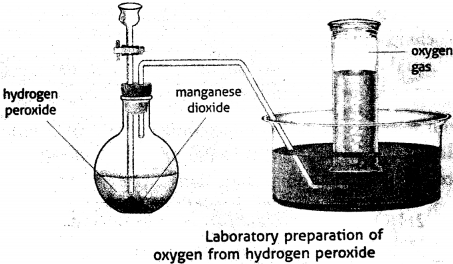
Describe the laboratory preparation of oxygen from hydrogen peroxide with a neat labelled diagram. Also, write the balanced equation for the reaction involved.
Answer
Oxygen gas can be prepared in the laboratory by the decomposition of hydrogen peroxide using manganese dioxide as a catalyst.
Aim : To prepare oxygen from hydrogen peroxide manganese dioxide as a catalyst.
Materials required : A flat-bottom flask, a two-holed rubber stopper, a thistle funnel with a stopper, a delivery tube, a beehive shelf, a gas jar, a trough containing water, hydrogen peroxide, manganese dioxide.
Procedure :
  1. Take some manganese dioxide in a flat-bottom flask.
  2. Set up die apparatus as shown in the figure.
  3. Add hydrogen peroxide drop by drop through the thistle funnel.
Observation :
As hydrogen peroxide drips onto manganese dioxide, a brisk effervescence takes place due to the evolution of oxygen gas
Image
Collection of oxygen gas :
Oxygen gas is collected by the downward displacement of water because it is very slightly soluble in water. Again, it cannot be collected over air since it almost as heavy as air.
Image
View full question & answer
Question 74 Marks
Suggest any five ways to prevent air pollution.
Answer
Ways to prevent air pollution :
  1. Use of fossil fuels should be reduced. Clean fuels such as solar energy and wind energy should be used in place of conventional fossil fuels like coal and petroleum.
  2. Pollution from automobile emissions can be reduced by installing a special device called catalytic converter.
  3. Industries must release gas into the air only after removing solid particles (particulate matter) and poisonous gases using device called electrostatic precipitator.
  4. Industries should be located away from residential areas.
  5. At an individual level, we should use public transport or carpooling or bicycles, should avoid burning of crackers and plant more trees.
View full question & answer
Question 84 Marks
What is air pollution ? What are the harmful effects of the following pollutants ?
a. Carbon monoxide
b. Sulphur dioxide
c. Nitrogen oxide
Answer
Air pollution means the addition of undesired substances to the natural air like gases, dust, smoke, etc which are harmful to plants animal life and environment. Substances that cause pollution are called pollutants.

a. Carbon monoxide – Carbon monoxide is a highly poisonous gas. When inhaled, it combines with the haemoglobin present in blood to form a stable compound called carboxyhaemoglobin and thus lowers the oxygen-carrying capacity of blood. Breathing in carbon-monoxide causes headache, dizziness and can even lead to death.

b. Sulphur dioxide – Sulphur dioxide is poisonous and affects our lungs. It may cause eye and throat irritation. It also combines with water vapour in the air to form sulphuric acid which fells down with rain causing acid rain, damaging building, aquatic life, plants, soil, animals, etc. Sulphur dioxide may also lead to heart problems and birth defects.

c. Nitrogen oxide – Nitrogen oxide reacts with water vapour present in the air to form nitric acid which is a component of acid rain. Acid rain damages buildings, plant and animal life, soil, etc. Oxides of nitrogen also form smog, which affects our lungs and eyes. Nitrogen oxides can also lead to heart problems and cancer.
View full question & answer