Questions

[5 Mark Question Answer]

🎯

Test yourself on this topic

6 questions · timed · auto-graded

Question 14 Marks
What is a decomposition reaction ? Give one example of it in which a catalyst is used.
Answer
A type of chemical reaction in which a substance $($usually a compound$)$ breaks up into two or more simple substances is known as a decomposition reaction. A decomposition reaction takes place when the energy is supplied in the form of heat, electricity or light. Generally, it is represented as : $\text{AB} \rightarrow \text{A} + \text{B}$
Examples :
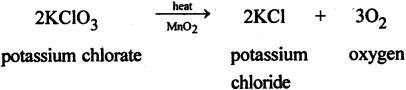
$(i)$ Decomposition of potassium chlorate on heating in the presence of manganese dioxide $(\text{MnO}_2)$ as a catalyst.
Image
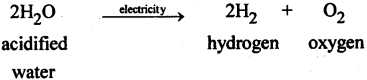
$(ii)$ Decomposition of acidified water by passing electric current
Image
View full question & answer
Question 24 Marks
What is a combination reaction ? Give one example of it.
Answer
A type of chemical reaction in which two or more substances (element or compounds) combine to form a new substance (a compound) is called as a combination reaction. Generally, it is represented as :
A + B → AB
Example:
(i) Formation of hydrogen chloride
Image
(ii) Burning of coal (carbon)
Image
View full question & answer
Question 34 Marks
What information does a balanced equation give us ?
Answer
A balanced equation gives the following information :
  1. Number of molecules of each of the reactants and products taking part in the reaction.
  2. Number of atoms of each element of the reactants and the products taking part in the reaction.
  3. It enables us to calculate the mass of the reactants and the products involved in the reaction.
  4. It enables us to find that the mass of the reactants is equal to the mass of the products.
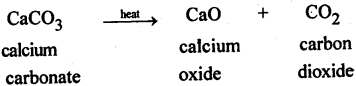
  5. For example, the equation
Image
gives the following information :
$(a)$ One molecule of calcium carbonate on heating gives one molecule of calcium oxide and one molecule of carbon dioxide.
$(b)$ Mass of $\text{CaCO}_3 =$ Mass of $\text{CaO}\  +$ Mass of $\text{CO}_{2}$
View full question & answer
Question 44 Marks
Give the main difference between physical changes and chemicals changes.
Answer
PropertyPhysical changeChemical change
Composition of substanceNo new substance is formed. However some physical properties of the original substance may change.One or more new substances with different properties and compositions from the original substance (s) are formed.
Nature of changeThe change is temporary and reversible.The change is permanent and irreversible.
Mass of substanceThere is no change in the mass of the substance undergoing a physical change.There is a change in the mass of the substance undergoing a chemical change. However, the total mass of the substances involved in a chemical change remains constant.
Energy changeNo significant change in energy is involved.Energy is either absorbed or evolved during a chemical change.
View full question & answer
Question 54 Marks
Write the characteristics of chemical changes.
Answer
Characteristics of a chemical change :
  1. One or more new substances are formed with composition and properties different from the original substances.
  2. The change is permanent and irreversible.
  3. An energy change is generally involved in a chemical change. Energy is either absorbed or evolved during a chemical change. Absorption of heat energy in a chemical reaction is called endothermic while evolution of heat energy is called exothermic reaction.
  4. The mass of the substances undergoing a chemical change is generally altered. However, the total mass of the substances involved in a chemical change remains the same. Mass is neither created nor destroyed during a chemical change.
View full question & answer
Question 64 Marks
Write the characteristics of physical changes.
Answer
Characteristics of physical changes :
  1. Generally, the change is temporary and can be reversed by changing the conditions.
  2. No new substance is formed. So there is no change in the mass of the substance undergoing a physical change.
  3. There is no change in the chemical composition of the original substance.
  4. There may or may not be a change in the physical properties like state, shape, size or colour of the original substance.
  5. No significant change in energy is involved.
View full question & answer
[5 Mark Question Answer] - CHEMISTRY STD 7 Questions - Vidyadip