In the figure shown, line $t$ cuts lines $l$ and m. A student makes two statements about the lines $l$ and $m$. Statement I: If $\angle 5$ and $\angle 6$ are equal, lines $l$ and $m$ will always be parallel. Statement II: If $\angle 4$ and $\angle 8$ are equal, lines $l$ and $m$ will always be parallel. Which of these statement(s) is/are true?
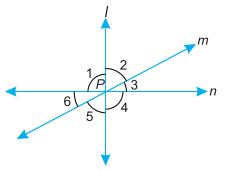
Three lines $l, m, n$ intersect each other at point $P$, as shown in the figure. Line $l$ is perpendicular to line $n$. The measure of $\angle 2$ is $65^{\circ}$. What is the sum of the measure of $\angle 3$ and $\angle 4$ ?
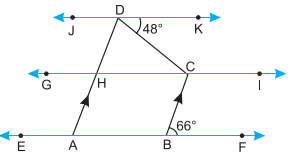
In the given figure (not drawn to scale), $A D$ is parallel to BC, JDK, GHCI, EABF are straight and parallel lines, then $\angle B C I+\angle H A B$ is equal to: