Questions

[5 marks sum]

🎯

Test yourself on this topic

14 questions · timed · auto-graded

Question 15 Marks
A square lawn is surrounded by a path 2.5 m wide. If the area of the path is $165 m^2$ find the area of the lawn.
Answer
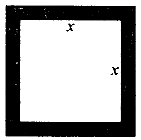

Area of path $=165 \mathrm{~m}^2$
Width of path $=2.5 \mathrm{~m}$
Let the side of square lawn $=x \mathrm{~m}$
$\therefore$ Outer side $=x+2 \times 2.5$
$ =(x+5) m $
$\therefore$ Area of path $=(x+5)^2-x^2$
$ \Rightarrow x^2+10 x+25-x^2=165 $
$ \Rightarrow 10 x=165-25=140 $
$ \Rightarrow x=\frac{140}{10}=14 \mathrm{~m} $
$\therefore$ Side of lawn $=14 \mathrm{~m}$
and area of lawn $=(14)^2 m^2=196 \mathrm{~m}^2$
View full question & answer
Question 25 Marks
The length and breadth of a rectangular piece of land are in the ratio $5: 3$. If the total cost of fencing it at the rate of ₹24 per meter is ₹9600, find its:
(i) length and breadth
(ii) area
(iii) cost of levelling at the rate of $₹ 60$ per $m ^2$.
Answer
Ratio in length and breadth of a rectangular piece of land $=5: 3$
Cost of fencing = ₹ 9600
And rate = ₹ 24 per $m$
Perimeter $=\frac{\text { Total cost of fencing }}{\text { Rate per } m}$
$=\frac{9600}{24}$
$=400 \mathrm{~m}$
Let length $=5 \mathrm{x}$
Then breadth $=3 \mathrm{x}$
$\therefore$ Perimeter $=2(l+b)$
$400=2 \times(5 x+3 x)$
$\therefore 16 x=400$
$x=\frac{400}{16}=25$
(i) $\therefore$ Length of land $=5 \mathrm{x}=5 \times 25=125 \mathrm{~m}$
and breadth $=3 x=3 \times 25=75 \mathrm{~m}$
(ii) Area $=1 \times b$
$=125 \times 75=9375 \mathrm{~m}^2$
(iii) Cost of levelling at rate ₹ 60 per $\mathrm{m}^2$
$=\text₹ 60 \times 9375 \mathrm{~m}^2=$ ₹ 5,62,500
View full question & answer
Question 35 Marks
The ratio between the areas of two circles is 16 : 9. Find the ratio between their :
(i) radius
(ii) diameters
(iii) circumference
Answer
(i) Let radius of first circle $=r_1$
and radius of second circle $=r_2$
Given that ratio of the areas of circles $=16: 9$
$\Rightarrow \frac{\pi r_1^2}{\pi r_2^2}=\frac{16}{9}$
$\Rightarrow \frac{\pi r_1^2}{\pi r_2^2}=\frac{4^2}{3^2}$
$\Rightarrow \frac{\mathrm{r}_1}{\mathrm{r}_2}=\frac{4}{3}$
(ii) Let the diameter of first circle $=d_1$
and diameter of second circle $=\mathrm{d}_2$
Since, we know that diameter $=2 \times$ radius
$\therefore d_1=2 \times r_1=2 \times 4 x=8 x$
and $d_2=2 \times r_2=2 \times 3 x=6 x$
Now, the ratio between the diameter of two circles $=d_1: d_2$
$ =8 x: 6 x=4: 3 $
(iii) Now, consider the ratio of circumference of the circles
$ =\frac{2 \pi r_1}{2 \pi r_2}=\frac{r_1}{r_2}=\frac{4}{3} $
$\therefore$ The ratio between the circumference of two circles $=4: 3$
View full question & answer
Question 45 Marks
 The sides of a rectangular park are in the ratio $4: 3$. If its area is $1728 m^2$, find
(i) its perimeter
(ii) cost of fencing it at the rate of ₹ $40$ per meter.
Answer
Ratio in the sides of a rectangle $=4: 3$
Area $=1728 \mathrm{~m}^2$
Let length $=4 \mathrm{x}$, and breadth $=3 \mathrm{x}$
$\therefore$ Area $=1 \times b$
$1728=4 \mathrm{x} \times 3 \mathrm{x}$
$\Rightarrow 12 x^2=1728$
$\Rightarrow \mathrm{x}^2=\frac{1728}{12}$
$\Rightarrow \mathrm{x}^2=144=(12)^2$
$\therefore x=12$
$\therefore$ Length $=4 \mathrm{x}=4 \times 12=48 \mathrm{~m}$
Breadth $=3 \mathrm{x}=3 \times 12=36 \mathrm{~m}$
(i) Now perimeter $=2(l+b)$
$=2(48+36) m$
$=2 \times 84=168 \mathrm{~m}$
(ii) Rate of fencing = ₹ 40 per metre
Total cost =168 $\times 40=$ ₹ 6720
View full question & answer
Question 55 Marks
The ratio between the radius of two circles is $5 : 7.$ Find the ratio between their:
(i) circumference
(ii) areas
Answer
(i) The ratio of the radius of the circles $=5: 7$
Let radius of first circle $=5 \mathrm{x}$
and radius of second circle $=7 \mathrm{x}$
$\therefore$ Circumference of first circle $=2 \pi r$
$ =2 \pi \times 5 x=10 \pi x $
and circumference of second circle
$ =2 \pi \times 7 x=14 \pi x $
$\therefore$ Ratio between their circumference
$ \begin{aligned} & =10 \pi x: 14 \pi x \\ & =10: 14=5: 7 \end{aligned} $
(ii) Area of first circle $=\pi r^2$
$ =\frac{22}{7} \times 5 \mathrm{x} \times 5 \mathrm{x}=\frac{550}{7} \mathrm{x}^2 $
and area of second circle $=\pi r^2$
$ =\frac{22}{7} \times 7 \mathrm{x} \times 7 \mathrm{x}=\frac{1078}{7} \mathrm{x}^2 $
Ratio between their areas
$=\frac{550}{7} x^2: \frac{1078}{7} x^2$
$=550: 1078 \ldots \ldots \ldots . . .(\text { Dividing by } 22)$
$=25: 49$
View full question & answer
Question 65 Marks
The sides of a triangle are in the ratio 15 : 13 : 14 and its perimeter is 168 cm. Find the area of the triangle.
Answer
Perimeter of the triangle $=168 \mathrm{~cm}$
Sum of ratio of sides $=15+13+14=42$
Let the first side $=\frac{168 \times 15}{42}=60 \mathrm{~cm}$
Second side $=\frac{168 \times 13}{42}=52 \mathrm{~cm}$
Third side $=\frac{168 \times 14}{42}=56 \mathrm{~cm}$
Now, $s=\frac{a+b+c}{2}$
$ =\frac{60+52+56}{2}=\frac{168}{2}=84 $
$\therefore$ Area $=\sqrt{s(s-a)(s-b)(s-c)}$
$ =\sqrt{84(84-60)(84-52)(84-56)} $
$ =\sqrt{84 \times 24 \times 32 \times 28} $
$ =\sqrt{2 \times 2 \times 3 \times 7 \times 2 \times 2 \times 2 \times 3 \times 2 \times 2 \times 2 \times 2 \times 2 \times 2 \times 2 \times 7} $
$ =2 \times 2 \times 2 \times 2 \times 2 \times 2 \times 3 \times 7 $
$ =1344 \mathrm{~cm}^2 $
View full question & answer
Question 75 Marks
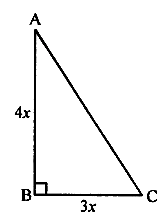
The legs of a right-angled triangle are in the ratio $4 : 3$ and its area is $4056 cm^2$​​​​​​​. Find the length of its legs.
Answer
Area of right-angled triangle $=4056 \mathrm{~cm}^2$
Legs of a right-angled triangled are in the ratio i.e. $4: 3$
Let one leg (Base) $=3 x$
Then second leg (altitude) $=4 x$

Area $=\frac{1}{2} \times$ Base $\times$ Altitude
$ \begin{aligned} & =\frac{1}{2} \times 3 \mathrm{x} \times 4 \mathrm{x}=6 \mathrm{x}^2 \\ & \therefore 6 \mathrm{x}^2=4056 \end{aligned} $
$ x^2=\frac{4056}{6}=676 $
$ x=\sqrt{676}=\sqrt{26 \times 26} $
$\therefore \mathrm{x}=26 \mathrm{~cm}$
$\therefore$ One leg $($ base $)=3 x=3 \times 26=78 \mathrm{~cm}$
and second leg (altitude) $4 x=4 \times 26=104 \mathrm{~cm}$
View full question & answer
Question 85 Marks
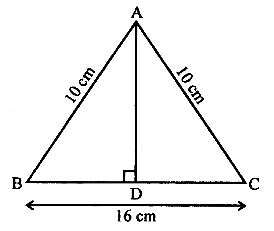
Find the area of an isosceles triangle whose base is 16 cm and the length of each of the equal sides is 10 cm.
Answer
In isosceles $\triangle A B C$
Base $B C=16 \mathrm{~cm}$
and $A B=A C=10 \mathrm{~cm}$

$\begin{aligned} & \text { Let } A D \perp B C \text { and } B D=\frac{1}{2} B C=\frac{16}{2} \\ & \therefore B D=8 \mathrm{~cm} \\ & \text { In right } \triangle A B D \\ & A B^2=A D^2+B D^2 \ldots \ldots \ldots \ldots .(\text { Pythagoras Theorem) } \\ & (10)^2=A D^2+(8)^2 \\ & 100=A D^2+64 \\ & 100-64=A D^2 \\ & 36=A D^2 \\ & A D=\sqrt{36}=\sqrt{6 \times 6} \\ & \therefore A D=6 \mathrm{~cm} \\ & N o w \text { the area of triangle }=\frac{\text { Base } \times \text { Altitude }}{2} \\ & =\frac{16 \times 6}{2}=48 \mathrm{~cm} 2\end{aligned}$
View full question & answer
Question 95 Marks
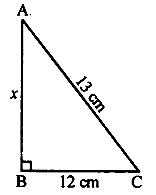
Find the area of a right-angled triangle whose hypotenuse is 13 cm long and one of its legs is 12 cm long.
Answer
In right-angled $\triangle A B C$,
Base $B C=12 \mathrm{~cm}$
and hypotenuse $\mathrm{AC}=13 \mathrm{~cm}$

Applying Pythagoras Theorem,
$ \begin{aligned} & (A C)^2=(A B)^2+(B C)^2 \\ & (13)^2=(A B)^2+(12)^2 \\ & 169=(A B)^2+144 \\ & (A B)^2=169-144 \\ & (A B)^2=25 \\ & \therefore A B=\sqrt{25} \\ & =\sqrt{5 \times 5}=5 \mathrm{~cm} \end{aligned} $
Now, area of $\triangle A B C=\frac{1}{2}$ base $\times$ altitude
$ =\frac{1}{2} \times 12 \times 5=30 \mathrm{~cm}^2 $
View full question & answer
Question 105 Marks
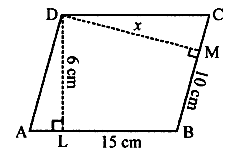
The adjacent sides of a parallelogram are 15 cm and 10 cm. If the distance between the longer sides is 6 cm, find the distance between the shorter sides.
Answer
In parallelogram $A B C D$
$ A B=D C=15 \mathrm{~cm} $
$ B C=A D=10 \mathrm{~cm} $

Distance between longer sides $A B$ and $D C$ is $6 \mathrm{~cm}$
i.e., perpendicular $\mathrm{DL}=6 \mathrm{~cm}$
$\mathrm{DM} \perp \mathrm{BC}$
Area of parallelogram $=$ Base $\times$ Altitude
$ =A B \times D L=15 \times 6=90 \mathrm{~cm}^2 $
Again let $\mathrm{DM}=\mathrm{xcm}$
$\therefore$ Area of parallelogram $A B C D=B C \times D M$
$ =10 \times x=10 x \mathrm{~cm}^2 $
$\therefore 10 \times \mathrm{cm}^2=90 \mathrm{~cm}^2$
$\Rightarrow x=\frac{90}{10}=9 \mathrm{~cm}$
View full question & answer
Question 115 Marks
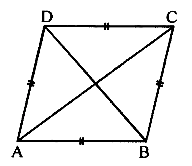
Find the area of the rhombus, if its diagonals are 30 cm and 24 cm.
Answer
Given, diagonal $\left(d_1\right)=30 \mathrm{~cm}$
Other diagonal $\left(\mathrm{d}_2\right)=24 \mathrm{~cm}$

If $A C$ and $B D$ are the diagonals of a rhombus its
Area $=\frac{1}{2} \times$ Product of it diagonals
$ \begin{aligned} & =\frac{1}{2} \times \mathrm{AC} \times \mathrm{BD} \\ & =\frac{1}{2} \times \mathrm{d}_1 \times \mathrm{d}_2 \\ & =\frac{1}{2} \times 30 \times 24 \mathrm{~cm}^2 \\ & =15 \times 24=360 \mathrm{~cm}^2 \end{aligned} $
$\therefore$ Area of rhombus $=360 \mathrm{~cm}^2$
View full question & answer
Question 125 Marks
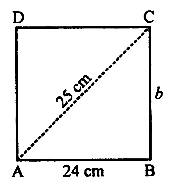
Find the perimeter of a rectangle with length = 24 cm and diagonal = 25 cm
Answer
Length of a rectangle $(\mathrm{I})=24 \mathrm{~cm}$, Diagonal $=25 \mathrm{~cm}$

Let breadth of the rectangle $=\mathrm{b} \mathrm{m}$
Applying Pythagoras Theorem in triangle $A B C$,
We get, $(A C)^2=(A B)^2+(B C)^2$
$ \begin{aligned} & (25)^2=(24)^2+(b)^2 \\ & 625=576+(b)^2 \\ & 625-576=b^2 \\ & 49=b^2 \\ & \sqrt{7 \times 7}=b \\ & \therefore b=7 \mathrm{~cm} \end{aligned} $
Now, perimeter of the rectangle
$ \begin{aligned} & =2(1+b) \\ & =2(24+7) \\ & =2(31) \\ & =62 \mathrm{~cm} \end{aligned} $
View full question & answer
Question 135 Marks
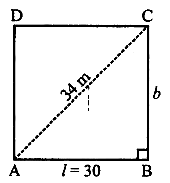
The length of a rectangular field is 30 m and its diagonal is 34 m. Find the breadth of the field and its perimeter.
Answer
Length $=30 \mathrm{~m}$
Diagonals $=34 \mathrm{~m}$

Let the breadth of the rectangle $=b \mathrm{~m}$
Applying Pythagoras Theorem in triangle $A B C$,
We get,
$ \begin{aligned} & A C^2=A B^2+B C^2 \\ & (34)^2=(30)^2+b^2 \\ & 1156=900+b^2 \\ & 1156-900=b^2 \\ & 256=b^2 \\ & \Rightarrow b \sqrt{256}=16 \mathrm{~m} \\ & \text { Perimeter }=2(1+b) \\ & =2(30+16) \\ & =2 \times 46 \\ & =92 \mathrm{~m} \end{aligned} $
View full question & answer
Question 145 Marks
Find the radius of the circle whose circumference is equal to the sum of the circumferences of the circles having radius 15 cm and 8 cm.
Answer
For circle with radius $=15 \mathrm{~cm}$
Circumference of circle $=2 \pi r$
$=2 \times \frac{22}{7} \times 15 \mathrm{~cm}$
$ =\frac{660}{7} \mathrm{~cm} $
For circle with radius $=8 \mathrm{~cm}$
Circumference of circle $=2 \pi \mathrm{r}$
$=2 \times \frac{22}{7} \times 8 \mathrm{~cm}$
$=\frac{352}{7} \mathrm{~cm}$
Sum of the circumferences of these two circles
$ =\frac{660}{7} \mathrm{~cm}+\frac{352}{7} \mathrm{~cm}=\frac{1012}{7} \mathrm{~cm} $
If the required radius $=R \mathrm{~cm}$
$ \begin{aligned} & \text { Its circumference }=2 \pi R \\ & =2 \times \frac{22}{7} \times \mathrm{R} \mathrm{cm} \\ & =\frac{44}{7} \mathrm{R} \mathrm{cm} \end{aligned} $
Given, $\frac{44}{7} \mathrm{R}=\frac{1012}{7}$
$ \Rightarrow \mathrm{R}=\frac{7}{44} \times \frac{1012}{7} \mathrm{~cm} $
$ =23 \mathrm{~cm} $
$\therefore$ Required radius $=23 \mathrm{~cm}$
View full question & answer
[5 marks sum] - MATHS STD 7 Questions - Vidyadip