Questions

[2 Mark Question Answer]

🎯

Test yourself on this topic

12 questions · timed · auto-graded

Question 12 Marks
Each of the points A (0, 7), B (8, 0), C (0, − 5), D (− 7, 0) and E (0, 0) are reflected in origin to points A’, B’, C’, D’ and E’ respectively. Write the co-ordinates of each of the image points A’, B’, C’, D’ and E’.
Answer
The points $A(0,7), B(8,0), C(0,-5), D(-7,0)$ and $E(0,0)$ are reflected in origin.
So, the co-ordinates of their images will be $A^{\prime}(0,-7), B^{\prime}(-8,0), C^{\prime}(0,5), D^{\prime}(7,0)$ and $E ^{\prime}(0,0)$
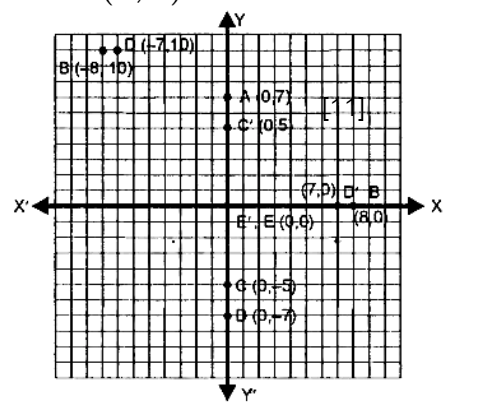
Image
View full question & answer
Question 22 Marks
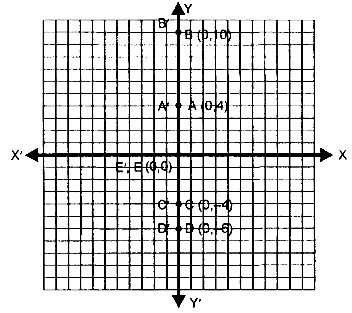
Each of the points A (0, 4), B (0, 10), C (0, – 4), D (0, – 6) and E (0, 0) is reflected in y-axis to points A’, B’, C’, D’ and E’ respectively. Write the co-ordinates of each of the image points A’, B’, C’, D’ and E’.
Answer
The points given are:
$A(0,4), B(0,10), C(0,-4), D(0,-6)$ and $E(0,0)$ are reflected in $y-$ axis. The co - ordinates of their images will be $A^{\prime}(0,4), B^{\prime}(0,10), C^{\prime}$ $(0,-4) D^{\prime}(0,-6)$ and $E^{\prime}(0,0)$ as they all lie on $y$-axis.
View full question & answer
Question 32 Marks
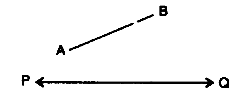
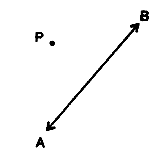
In the given figure, find the image of the line segment $A B$ in the line PQ

Answer


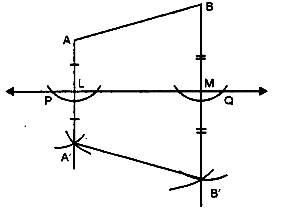
Steps of Construction :
(i) From $A$ and $B$, draw perpendiculars on $P Q$ intersecting $P Q$ at $L$ and $M$.
(ii) Produce $A L$ to $A^{\prime}$ such that $A L=L A^{\prime}$ and produce $B M$ to $B^{\prime}$ such that $B M=M B^{\prime} A^{\prime} B^{\prime}$ is the image of the line segment $A B$ in $P Q$.
View full question & answer
Question 42 Marks
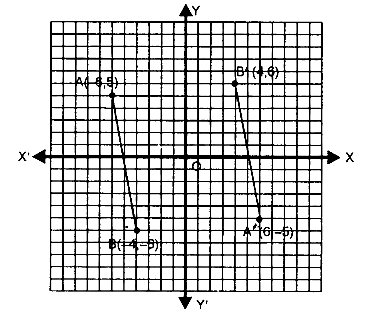
Mark points A (– 6, 5) and B (– 4, – 6) on a graph paper. Find A’, the image of A in origin and B’, the image of B in origin. Mark A’ and B’ also on the same graph paper. Join AB and A’ B’. Is AB = A’ B’?
Answer
The given points are $A(-6,5)$ and $B(-4,-6)$. The images of $A$ and $B$ in the origin are $A^{\prime}$ and $B^{\prime}$ where co-ordinates are $A^{\prime}(6,-5)$ and $B^{\prime}$ $(4,6)$ which have been plotted on the same graph.

$A B$ and $A^{\prime} B^{\prime}$ are joined we see that $A B=A^{\prime} B^{\prime}$.
View full question & answer
Question 52 Marks
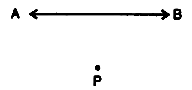
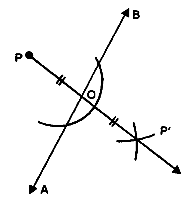
In the given figure, find the image of the point $P$ in the line $A B$ :
Answer
Steps of Construction:
Produce $PO$ to $P ^{\prime}$ such that $OP ^{\prime}= PO$.
$P^{\prime}$ is the required image of $P$ in $A B$.
View full question & answer
Question 62 Marks
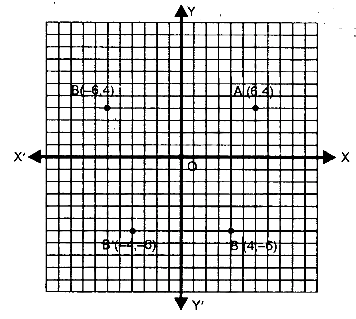
Mark points A (6, 4) and B (4, – 6) on a graph paper.
Find A’, the image of A in y-axis and B’, the image of B in the y-axis. Mark A’ and B’ also on the same graph paper.
Answer
The given points are $A(6,4)$ and $B(4,-6)$
The images of $A$ and $B$ are $y$-axis are $A^{\prime}(-6,4)$ and $B^{\prime}(-4,-6)$ respectively as shown in the same graph.
View full question & answer
Question 72 Marks
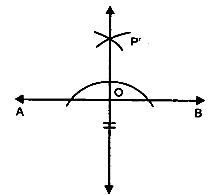
In the given figure, find the image of the point $P$ in the line $A B$ :
Answer
Steps of Construction:
From $P$, draw a perpendicular to the given line $A B$ meeting it at $O$.
View full question & answer
Question 82 Marks
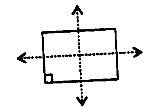
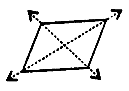
Draw a quadrilateral with exactly two lines of symmetry. In case, if possible, represent the line/ lines of symmetry by dotted lines. Also, write the special name of the quadrilateral drawn.
Answer


[Rectangle]

[Rhombus]
View full question & answer
Question 92 Marks
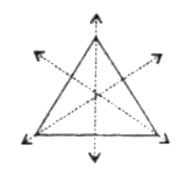
Draw a triangle with exactly three lines of symmetry. In case, if possible, represent the line/ lines of symmetry by dotted lines. Also, write the special name of the triangle drawn.
Answer

Image
[Equilateral $\Delta$ ]
View full question & answer
Question 102 Marks
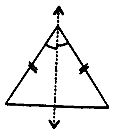
Draw a triangle with only one line of symmetry. In case, if possible, represent the line/ lines of symmetry by dotted lines. Also, write the special name of the triangle drawn.
Answer
Isosceles Triangle: It has one line of symmetry as shown.

[Isosceles $\Delta$ ]
View full question & answer
Question 112 Marks
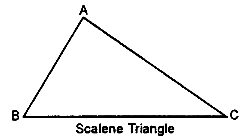
Draw a triangle with no line of symmetry. In case, if possible, represent the line/ lines of symmetry by dotted lines. Also, write the special name of the triangle drawn.
Answer
Scalene triangle: It has no line of symmetry.
View full question & answer
Question 122 Marks
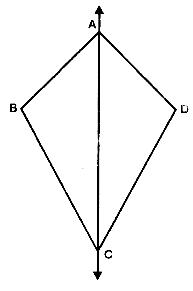
A quadrilateral ABCD is symmetric about its diagonal AC. Name three sides of this quadrilateral which are equal.
Answer
The quadrilateral $A B C D$ is symmetric about its diagonal $A C$.

$\therefore$ It must be a kite-shaped.
Hence side $A B=A D$ and $B C=D C$.
View full question & answer
[2 Mark Question Answer] - MATHS STD 7 Questions - Vidyadip