Questions

[5 Mark Question Answer]

🎯

Test yourself on this topic

5 questions · timed · auto-graded

Question 15 Marks
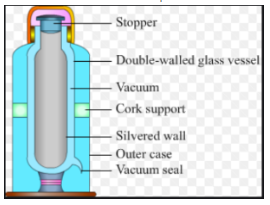
Describe the construction of a thermos flask with the help of a neat diagram and label it.
Answer
A thermos flask consists of a double-walled glass or metal bottle. The narrow region between the inner and the outer walls is evacuated and sealed together at their necks or at the bottom. The walls are silvered. The vessel is put in a metallic or plastic case and is separated from it by a cork or a plastic piece to prevent it from breaking. The mouth of the vessel is closed by a stopper made from an insulating material.
The vacuum between the glass walls of the thermos flask considerably reduces the flow of heat by conduction and convection. This is because both conduction and convection need a material medium for transfer of heat. The silvered surfaces reflect the heat back, thus reducing the heat exchange due to radiation. This causes the liquid in a thermos flask to stay hot or cold for a longer period of time.
Image
View full question & answer
Question 25 Marks
Water is a bad conductor of heat but it becomes hot when kept over a flame. Name the phenomenon that takes place in this case. Explain it with the help of an experiment.
Answer
  • Half fill a test-tube with cold water.
  • Wrap a piece of ice in wire gauze and drop it in test tube. It will sink to the bottom.
  • Now, heat the top end of test tube. The water soon begins to boil at the top. But ice below it still not melted.
This shows water is bad conductor of heat. It does not easily conduct heat from top to bottom of test tube. But water becomes hot when it is kept over a flame because of convection.
Activity :
Aim : To show convection currents in water.
Materials Required: A large potassium permanganate crystal, a beaker, a burner and some water.
Procedure :
(a) Drop the potassium permanganate crystal into the beaker containing a little water. The crystal starts dissolving in , water and colouring it.
(b) Now pour some more water slowly into the beaker without disturbing the crystal.
(c) Heat the water using a very small flame just below the crystal.
Observation : The coloured water rises from the place where the heat is supplied. After moving up some distance, it spreads out and comes down along the sides of the : beaker.
View full question & answer
Question 35 Marks
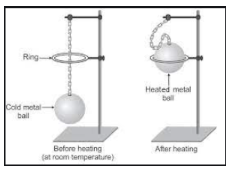
Explain the Gravesand’s ring-and-ball experiment to describe thermal expansion in solids.
Answer
Gravesand’s ring-and-ball experiment: Take an iror*ball and an iron ring such that ball can just pass through the ring. Take a metal stand with a hook and a burner. Suspend ball by chain from hook. Heat the ball and try passing through the ring. Now, cool it and try again.
Image
Observation : When ball is heated, it doesn’t pass through the ring due to thermal expansion. When it is cooled, it regains its original size and easily passes through it. This shows solids expand on heating.
View full question & answer
Question 45 Marks
Describe the different temperature scales.
Answer
There are three different scales to measure temperature. These are the Celsius scale, the Fahrenheit scale and the Kelvin I scale.
Celsius scale : In the Celsius scale, the lower fixed point is j 0 °C, the upper fixed point is 100 °C, and the length of the thermometer between the lower fixed point and the upper j fixed point is divided into 100 equal parts.
Fahrenheit scale : In the Fahrenheit scale, the lower fixed point is 32 °F, the upper fixed point is 212 °F, and the length of the thermometer between the lower fixed point and the 1 upper fixed point is divided into 180 equal parts.
Kelvin scale : In the Kelvin scale, the lower fixed point is 273 K, the upper fixed point is 373 K, and the length of the thermometer between the lower fixed point and the upper fixed point is divided into 100 equal parts.
View full question & answer
Question 55 Marks
Convert
$a. 65^\circ F$ into $^\circ C$
$b. 37^\circ C$ into $^\circ F$
$c. 273 K$ into $^\circ C$
$d. 96^\circ F$ into $K$
Answer
$(a) \ C =\frac{5}{9}(F-32)$
$=\frac{5}{9}(65-32)$
$=\frac{5}{9} \times 33$
$=18.33^{\circ} C$
$(b)  \ F =\frac{9}{5} \times C +32$
$=\frac{9}{5} \times 37+32$
$=66.6+32=98.6^{\circ} F$
$(c) \ K = C +273$
$C = K -273=273-273=0^{\circ} C$
$(d)$ First convert $96^{\circ} F$ into ${ }^{\circ} C$
$ C =\frac{5}{9}( F -32)$
$=\frac{5}{9}(96-32)=\frac{5}{9} \times 64$
$=35.56^{\circ} C$
We know,
$K = C +273=35.56+273=308.56 K$
View full question & answer
[5 Mark Question Answer] - PHYSICS STD 7 Questions - Vidyadip