Questions

[3 Mark Question Answer]

🎯

Test yourself on this topic

7 questions · timed · auto-graded

Question 13 Marks
Name five different types of motion you know.
Answer
The different types of motion are :
1. Translatory motion
2. Rotatory motion
3. Oscillatory motion
4. Vibratory motion
5. Periodic motion
6. Multiple motion
7. Random motion.
View full question & answer
Question 23 Marks
State three differences between mass and weight.
Answer
Mass
It is the quantity of mattercontained in a body.
Its S.J. unit is kilogram (kg)
It is constant for a body and it does not change by changing the place of the body.
It is measured by a beam balance.
Weight
It is the force with which the earth attracts the body.
Its S.I. unit is newton (N) and other unit is kilogram-force (kgf) where 1 kgf= 1ON(nearly).
It is not constant for a body, but it changes from place to place.
It is measured by a spring balance.
View full question & answer
Question 33 Marks
Distinguish between uniform and non-uniform motions, giving an example of each.
Answer
 Uniform motion    Variable motion of Non - uniform motion
 (1) When a body covers equal distances in a straight line, in equal intervals of time, however small these time intervals may be.  (1)When a body covers unequal distances in equal intervals of time in a straight line. 
(2) In this case direction of motion remains the same. (2) In this case direction of motion changes.
 (3) Example: A body moving with a constant speed in a straight line has uniform motion. (3) Example: Circular motion is example of non - uniform motion.
View full question & answer
Question 43 Marks
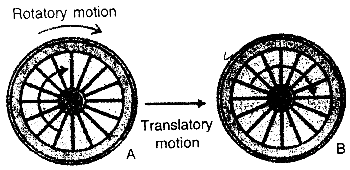
Give two examples to illustrate that a body can have two or more types of motion simultaneously.
Answer
Sometime a body can have more than one type of motion. Such a motion is called the mixed motion.
Example :
(i) The wheels of a moving train have both the translatory as well as the rotatory motions as it moves from position A to position B while rotating.

(ii) The earth rotates about its axis (rotatory motion) and at the same time it revolves around the sun in a curved path (curvilinear or circular motion) in a fixed time interval (periodic motion).
View full question & answer
Question 53 Marks
Differentiate between periodic and non-periodic motions by giving an example of each.
Answer
Periodic motion : A motion which gets repeated after regular intervals of time is called periodic motion.
Examples: The earth moving around the sun takes 365 days to complete one revolution and this motion gets repeated after every 365 days.
Non-periodic motion: The motion which does not repeat itself after a regular interval of time is called non-periodic motion.
Examples: A footballer running on a field, application of brakes in a moving vehicle, a ball rolling down the ground gradually slows down and finally stops, the motion of tides in the sea, etc. 
View full question & answer
Question 63 Marks
A cyclist travels a distance of $1 \ km$ in the first hour$, 0.5 \ km$ in the second hour and $0.3 \ km$ in the third hour. Find the average speed of the cyclist in $(1) \ km \ h^{-1}, (2)\  m\  s^{-1}.$
Answer
Distance travelled in first hour $=1 \ km$
Distance travelled in second hour $=0.5 \ km$
Distance travelled in third hour $=0.3 \ km$
Total time taken $=3\ hr$
Total distance travelled $=1+0.5+0.3=1.8 \ km$
$(1)$ Average speed in $km\  h ^{-1}$
Speed $=\frac{Distance}{Time\ taken}$
$=\frac{1.8}{3}=0.6 \ km\  h ^{-1}$
$(2)$ Average speed in $m\  s -1$
$1 \ km =1000\  m$
$1.8 \ km =1.8 \times 1000 \ m$
$=1800 \ m$
$1$ hour $=3600$ seconds
$3$ hour $=3600 \times 3=10800 \ sec .$
Average speed $=\frac{ D }{ T }$
$ =\frac{1800}{10800}$
$=0.167 \ m\  s ^{-1}$
View full question & answer
Question 73 Marks
A boy walks a distance 30 m in 1 minute and another 30 m in 1.5 minute. Describe the type of motion of the boy and find his average speed in m s-1.
Answer
As the speed does not remain constant throughout the journey the motion is non-uniform
Total distance travelled in going and coming back
$
d=30 m+30 m=60 m
$
Total time taken in going and coming back
$
\begin{aligned}
t =1 \min +1.5 \min & =2.5 \min \\
& =2.5 \times 60_{ s }=150 s
\end{aligned}
$
Average speed $=\frac{\text { Total distance travelled }}{\text { Total time of travel }}$
$
=\frac{60 m }{150 s }=0.4 m s ^{-1}
$
View full question & answer
[3 Mark Question Answer] - PHYSICS STD 7 Questions - Vidyadip