Questions

[3 Mark Question Answer]

🎯

Test yourself on this topic

11 questions · timed · auto-graded

Question 13 Marks
State and define the S.I. unit of volume.
Answer
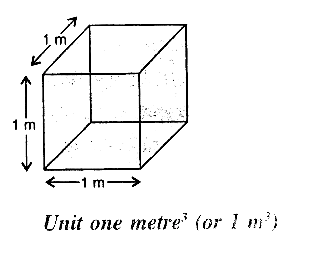
S.I. unit of volume – The S.I. unit of volume is cubic metre. In short form, it is written as $m^3.$
One cubic metre is the volume of a cube of each side 1 metre as shown in figure below i.e., $1 m^3 = 1 m \times 1 m \times 1 m.$​​​​​​​
View full question & answer
Question 23 Marks
A car travels with a speed $12 m s”1$, while a scooter travels with a speed $36 km h-1$. Which of the two travels faster ?
Answer
Speed of car $=12 m s ^{-1}$
Speed of scooter $=36 km h ^{-1}$
here, $1 km=1000 m$
$1 hr =3600 sec$
$\therefore$ Speed of scooter $=\frac{36 \times 1000}{3600} 10 m s ^{-1}$
$\therefore$ Speed of car is more. Car travels faster than scooter.
View full question & answer
Question 33 Marks
Explain the meaning of the term speed.
Answer
The distance covered or travelled by a body in one second is called the speed of the body, i.e.
Speed $=\frac{\text { Distance travelled }}{\text { Time taken }}$
Speed is usually denoted by the symbol v.
If a body travels a distance d in time t , then its speed is given as
Speed (v) = $\frac{d}{t}$
View full question & answer
Question 43 Marks
The mass of 5 litre of water is 5 kg . Find the density of water in $g cm ^{-3}$.
Answer

$\begin{aligned} & \text { Given, Mass } M=5 \mathrm{~kg}=5000 \mathrm{~g}
\\ & \text { volume } V=5 \text { litre }=5000 \mathrm{~cm}^3
\\ & \text { Density of water } d=\frac{M}{V}
\\ & =\frac{5000 \mathrm{~g}}{5000 \mathrm{~cm}^3}
\\ & =1 \mathrm{~g} \mathrm{~cm}^{-3}\end{aligned}$
View full question & answer
Question 53 Marks
A cork has a volume $25 cm^3$. The density of cork is $0.25 g cm ^{-3}$. Find the mass of cork.
Answer
Given, density $\mathrm{d}=0.25 \mathrm{~g} \mathrm{~cm}^{-3}$
$
V=25 \mathrm{~cm}^3
$
From relation $d=\frac{M}{V} \Rightarrow M=d \times V$
$
\begin{aligned}
& =0.25 \times 25 \\
& =6.25 \mathrm{~g}
\end{aligned}
$
View full question & answer
Question 63 Marks
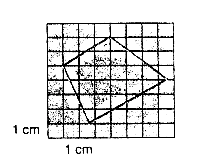
Find the approximate area of an irregular lamina of which boundary line is drawn on the graph paper shown in following figure.
Answer
From figure, the number of complete squares $=11$
The number of squares more than half $=9$
$\therefore$ Total number of squares $=11+9=20$
$\therefore$ Area of the 1 square $=1 cm \times 1 cm^{-1 cm^2}$
$\therefore$ Area of 20 squares $=20 \times 1 cm^2=20 cm^2$
$\therefore$ Approximate area of irregular lamina $=20 cm^2$
View full question & answer
Question 73 Marks
A solid silver piece is immersed in water contained in a measuring cylinder. The level of water rises from $50$ ml to $62$ ml. Find the volume of silver piece.
Answer
Given, initial level of water .$v_1 = 50 ml$
Final level of water $v_2 = 62 ml$
Volume of silver piece $V = v_2 – v_1$
$= 62 ml – 50 ml$
$= 12 ml$
As, $1 ml =1 cm^3$
So, $12 ml =12 cm^3$
View full question & answer
Question 83 Marks
The mass of a lead piece is $115 g$. When it is immersed into a measuring cylinder, the water level rises from $20$ ml mark to $30$ ml mark ,
Find the density of the lead in$ kg m^{-3}.$
Answer
Given, $M=115 \mathrm{~g}$
$\mathrm{v}_1=20 \mathrm{ml}, \mathrm{V}_2=30 \mathrm{ml}$
Density of lead piece $d=\frac{M}{V}$
$=\frac{115}{10 \mathrm{~cm}^3}$
$=11.5 \mathrm{~g} \mathrm{~cm}^{-3}$
(since $1 \mathrm{~g} \mathrm{~cm}^{-3}=1000 \mathrm{~kg}^{-3}$ )
$=11.5 \times 1000=11500 \mathrm{~kg} \mathrm{~m}^{-3}$
View full question & answer
Question 93 Marks
The mass of a lead piece is 115 g. When it is immersed into a measuring cylinder, the water level rises from 20 ml mark to 30 ml mark.
Find the volume of the lead piece.
Answer
Given , $M=115 \mathrm{~g}$
$
\mathrm{V}_1=20 \mathrm{ml}, \mathrm{V}_2=30 \mathrm{ml}
$
Volume of lead piece $V=V_2-V_1$
$
\begin{aligned}
= & 30 \mathrm{ml}-20 \mathrm{ml} \\
= & 10 \mathrm{ml} \text { or } 10 \mathrm{~cm}^3 \\
& {\left[\therefore 1 \mathrm{ml}=1 \mathrm{~cm}^3\right] }
\end{aligned}
$
View full question & answer
Question 103 Marks
A cubical tank of side $1$ m is filled with $800$ kg of a liquid. Find:
(i) the volume of tank,
(ii) the density of liquid in $kg m^{-3}.$
Answer

$\begin{aligned} & \text { (i) Volume of a cube }=\text { side } \times \text { side } \times \text { side }
\\ & \text { side }=1 \mathrm{~m}
\\ & \therefore \text { volume }=1 \mathrm{~m} \times 1 \mathrm{~m} \times 1 \mathrm{~m}=1 \mathrm{~m}^3
\\ & \text { (ii) Density of liquid in } \mathrm{kg} \mathrm{m}^{-3}
\\ & =\frac{\text { mass }(\mathrm{m})}{\text { volume }(\mathrm{v})}
\\ & \text { Mass }=800 \mathrm{~kg}
\\ & \text { Volume }=1 \mathrm{~m}^3
\\ & \therefore \text { Density }=\frac{800}{1 \mathrm{~m}^3} \mathrm{~kg}=800 \mathrm{~kg} \mathrm{~m}^{-3}\end{aligned}$
View full question & answer
Question 113 Marks
The length, breadth and height of a water tank are $5 m, 2.5 m$ and $1.25$ m respectively. Calculate the capacity of the water tank in (a) $m ^3$ (b) litre.
Answer
Given,
Length $(1) = 5m$
Breadth $(b) = 2.5 m$
and Height $(h) = 1.25 m$
(a) Volume of water tank in $m ^3= l \times b \times h$
$ =5 m \times 2.5 m \times 1.25 m$
$=15.625 m ^3 $
(b) Volume of water tank in litre
$ =15.625 \times 1000$
$=15625 \text { litre } $
View full question & answer
[3 Mark Question Answer] - PHYSICS STD 7 Questions - Vidyadip