Questions

[5 Mark Question Answer]

🎯

Test yourself on this topic

14 questions · timed · auto-graded

Question 15 Marks
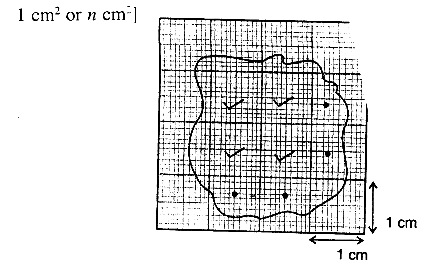
Describe the method in steps to find the area of an irregular lamina using a graph paper.
Answer
Method to find the area of an irregular lamina using a graph paper: First, place the lamina over a graph paper and draw its boundary line on the graph paper with a pencil. Then remove the lamina and count and note the number of complete squares as well as the number of squares more than half within the boundary line (only the squares less than half, are left while counting). The area of lamina is equal to the sum of the area of complete squares and the area of squares more than half. Let n be the total number of complete and more than half or half squares within the boundary of lamina. Since area of one big square is $1 cm \times 1 cm=1 cm^2$, so the area of lamina will be $n x$
View full question & answer
Question 25 Marks
You are required to take out 200 ml of milk from a bucket full of milk. How will you do it ?
Answer
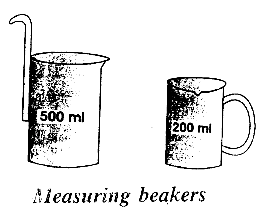
By using the measuring beaker A measuring beaker is used to measure a fixed volume of liquid from a large volume. Suppose it is required to measure 200 ml of milk from the milk contained in a bucket. For this, take the measuring beaker of capacity 200 ml. Wash it and dry it. Then, immerse the measuring beaker well inside the milk contained in the bucket so that the beaker gets completely filled with the milk.
Take out the measuring beaker from the bucket gently so that no milk splashes out and then pour the milk from the measuring beaker into the another empty vessel.
View full question & answer
Question 35 Marks
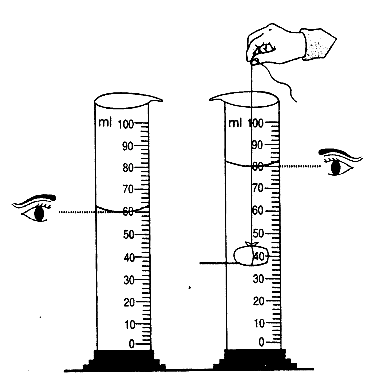
How can you determine the volume of an irregular solid (say a piece of brass) ? Describe in steps with neat diagrams.
Answer
To measure the volume of a piece of stone.
Take a piece of brass, a measuring cylinder, fine thread of sufficient length and some water.
Place a measuring cylinder on a flat horizontal surface and fill it partially with water. Note the reading of the water level very carefully. Now tie the piece of brass with a thread and dip it completely into water. We see that the level of water rises. Note the reading of the new water level.

The difference in the two levels of water gives the volume of the piece of brass Initial level of water $=60 ml$
Level of water when brass is immersed $=80 ml$
$\therefore$ Volume of water displaced $=80 ml -60 ml =20 ml$
$\therefore$ Volume of the piece of brass $=20 cm^3$
Note : $1 ml =1 cm^3$
View full question & answer
Question 45 Marks
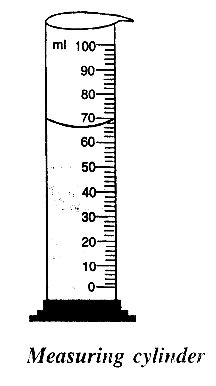
Name two devices which are used to measure the volume of an object. Draw their neat diagrams.
Answer
Two devices that are used to measure the volume of an object are :
(i) Measuring cylinder and
(ii) Measuring beaker.

View full question & answer
Question 55 Marks
State two smaller units of volume. How are they related to the S.I. unit?
Answer
 A smaller unit of volume is cubic centimetre (symbol $cm ^3$ ) and cubic decimetre (symbol $1 dm ^3$ ). One cubic centimetre is the volume of a cube of each side 1 centimetre, i.e.,
$1 cm^3=1 cm \times 1 cm \times 1 cm$
Relationship between $m ^3$ and $c m ^3$
$1 m^3=1 m \times 1 m \times 1 m$
$=100 cm \times 100 cm \times 100 cm$
$=10,00,000 cm^3=10^6 cm^3$
Relationship between $m ^3$ and $d m ^3$
$1 m^3=1 m \times 1 m \times 1 m$
$=10 dm \times 10 dm \times 10 dm$
$=1000 dm$
$=10^3 dm$
Note $1 m=10 dm$
View full question & answer
Question 65 Marks
State the S.I. and C.G.S. units of density. How are they inte related ?
Answer
The S.I. unit of mass is kilogram (symbol kg) and of volume is cubic metre (symbol $m ^3$ ).
Therefore S.I. unit of density is $kg / m ^3$ or $kg m ^{-3}$.
The $C.G.S$. unit of mass is gram (symbol g) and of volume is cubic centimetre (symbol cm3).
Therefore the $C.G.S$. unit of
density is $g/cm^3$ or $g cm^{-3}.$
Relationship between $\mathrm{kg} \mathrm{m}^{-3}$ and $\mathrm{g} \mathrm{cm}^{-3}$
$1 \mathrm{~kg}=1000 \mathrm{~g}$
or $1 \mathrm{~g}=\frac{1}{1000} \mathrm{~kg}$
and $1 \mathrm{~m}^3=(100 \mathrm{~cm})^3$
$
\begin{aligned}
& =100 \times 100 \times 100 \mathrm{~cm}^3 \\
& =10,00,000 \mathrm{~cm}^3
\end{aligned}
$
or $1 \mathrm{~cm}^3=\frac{1}{1000000} \mathrm{~m}^3$
now $1 \mathrm{~g} \mathrm{~cm}^{-3}=\frac{1 \mathrm{~g}}{1 \mathrm{~cm}^3}$
$
=\frac{\frac{1}{1000} \mathrm{~kg}}{\frac{1}{1000000} \mathrm{~m}^3}
$
$
=\frac{1000000}{1000} \mathrm{~kg} \mathrm{~m}^{-3}
$
$
=1,000 \mathrm{~kg} \mathrm{~m}^{-3}
$
Thus, $1 \mathrm{~g} \mathrm{~cm}^{-3}=1.000 \mathrm{~kg} \mathrm{~m}^{-3}$
View full question & answer
Question 75 Marks
Match the following:
Column A Column B
1.Volume of a liquid 1. $\mathrm{kg} m^{-3}$
2. Area of a leaf 2. $m^3$
3. S.I. unit of volume 3. graph paper
4. S.I. unit of density 4. $\mathrm{m} s^{-1}$
5. S.I.unit of speed 5. measuring cylinder
Answer
Column A Column B
1.Volume of a liquid 5. measuring cylinder
2. Area of a leaf 3. graph paper
3. S.I. unit of volume 2. $\mathrm{m}^3$
4. S.I. unit of density 1.$\mathrm{kg} \mathrm{m}^{-3}$
5. S.I.unit of speed 4. $\mathrm{m} \mathrm{s}^{-1}$
View full question & answer
Question 85 Marks
A piece of brass of volume $30 cm^3$ has a mass of 252 g . Find the density of brass in (i) $g cm ^{-3}$, (ii) $kg m ^{-3}$.
Answer
Given, Mass M $=252 \mathrm{~g}$
Volume $\mathrm{V}=30 \mathrm{~cm}^3$
(i) Density $\mathrm{d}=\frac{\mathrm{M}}{\mathrm{V}}=\frac{252}{30 \mathrm{~cm}^3}$
$=8.4 \mathrm{~g} \mathrm{~cm}^{-3}$
(ii) since, $\mathrm{M}=252 \mathrm{~g}=0.252 \mathrm{~kg}$
$v=30 \mathrm{~cm}^3=30 \times 10^{-6} \mathrm{~m}^3$
Density $d=\frac{0.252 \mathrm{~kg}}{30 \times 10^{-6} \mathrm{~m}^3}$
$=\frac{0.252 \mathrm{~kg}}{30 \times \frac{1}{1000000} \mathrm{~m}^3}$
$\begin{aligned} & =\frac{0.252 \times 1000000 \mathrm{~kg}}{30 \mathrm{~m}^3}
\\ & =\frac{25200}{3} \mathrm{~kg} \mathrm{~m}^{-3}
\\ & =8400 \mathrm{~kg} \mathrm{~m}^{-3}\end{aligned}$
View full question & answer
Question 95 Marks
Express $15 m s ^{-1}$ in $km h ^{-1}$.
Answer
1 metre $=\frac{1}{1000} \mathrm{~km}$
15 metre $=\frac{15}{1000} \mathrm{~km}$
1 second $=\frac{1}{3600} \mathrm{hr}$
Here, Distance $=\frac{15}{1000} \mathrm{~km}$
Time taken $=\frac{1}{3600} \mathrm{hr}$.
Speed $=\frac{\text { Distance }}{\text { Time taken }}$
$ =\frac{\frac{15}{1000}}{\frac{1}{3600}}$
$ =\frac{15}{1000} \times \frac{3600}{1}$
$=54 \mathrm{~km} \mathrm{~h}^{-1}$
View full question & answer
Question 105 Marks
A boy travels with a speed of $10 m s ^{-1}$ for 30 minute. How much distance does he travel ?
Answer
Speed of boy $=10 m s ^{-1}$
Time taken $=30$ minutes
speed $=$ distance travelled $/$ time taken
Distance travelled $=$ Speed $\times$ Time taken
Convert 30 minutes to seconds
1 minute $=60 sec$
30 minute $60 \times 30=1800$ seconds
Putting the value of speed and time we get
Distance travelled $=10 ms^{-1} \times(1800 sec )=18000 m$
$=18000$ metre or 18 km Ans.
View full question & answer
Question 115 Marks
How long a train will take to travel a distance of 200 km with a speed of $60 km h ^{-1}$ ?
Answer
Distance covered by train $=200 \mathrm{~km}$
Speed of train $=60 \mathrm{~km} \mathrm{~h}^{-1}$
We know speed $=\frac{\text { Distance }}{\text { Time }}$
$\Rightarrow 60=\frac{200}{\text { Time }}$
Time $=\frac{200}{60}=\frac{20}{6} \frac{10}{3}$ hours
$=3 \frac{1}{3}$ hours $=3 \mathrm{~h}+\frac{1}{3}$ hours
$=3 \mathrm{~h}+\frac{1}{3} \times 60 \mathrm{~min}$
$=3 \mathrm{~h}+20 \mathrm{~min}$
$=3 \mathrm{~h} 20 \mathrm{~min}$
View full question & answer
Question 125 Marks
A car travels a distance of 15 km in 20 minute. Find the speed of the car in $m s ^{-1}$.
Answer
Distance travelled by car =15 km
Time taken = 20 minutes
Speed of car in
Convert 15 km into metres
1 km = 1000 m
15 km = 1000 × 15 = 15000 m
Convert minutes into seconds
1 minutes = 60 sec..
20 minutes = 60 × 20 = 1200 sec
$\begin{aligned} \text { Speed of car } & =\frac{15000 \mathrm{~m}}{1200 \mathrm{sec}}
\\ & =12.5 \mathrm{~m} \mathrm{~s}^{-1}\end{aligned}$
View full question & answer
Question 135 Marks
A car travels a distance of $15$ km in $20$ minute. Find the speed of the car in $km h ^{-1}$.
Answer
istance travelled by car $=15 km$
Time taken $=20$ minutes
Speed of car in $km h ^{-1}$
Convert $20$ minutes to hour
$1$ minute $=\frac{1}{60}$ hour
$\therefore 20$ minutes $=\frac{1 \times 20}{60}=\frac{1}{3}$ hour
Speed of car $=\frac{\text { Distance }}{\text { Time taken }}$
$ =\frac{15 km }{\frac{1}{3} h }$
$=15 km \times 3 h ^{-1}$
$=45 km h ^{-1}=45 km h ^{-1} $
View full question & answer
Question 145 Marks
A block of iron has dimensions $2 m \times 0.5 m \times 0.25 m$. The density of iron is $7.8 g cm ^{-3}$. Find the mass of block.
Answer
Glven, $1=2 \mathrm{~m}$
$\mathrm{b}=0.5 \mathrm{~m}$
$ \mathrm{~h}=0.25 \mathrm{~m}$
Density of iron $=7.8 \mathrm{~g} \mathrm{~cm}^{-3}$
$=7.8 \times 1000 \mathrm{~kg} \mathrm{~m}^{-3}$
$ =7800 \mathrm{~kg} \mathrm{~m}^{-3}$
$ =2 \times 0.5 \times 0.25 \times=0.25 \mathrm{~m}^3 $
volume of block $=\mathrm{l} \times \mathrm{b} \times \mathrm{h}$
$=2 \times 0.5 \times 0.25 \times=0.25 \mathrm{~m}^3$
From relation $d=\frac{M}{V}$
$\therefore$ Mass of iron block $\mathrm{M}=\mathrm{V} \times \mathrm{d}$
$=0.25 \times 7800 \mathrm{~kg} \mathrm{~m}^{-3}$
$=1950 \mathrm{~kg}$
View full question & answer
[5 Mark Question Answer] - PHYSICS STD 7 Questions - Vidyadip